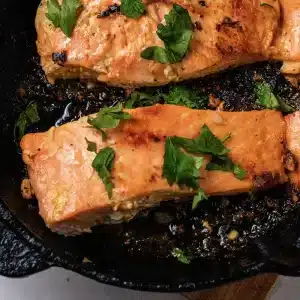
Baked Dijon Salmon
Dijon salmon baked in 20 minutes: fillets under a glaze of Dijon mustard, honey, lemon, olive oil and garlic, cooked at 400°F until the honey caramelizes at the edges and the fish flakes. Bake it in a cast-iron skillet, as pictured, or on a parchment-lined sheet pan.
Ingredients
Honey Dijon Glaze
- 2 tbsp Dijon mustard smooth, not yellow mustard
- 2 cloves garlic finely minced
- 1 tbsp olive oil
- 1 1/2 tbsp honey or maple syrup
- 1 pinch salt and black pepper each
- 1 tbsp lemon juice freshly squeezed
Salmon
- 4 fillets salmon about 6 oz each, skin on or off, fresh or fully thawed
- 1 tbsp fresh parsley or dill chopped, to finish
- lemon wedges for serving
Equipment
- Baking sheet
- Parchment paper (optional)
- Mixing bowl
- Whisk
Instructions
Make the Glaze
- Heat the oven and start the glaze. Heat the oven to 400°F (200°C). Lightly oil a cast-iron skillet or line a baking sheet with parchment. Spoon the Dijon into a small bowl and pour in the olive oil.
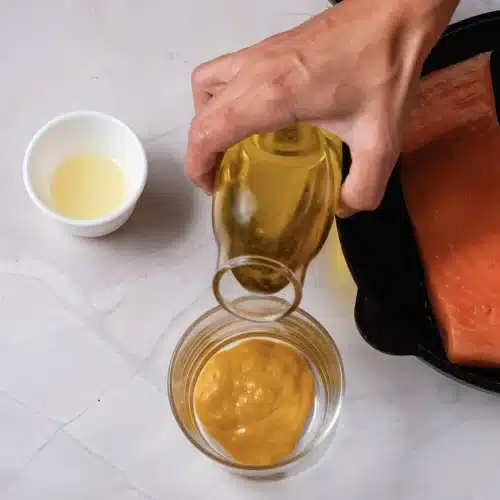
- Add the honey. Pour the honey into the bowl.
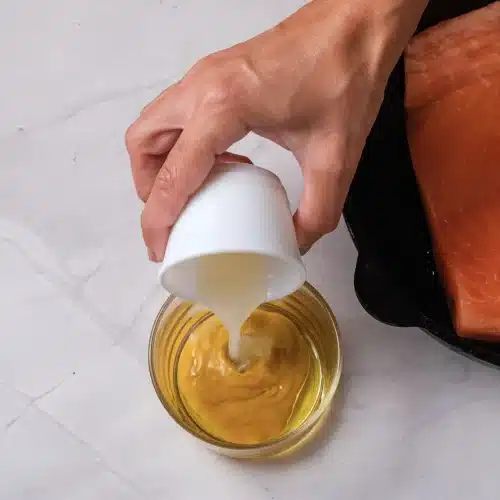
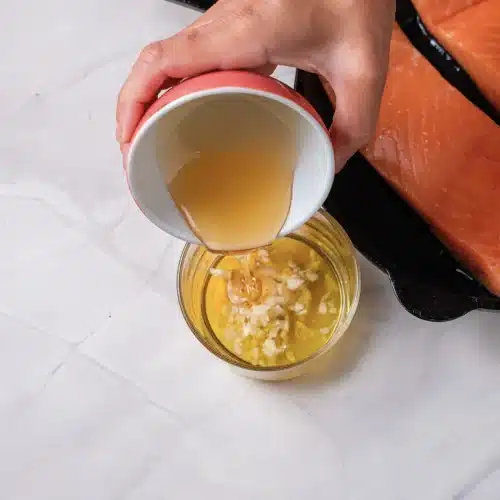
- Add the lemon and garlic, then whisk. Add the lemon juice, minced garlic and a pinch of salt and pepper, and whisk until smooth and glossy.
Glaze and Bake
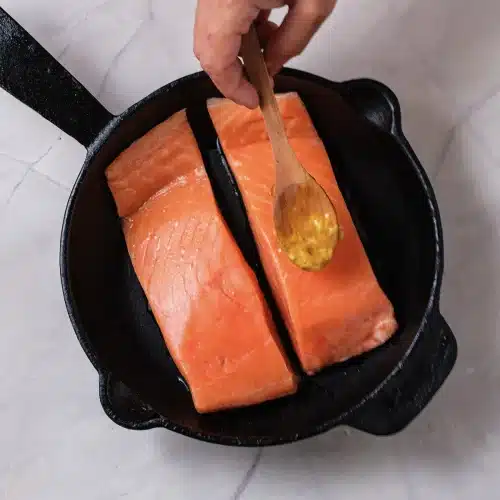
- Glaze the fish. Pat the fillets dry and set them skin-side down in the skillet or on the sheet, with a little space between them. Spoon the glaze over each fillet and spread it to the edges, using all of it.
- Bake. Bake for 12 to 15 minutes, until the fish flakes easily with a fork, reads 145°F at the thickest part and the glaze has darkened at the edges.
Rest and Serve
- Rest and serve. Let the fillets rest for 2 minutes, scatter the parsley over, and serve with lemon wedges and any glaze left in the pan spooned over the top.
Notes
Pictured version: two fillets baked in a 10-inch cast-iron skillet, where the glaze that runs off reduces into a pan sauce to spoon back over the fish. Four fillets fit a 12-inch skillet or a parchment-lined sheet pan; the timing is the same.
Doneness: the fish flakes under a fork and reads 145°F at the thickest part, the FDA's safe temperature. Many cooks pull it at 125°F to 130°F for a softer center and let it rest; that is a preference, not the guideline.
Make ahead: the glaze keeps 3 days in a jar in the fridge. Keep it off the fish until the oven is hot, because the lemon juice starts to cure the surface.
Storage: refrigerate within 2 hours and eat within 3 days. Reheat covered at 300°F for 10 minutes, or flake it cold over salad. Freeze wrapped fillets up to 2 months.
Substitutions: maple syrup for the honey; whole-grain mustard for the Dijon with an extra teaspoon; lime juice for the lemon; a pinch of red pepper flakes in the glaze for heat.
Nutrition values are an estimate.
Nutrition
Calories: 335kcal | Carbohydrates: 8g | Protein: 34g | Fat: 19g | Saturated Fat: 3g | Cholesterol: 83mg | Sodium: 332mg | Potassium: 730mg | Sugar: 7g | Vitamin A: 106IU | Vitamin C: 2mg | Calcium: 28mg | Iron: 1.1mg