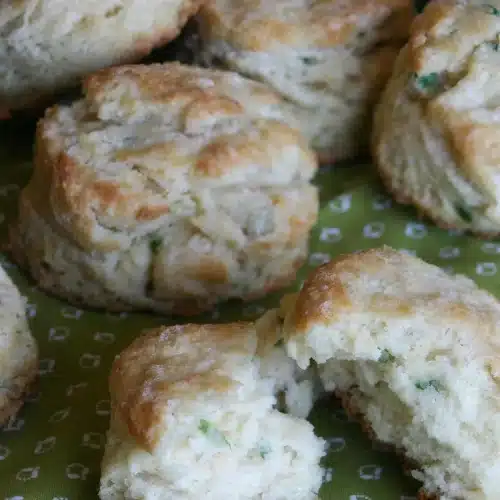
Flaky Biscuits with Scallions and Fresh Herbs
Frozen butter grated into the flour and three letter folds before cutting, which is what makes these pull apart in sheets. Three quarters of a cup of scallions and a quarter cup of parsley go through the dough.
Ingredients
Dry Ingredients and Herbs
- 4 cups all-purpose flour about 480 grams, plus more for dusting
- 1 tablespoon baking powder
- 2 teaspoons kosher salt
- 3/4 teaspoon baking soda
- 3/4 cup scallions about 6, sliced thin, white and green
- 1/4 cup flat-leaf parsley chopped fine, or thyme, chives or sage
Butter and Buttermilk
- 2 sticks unsalted butter 1 cup, frozen solid
- 1 1/2 cups buttermilk cold, cultured if you can get it
- 1 tablespoon buttermilk for brushing the tops
Equipment
- Large Bowl
- Pastry Blender or Fingers
- Baking Sheets
- 2½-inch Round Cookie Cutter or Glass
Instructions
Mix the Dry Ingredients
- Heat the oven to 400F and line a heavy baking sheet with parchment.
- Whisk the flour, baking powder, kosher salt and baking soda together in a wide bowl, then toss the sliced scallions and chopped parsley through until every shred is coated in flour.
Cut In the Frozen Butter
- Grate the frozen butter into the bowl on the large holes of a box grater, stopping twice to toss the shreds through the flour so they stay separate rather than clumping at the bottom.
- Rub any large pieces flat between your fingertips. You are aiming for flakes about the size of rolled oats, still cold and firm, not fine crumbs. If the butter starts to look greasy, put the whole bowl in the freezer for 5 minutes.
Mix and Laminate
- Pour in the cold buttermilk and stir with a fork only until there is no dry flour left. The dough will look rough and shaggy, which is correct; a smooth dough means it has been overworked.
- Tip it onto a lightly floured counter and pat it into a rough 1-inch-thick rectangle, then fold it in thirds like a letter.
- Repeat the pat and fold twice more, turning the dough 90 degrees each time, for 3 folds in total. This takes about 90 seconds and it is what builds the layers.
- Pat the folded dough out to a final thickness of 1 inch. Do not roll it, which flattens the butter into the dough instead of leaving it in sheets.
Cut and Bake
- Cut straight down with a floured 2 1/2-inch cutter and lift it straight out without twisting, which would seal the layered edge shut and halve the rise. Flour the cutter between each one.
- Set the rounds on the sheet with their sides almost touching, gently press the scraps together for the last few, and brush the tops with the spoonful of buttermilk.
- Bake for 18 to 22 minutes, until the tops are deep gold and the center of one reads about 205F. Cool for 5 minutes before splitting, and eat them within the hour.
Notes
Grate the butter frozen. A box grater turns 2 sticks into flat shreds in under a minute and gives more even pieces than a pastry cutter. Stop twice and toss them through the flour so they do not clump.
Never twist the cutter. Pressing straight down and lifting straight out leaves the layered edge open so it can climb; a twist seals it and the biscuit rises about half as far.
No buttermilk: stir 1 tablespoon of lemon juice or white vinegar into 1 cup of whole milk and leave it 10 minutes until it curdles. Use the full amount called for.
With plain milk instead, leave out the baking soda entirely and raise the baking powder to 4 teaspoons, or the biscuits taste faintly soapy.
Make-ahead: cut rounds freeze 3 months and bake from frozen with about 4 extra minutes. Store baked biscuits in a paper bag 2 days, never in the refrigerator.
Nutrition values are an estimate.
Nutrition
Serving: 1biscuit | Calories: 254kcal | Carbohydrates: 27g | Protein: 5g | Fat: 14g | Saturated Fat: 9g | Polyunsaturated Fat: 1g | Monounsaturated Fat: 4g | Cholesterol: 37mg | Sodium: 482mg | Potassium: 95mg | Fiber: 1g | Sugar: 2g | Vitamin A: 520IU | Vitamin C: 2mg | Calcium: 95mg | Iron: 2mg