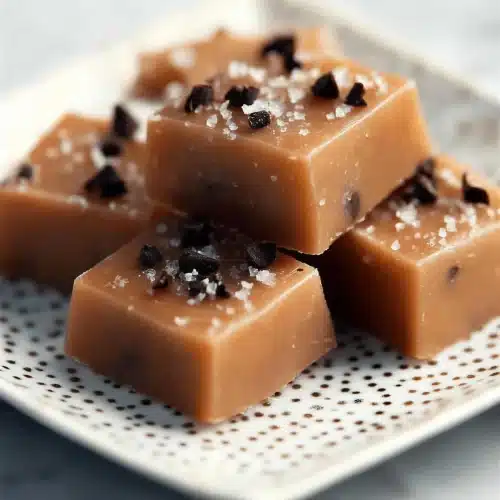
Homemade Caramels with Cacao Nibs and Sea Salt
The sugar is taken to a light amber on its own before the hot cream and butter go in, which gives a deeper caramel flavor than boiling everything together from cold. Cooked to 246F, folded through with cacao nibs, set overnight and cut into sixty-four thick squares.
Ingredients
For the Caramel
- 2 cups heavy cream warmed with the butter
- 8 tablespoons unsalted butter cubed, 1 stick
- 1 3/4 cups granulated sugar
- 1 cup light corn syrup or golden syrup by weight
- 1/4 cup water
- 1 1/2 teaspoons Diamond Crystal kosher salt or 3/4 teaspoon Morton or fine sea salt
- 2 teaspoons vanilla extract stirred in off the heat
- 1/3 cup roasted cacao nibs folded through the batch
For the Pan and the Top
- 1 teaspoon neutral oil for the parchment and the knife
- 2 tablespoons roasted cacao nibs for scattering over the top
- 1 teaspoon flaky sea salt Maldon or fleur de sel
Equipment
- Large saucepan
- Candy thermometer
- Measuring cups and spoons
- Wooden spoon or heatproof spatula
- 9×13-inch rimmed baking sheet or glass dish
- Parchment paper
- Vegetable oil spray
- Sharp knife
- Wax paper or cellophane for wrapping
Instructions
Line the Pan and Warm the Cream
- Line an 8-inch square pan with parchment, leaving a wide overhang on two opposite sides so you can lift the slab out later, and brush the parchment with the neutral oil.
- Warm the cream and the cubed butter together in a small pan until the cream steams and the butter has melted. Keep it warm. Cold cream poured into hot sugar seizes part of it into a lump on the base of the pan.
Caramelize the Sugar
- Combine the sugar, corn syrup and water in a heavy saucepan of at least 4 quarts. Stir over medium heat only until the sugar has dissolved, then stop stirring and wash any crystals off the sides with a wet pastry brush.
- Let it boil undisturbed until it turns a light amber, the color of clear honey, which takes about 10 minutes. Swirl the pan rather than stirring if the color is going unevenly.
Cook to Firm Ball
- Take the pan off the heat and pour in the hot cream and butter in a slow steady stream, standing back as you do it. The pan will foam up violently and then settle. Return it to medium heat and cook, stirring occasionally with a heatproof spatula, until it reads 246F. Allow 25 to 35 minutes and expect the last ten degrees to be much slower than the first thirty.
- Check it in a glass of very cold water if you want a second opinion. Half a teaspoon should form a ball that holds its shape and flattens when you squeeze it. Pull the pan two degrees early, since a heavy pan keeps climbing off the heat.
Finish and Set
- Stir the kosher salt, the vanilla and the 1/3 cup of nibs into the caramel off the heat, then wait a full minute until the surface stops moving on its own before pouring, or the nibs sink. Pour into the lined pan.
- Scatter the remaining 2 tablespoons of nibs and the flaky sea salt over the top and press them in lightly with the back of a spoon so they stay put when the pieces are handled.
- Leave the pan uncovered at cool room temperature for at least 8 hours, or overnight. Covering it makes the surface sweat and dissolves the salt.
Cut and Wrap
- Lift the slab out by the parchment onto a board, nib side up. Cut it 8 rows by 8 with a long heavy knife wiped with oil, pressing straight down rather than sawing and re-oiling every few cuts.
- Wrap each piece in a square of wax paper about four inches across, twisted at both ends. Left unwrapped in a tin they fuse back into one large slab within a day.
Notes
Use a 4-quart pan or larger. The batch foams to about three times its volume for fifteen seconds when the cream goes in.
Calibrate the thermometer in boiling water first. It should read 212F at sea level, about 2F lower per thousand feet of elevation. Apply whatever difference you find to the 246F target, and keep the probe off the base of the pan.
Doneness backup: half a teaspoon dropped into very cold water should form a ball that holds its shape but flattens when squeezed. That is the firm-ball stage.
Too soft to cut? Scrape it back into the pan with 2 tablespoons of cream and cook it up to temperature again.
Storage: wrapped in wax paper, 3 weeks in an airtight tin at cool room temperature or 3 months frozen. Do not refrigerate; they sweat on the way back out and the flaky salt dissolves.
Nutrition values are an estimate.
Inspired by Martha Stewart Living, December 2012.
Nutrition
Serving: 1caramel | Calories: 82kcal | Carbohydrates: 11g | Protein: 0.4g | Fat: 4.5g | Saturated Fat: 2.8g | Polyunsaturated Fat: 0.1g | Monounsaturated Fat: 1g | Trans Fat: 0.1g | Cholesterol: 13mg | Sodium: 25mg | Potassium: 15mg | Fiber: 0.2g | Sugar: 10g | Vitamin A: 175IU | Calcium: 8mg | Iron: 0.1mg