
A cherry galette is a pie that has given up on being tidy, and it is better for it: two pounds of sweet cherries piled onto a round of all-butter dough, the edges folded up in whatever creases they fall into, and a quarter teaspoon of almond extract doing quiet work underneath.
The reason to make one instead of a pie is speed and cooling. There is no pan to line, no lattice to weave and no second crust to roll, and because it sits flat on a sheet pan it cools in about half the time a deep pie needs. That matters in July, when nobody wants to wait until nine at night to eat dessert. It also uses fruit at a rate a pie cannot: two pounds of cherries go into one of these.
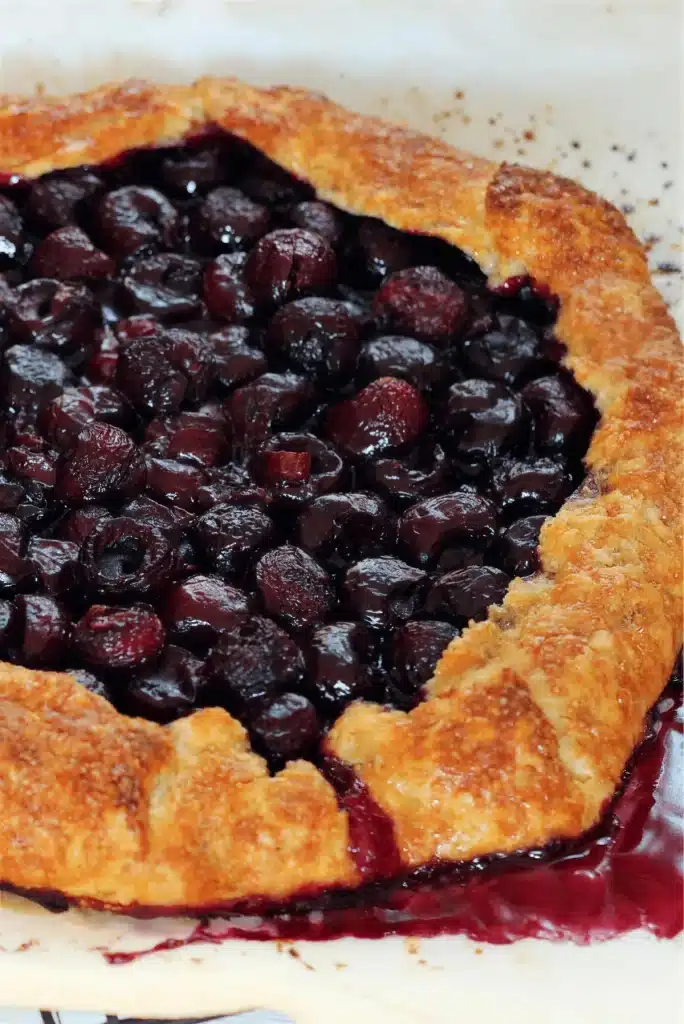
- One crust, no pie pan, and the ragged edge is the point rather than a fault
- Two pounds of cherries in a single dessert, which is what you want in cherry season
- It cools in about 45 minutes instead of the three hours a deep pie needs
- The dough can be made and frozen weeks ahead
- Almond extract makes the cherries taste more like cherries without tasting of almond
- A layer of almond flour under the fruit keeps the base crisp

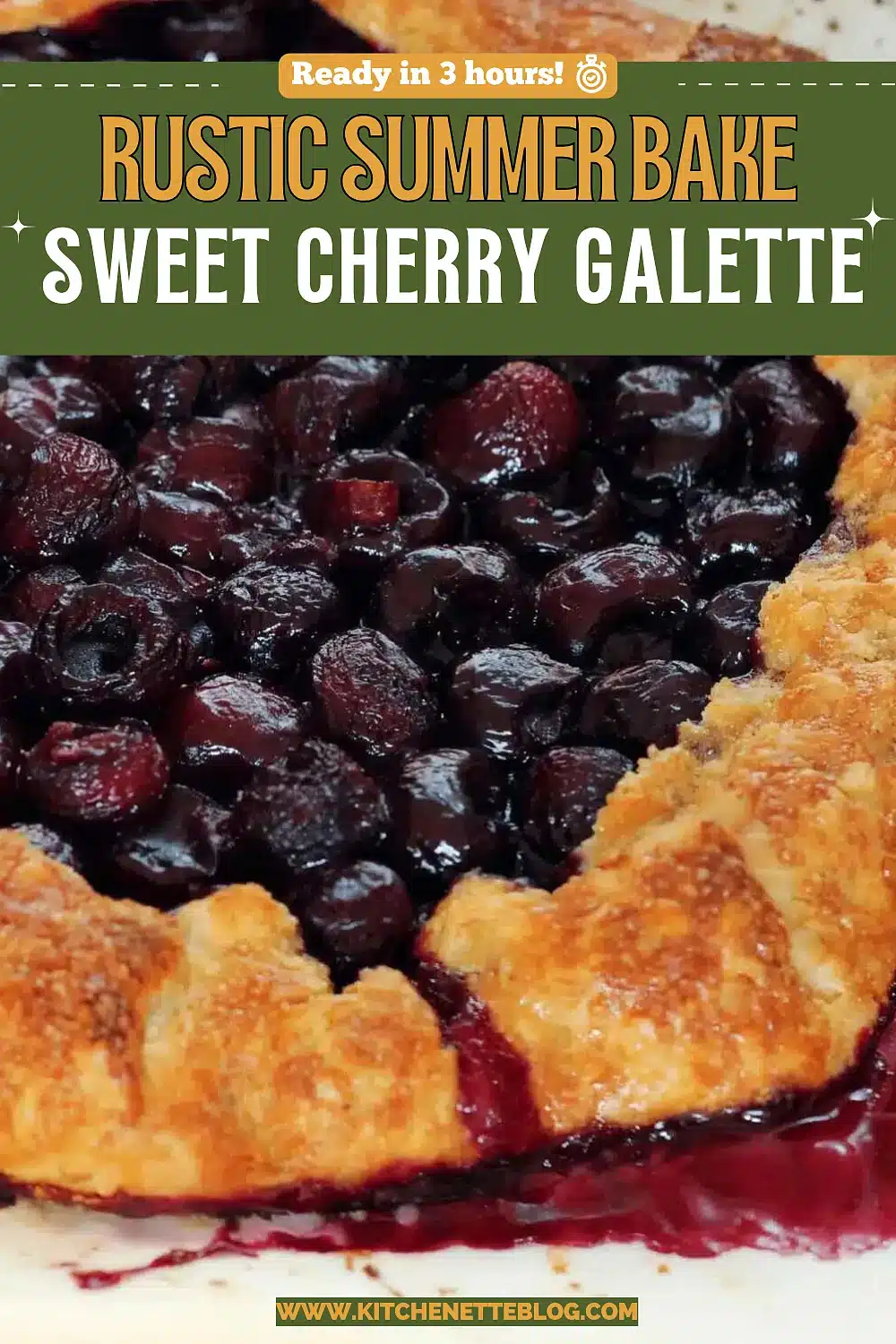
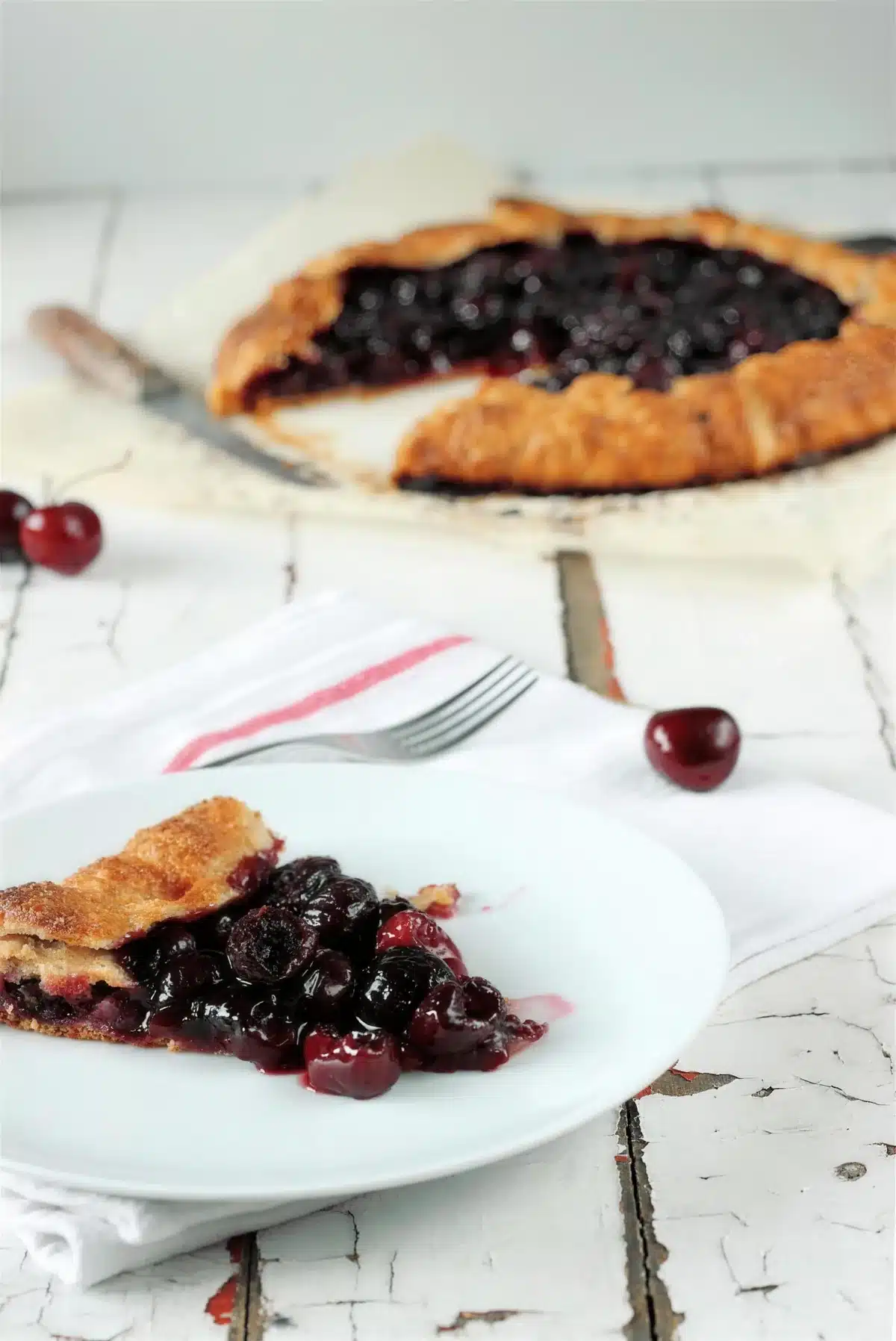
Two decisions separate a good cherry galette from a soggy one, and neither of them is the dough.
- What Makes a Galette Different from a Pie
- Ingredient Notes
- Which Cherries to Use
- How To Make a Cherry Galette
- How To Tell When the Cherry Galette Is Done
- Why the Juices Run, and How To Stop It
- Make It Ahead
- Storing Cherry Galette
- Variations and Substitutions
- What to Serve with Cherry Galette
- Cherry Galette FAQ
What Makes a Galette Different from a Pie
The words get used loosely, so it is worth being precise about what you are making.
A galette is free-form. It is rolled flat, filled in the middle and folded up at the edges, and it bakes on a sheet pan rather than in a dish.
It uses one crust where a double-crust pie uses two, which halves both the work and the butter.
The fruit is exposed, so water evaporates during the bake instead of being trapped under a lid. That is why a galette filling sets with less starch than a pie needs.
It cools fast. A shallow layer of fruit on an open sheet pan is at room temperature in about 45 minutes, against two to three hours for a deep-dish pie.
The name is French and slippery. In France a galette can also mean a buckwheat crepe or the puff-pastry cake eaten at Epiphany. What English-speaking bakers mean by a cherry galette is this: a rustic, folded, single-crust fruit tart.
Save this recipe
Enter your email and I’ll send this recipe straight to your inbox.
Ingredient Notes
A cherry galette runs to nine items, split between a dough and a filling. Exact amounts are in the recipe card at the foot of the page.
- All-purpose flour: one and a half cups for the dough. Nothing exotic is needed, and bread flour makes the crust chewy rather than short.
- Butter: ten tablespoons, unsalted and very cold, cut into cubes and left in the freezer for ten minutes before it goes into the flour. Visible sheets of butter in the dough are what turn into flaky layers.
- Ice water: four to six tablespoons. Add it a tablespoon at a time and stop the moment the dough holds together when squeezed.
- Sweet cherries: two pounds, which is a little over four cups once pitted. Bing, Lapins, Skeena and Chelan are all good here. The Washington State Fruit Commission’s rundown of Northwest cherry varieties is the clearest guide to which ones are around in a given week of the summer.
- Sugar: half a cup in the filling, plus two tablespoons of coarse turbinado for the crust. Cherries are already sweet, so this is a light hand on purpose.
- Cornstarch: three tablespoons. This is more than the original recipe called for, and the reason is in the photographs further down the page.
- Almond flour: two tablespoons, scattered on the dough before the fruit. It absorbs the first of the juice and keeps the base from going pale and damp.
- Almond extract: a quarter teaspoon and no more. Cherry and almond are botanical cousins and a small amount reads as more cherry rather than as almond.
- Egg and cream: one large egg beaten with a tablespoon of heavy cream, for a wash that browns evenly and holds the coarse sugar in place.
On the Salt and the Lemon
Two small things in the filling are easy to get wrong.
Salt is measured by brand here. Half a teaspoon of Diamond Crystal kosher salt is the amount; if you use Morton or fine sea salt, use a quarter teaspoon, because the crystals are denser and the same spoon holds nearly twice as much.
Lemon juice is not for flavor. A tablespoon of it sharpens sweet cherries, which have very little acid of their own, and without it the filling tastes flat and syrupy rather than of fruit.
Neither goes in the dough. The dough carries its own half teaspoon of salt and nothing else.
Which Cherries to Use
The fruit decides more about a cherry galette than anything you do to it.
Dark sweet cherries are the default. Bing is the one most people picture, and Lapins, Skeena and Sweetheart all behave the same way in the oven.
Rainier and other yellow cherries work, taste lovely and look pale and unconvincing once baked. If you use them, expect a blond filling rather than the dark one in the photographs.
Sour cherries are a different recipe. Montmorency and other tart varieties need roughly twice the sugar and a little more starch, so raise the sugar to a full cup if that is what you have.
Frozen cherries are fine. Do not thaw them. Toss them straight from the freezer with the sugar and starch and add about ten minutes to the bake.
Canned or jarred cherries are the one to avoid. They arrive already soft and already in syrup, and they collapse into something closer to jam.
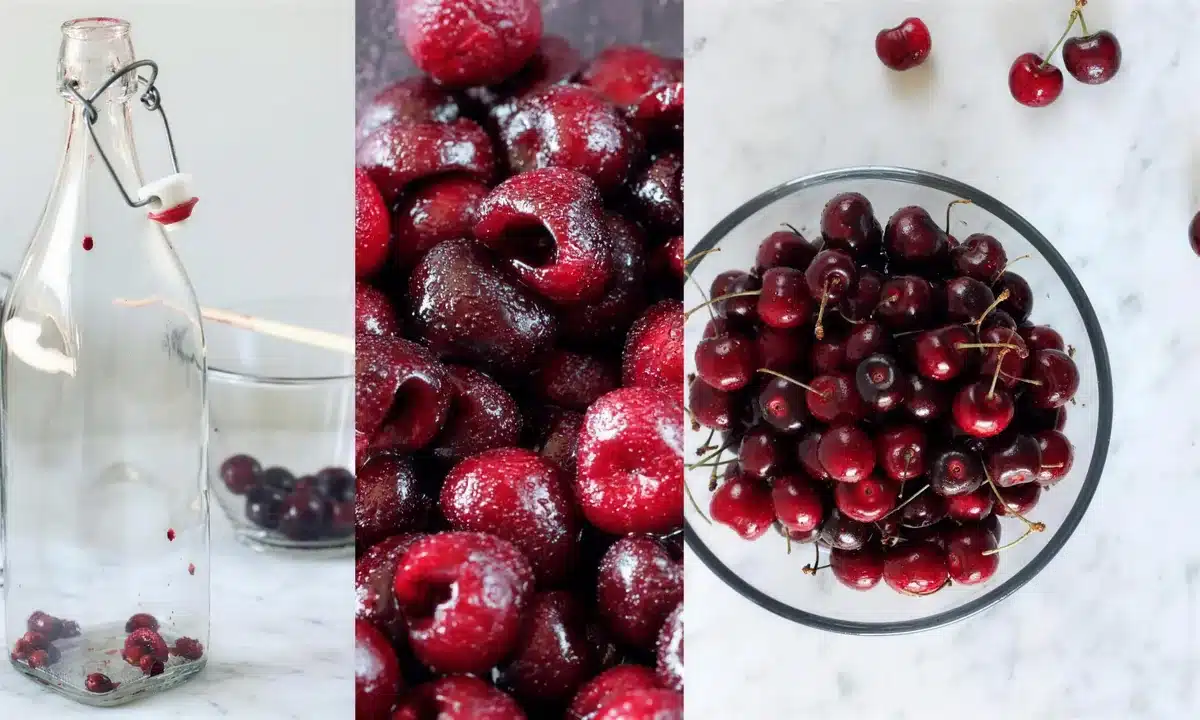
Pitting without a pitter is the reason most people never make this. Stand a cherry on the mouth of an empty bottle and push the pit through with a chopstick. Two pounds takes about fifteen minutes and the pits land in the bottle.
How To Make a Cherry Galette
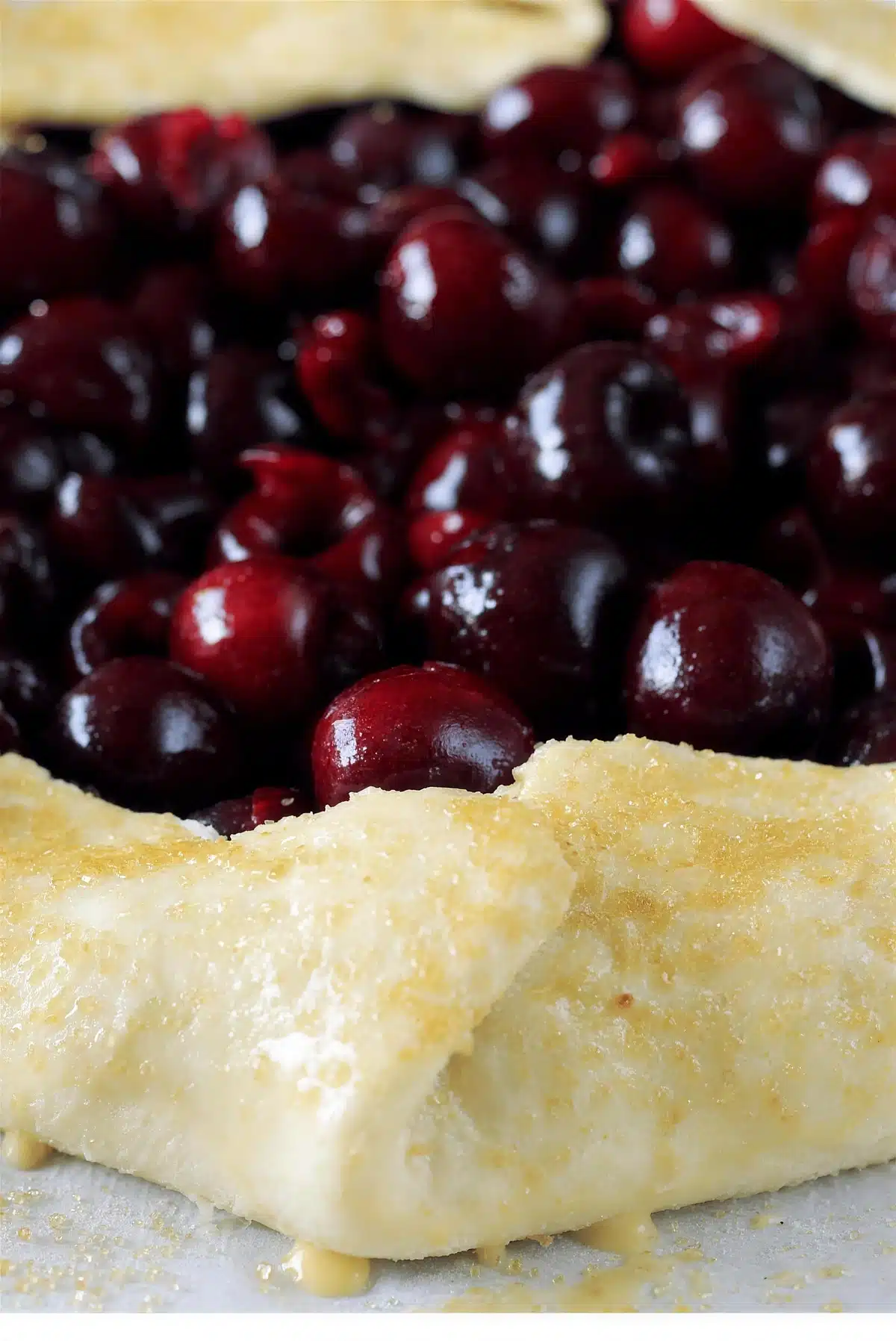
A cherry galette starts with an hour of chilling, so make the dough first and pit the cherries while it rests.
- First, rub the 10 tablespoons of cold butter into the flour and salt until the largest pieces are the size of a lima bean, add 4 to 6 tablespoons of ice water a spoonful at a time, and press the dough into a disk. Chill it for 1 hour.
- Next, pit the 2 pounds of cherries and toss them with the sugar, the 3 tablespoons of cornstarch, the lemon juice, the salt and the almond extract.
- Then roll the dough on parchment to a 14-inch round, slide the parchment onto a rimmed sheet pan, and scatter the 2 tablespoons of almond flour over the middle.
- After that, pile the fruit on the almond flour leaving a border of about 2 inches, fold the border up over the fruit in loose overlapping creases, then brush the crust with egg wash and sprinkle it with the coarse sugar.
- Finally, bake at 400F for 45 to 55 minutes, until the crust is deep golden and the juices bubble slowly and thickly at the center rather than only at the rim.
How To Tell When the Cherry Galette Is Done
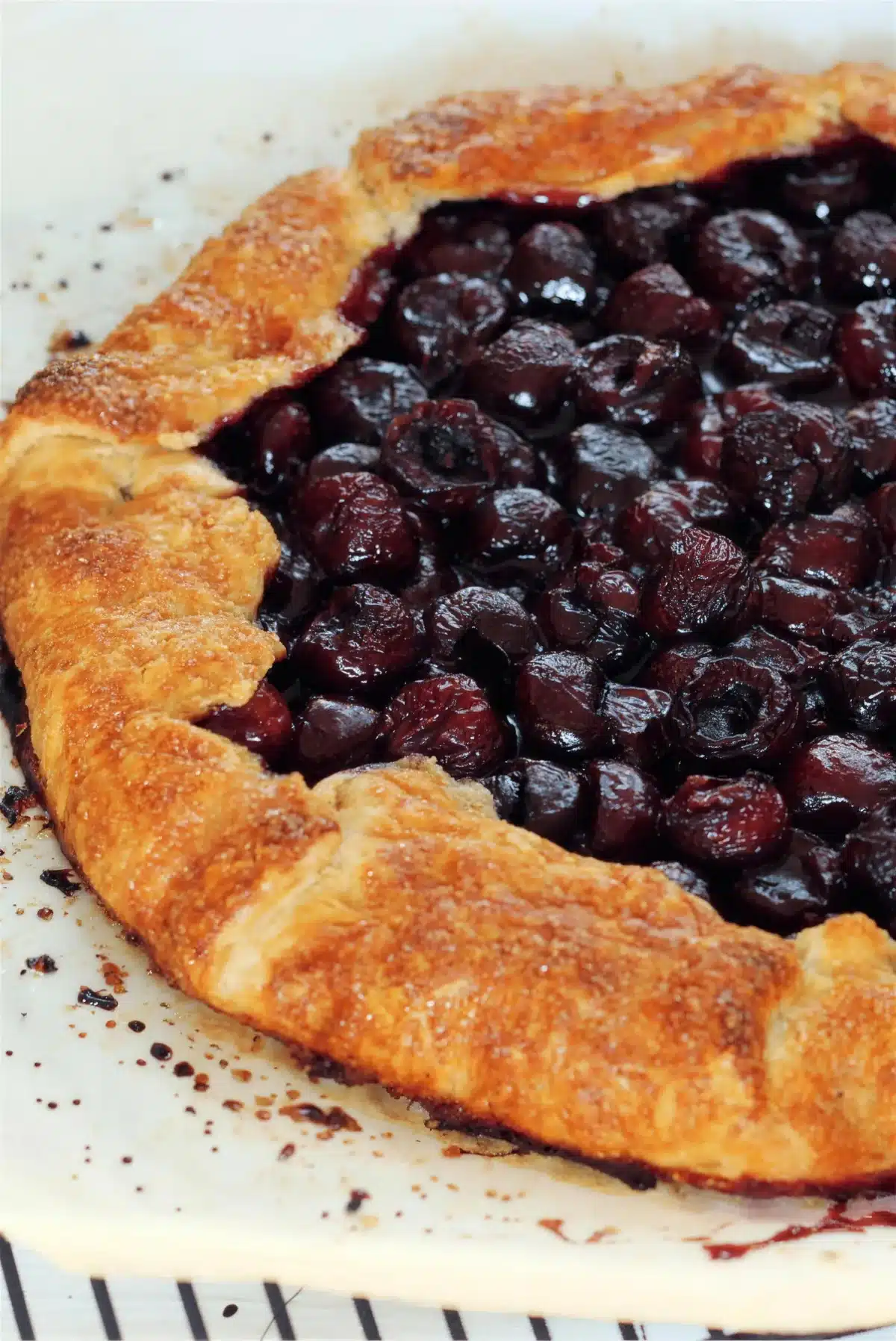
Underbaking a cherry galette is far more common than overbaking, and the consequence is a filling that never sets.
The juices must bubble at the center. Cornstarch does not thicken until the liquid around it actually boils, and the middle of the galette is the last place to get there.
Look for slow, thick bubbles rather than the thin fast ones that appear around the edge after twenty minutes. Thin bubbles mean the starch has not activated yet.
The crust should be deep golden brown, noticeably darker than you would take a cookie, with the folded edges browned at their peaks.
Lift a corner of the parchment and look underneath. The base should be dry and tan, not gray and glossy.
Fifty minutes is typical for a cherry galette at 400F. Frozen cherries need about ten minutes more, and a very juicy batch can need fifteen.
Why the Juices Run, and How To Stop It
Look closely at the photographs on this page and you can see dark juice pooled on the parchment beside the crust. That is the original recipe telling on itself, and it has been fixed.
Four teaspoons of cornstarch is not enough for two pounds of cherries. It has been raised to three tablespoons, which is roughly one and a half tablespoons per pound of fruit and is the standard rate for an open tart.
Almond flour under the fruit soaks up the first juice that runs before the starch has set. Fine dry breadcrumbs or crushed amaretti do the same job.
A leak at the folds is normal and does not mean the recipe failed. Overlap the creases firmly and press them together where they meet.
Use a rimmed sheet pan, always. A flat cookie sheet sends escaped juice onto the oven floor, where it burns and smokes.
Let it cool completely before slicing. Cornstarch finishes setting as it cools, and a cherry galette cut hot will run whatever you did to it.
Make It Ahead
Almost every part of a cherry galette can be done days in advance.
The dough keeps three days wrapped in the refrigerator and three months in the freezer. Thaw a frozen disk overnight in the refrigerator before rolling.
Roll it ahead too. A rolled round on its parchment can be stacked flat on a sheet pan, covered, and refrigerated overnight.
Pit the cherries a day early and keep them dry in a sealed box. Do not mix them with the sugar until you are ready to bake, because sugar pulls water out of them within about twenty minutes.
Assemble and freeze the whole cherry galette unbaked. Freeze it solid on its pan, wrap it, and bake from frozen at 400F for about 65 minutes.
A baked cherry galette is best the day it is made, and it is still good the next day if the crust is refreshed in a hot oven for ten minutes.
Storing Cherry Galette
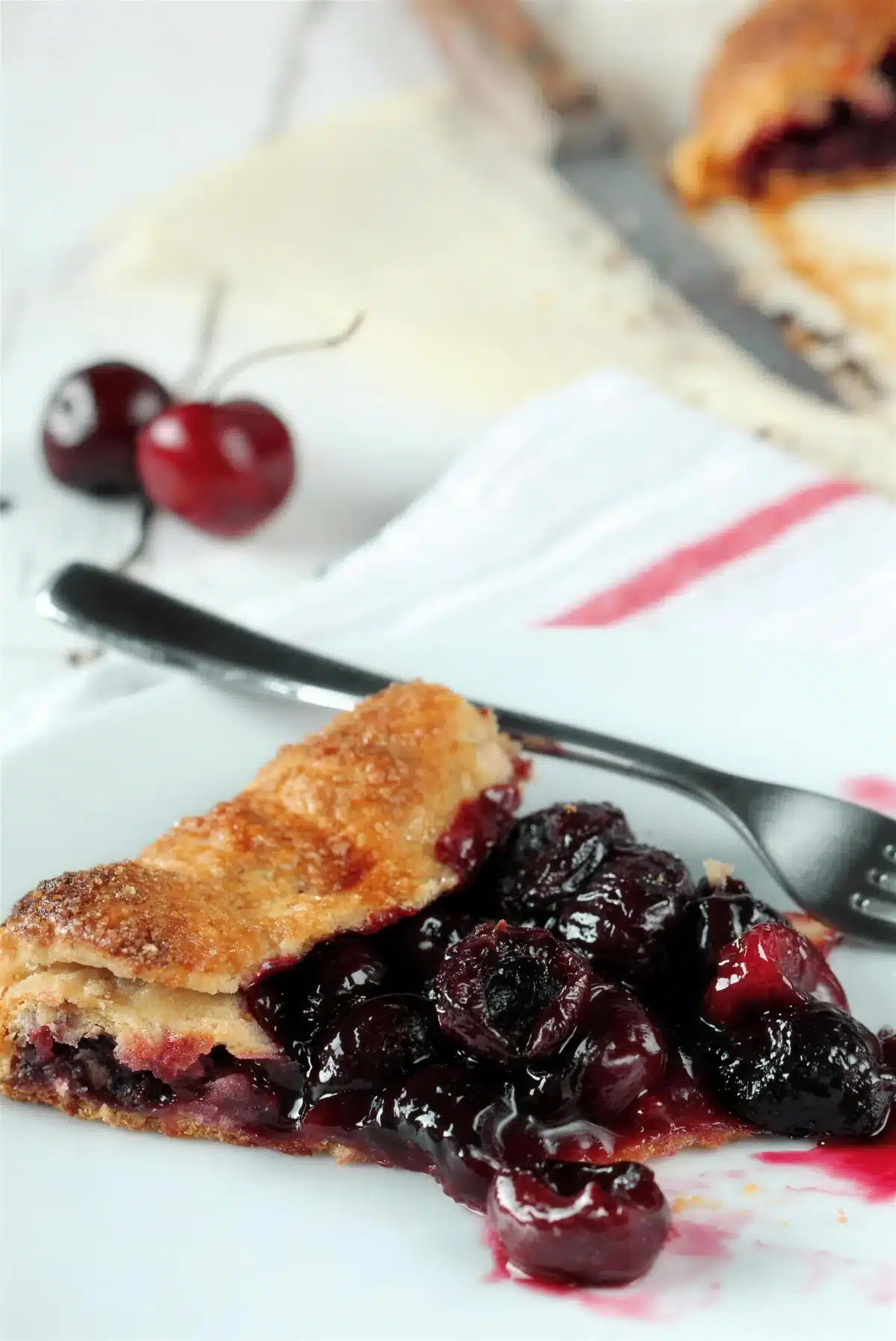
- At room temperature: a cherry galette holds 2 days loosely covered. A sealed container softens the crust within hours.
- In the refrigerator: up to 4 days, though the pastry goes noticeably softer. Bring slices back with 10 minutes at 350F.
- In the freezer: 2 months baked, wrapped whole or in slices. Reheat from frozen at 350F for about 20 minutes.
- Never wrap it warm. Steam trapped against the pastry is the fastest way to ruin a crust you spent an hour making.
- Keep it on its parchment until it is completely cool, then slide the whole thing onto a board. Moving it hot is how they tear.
Variations and Substitutions
The cherry galette format takes almost any fruit that holds its shape, and the ratios barely move.
- Cherry and rhubarb: swap half a pound of the cherries for chopped rhubarb and raise the sugar by two tablespoons.
- Stone fruit generally: apricots, plums or sliced peaches at the same weight. Peaches are wetter, so add another tablespoon of cornstarch.
- Frangipane base: spread a thin layer of almond cream over the dough in place of the almond flour, which turns it into something considerably richer.
- No almond extract: use a teaspoon of vanilla, or a tablespoon of kirsch stirred into the fruit.
- Cornmeal in the dough: replace a quarter cup of the flour with fine cornmeal for a sandier, more biscuit-like crust.
- Individual tarts: divide the dough into four, roll each to about seven inches, and bake for 28 to 32 minutes.
- Store-bought crust: one chilled round of rolled pie dough makes a perfectly good cherry galette and is what the original recipe used. Roll it a little thinner and expect a shorter bake.
What to Serve with Cherry Galette
Cherry galette is warm, tart and faintly almond-scented, so it takes cold and plain things well.
- Vanilla ice cream, which is the obvious answer and remains the best one.
- Cold heavy cream poured straight from the jug, unwhipped, which is how it is eaten in the north of England and is worth trying once.
- A scoop of strawberry cantaloupe sorbet beside a warm slice, if you would rather not have dairy on it.
- Creme fraiche with a spoon of sugar beaten through it, for something between cream and yogurt.
- Strong black coffee, at the end of a long summer dinner.
If you are working through the summer fruit in order, the blueberry rhubarb pie covers the deep-dish version of the same problem, and the pear upside down cake takes over when the stone fruit runs out. For something considerably more ambitious, there is the peanut butter cream pie.
Here is what people ask most often.
Cherry Galette FAQ
Frequently Asked Questions
Do I have to pit the cherries?
Yes, always. Cherry pits contain amygdalin, and beyond any question of safety a mouthful of pits ruins the eating of it. Without a pitter, stand each cherry on the neck of an empty bottle and push the pit through with a chopstick or a sturdy straw. Two pounds takes about fifteen minutes, the pits fall into the bottle, and the juice mostly stays in the fruit.
Why is my base soggy?
Three causes, in order of likelihood. A cherry galette wants the lower third of the oven and the rack was in the middle, so the base never got direct heat from below. There was no absorbent layer under the fruit, so juice sat against raw pastry from the first minute. Or the galette came out before the center was bubbling, which means the starch never set and the filling stayed liquid. The almond flour and the lower rack fix the first two.
Can I use store-bought pie dough?
You can, and the original version of this recipe did exactly that. Use one chilled round meant for a 9-inch pie, unroll it on parchment and roll it out another inch or two so there is enough border to fold. Commercial dough is thinner and browns faster, so start checking at 40 minutes. The homemade dough here is flakier because it has more butter in larger pieces.
More Questions About the Crust
Frequently Asked Questions
My dough cracks when I fold it. What went wrong?
It is too cold, too dry, or both. Straight from the refrigerator the dough for a cherry galette is brittle; let it sit on the counter for ten minutes before rolling. If it cracked while you were still rolling it, the water was short, so next time add another tablespoon. Small cracks at the fold do not matter and can be pinched shut.
Can I make the dough in a food processor?
Yes, and the risk is going too far. Pulse the cold butter into the flour six or seven times only, until the biggest pieces are the size of a lima bean, then tip it into a bowl and add the water by hand. A processor turns visible butter into a uniform paste in about three seconds, and uniform butter gives a crumbly crust instead of a flaky one.
How far ahead can I freeze it?
The unbaked dough keeps three months, and a fully assembled unbaked cherry galette keeps one month. Freeze the assembled one solid on its sheet pan first, then wrap it. Bake it straight from frozen at 400F, giving it about 65 minutes and checking that the center is bubbling thickly before it comes out.
Two pounds of cherries, one round of dough and an hour in the oven is the whole of a cherry galette, and it is the dessert this blog makes more of than any other between June and August.
Rustic Cherry Galette with Almond
Save this recipe
Enter your email and I’ll send this recipe straight to your inbox.
Ingredients
For the All-Butter Crust
- 1 1/2 cups all-purpose flour spooned and leveled
- 1/2 teaspoon fine sea salt
- 10 tablespoons unsalted butter very cold, cut into cubes
- 5 tablespoons ice water 4 to 6, depending on your flour
For the Cherry Filling
- 2 pounds sweet cherries pitted, a little over 4 cups
- 1/2 cup granulated sugar a full cup if you are using sour cherries
- 3 tablespoons cornstarch
- 1 tablespoon lemon juice sweet cherries have almost no acid of their own
- 1/2 teaspoon Diamond Crystal kosher salt or 1/4 teaspoon fine sea salt
- 1/4 teaspoon almond extract no more than this
- 2 tablespoons almond flour or fine dry breadcrumbs, to go under the fruit
To Finish
- 1 large egg for the wash
- 1 tablespoon heavy cream beaten into the egg
- 2 tablespoons turbinado sugar or any coarse sugar
Equipment
- Parchment paper
- rimmed sheet pan
- Mixing bowl
- Wire rack
Instructions
Make the Dough
- Whisk the flour and the fine sea salt together in a bowl. Rub or cut in the cold butter until the largest pieces are about the size of a lima bean and the rest looks like coarse meal. Visible flakes of butter are what you are after, so stop well before it looks uniform.
- Sprinkle in the ice water a tablespoon at a time, tossing with a fork, and stop as soon as a handful holds together when squeezed. Press the dough into a disk, wrap it and refrigerate it for at least 1 hour. It keeps 3 days here and 3 months in the freezer.
Fill and Fold
- Heat the oven to 400F with a rack in the lower third. Pit the cherries and toss them with the granulated sugar, the cornstarch, the lemon juice, the kosher salt and the almond extract. Let the dough sit on the counter for 10 minutes before rolling, or it will crack at the folds.
- Roll the dough on a sheet of parchment to a 14-inch round and slide the parchment onto a rimmed sheet pan. Scatter the almond flour over the middle, leaving a clear border of about 2 inches, and pile the fruit on top of it. Fold the border up over the fruit in loose overlapping creases, pressing each one where it meets the next.
Bake and Cool
- Beat the egg with the heavy cream, brush it over the folded crust and sprinkle the turbinado sugar generously over the top. Bake for 45 to 55 minutes.
- It is done when the crust is deep golden and the juices bubble slowly and thickly at the center, not merely at the rim. Thin, fast bubbles at the edge mean the starch has not set yet. Cool it on the pan for 15 minutes, then slide the parchment onto a wire rack and let it cool completely, about 45 minutes, before slicing.