
A good pumpkin cheesecake is not a pumpkin pie that has been made richer. It is a cheesecake first, with two pounds of cream cheese carrying a can of pumpkin, which is a very different balance from a pie and a much denser slice.
This pumpkin cheesecake puts a cup of ground pecans into the crust rather than a praline layer on top, and three tablespoons of bourbon into the filling, where it does the same job a splash of vanilla does but with more behind it. It bakes in a water bath, it feeds twelve, and it has to be made the day before you want to eat it.
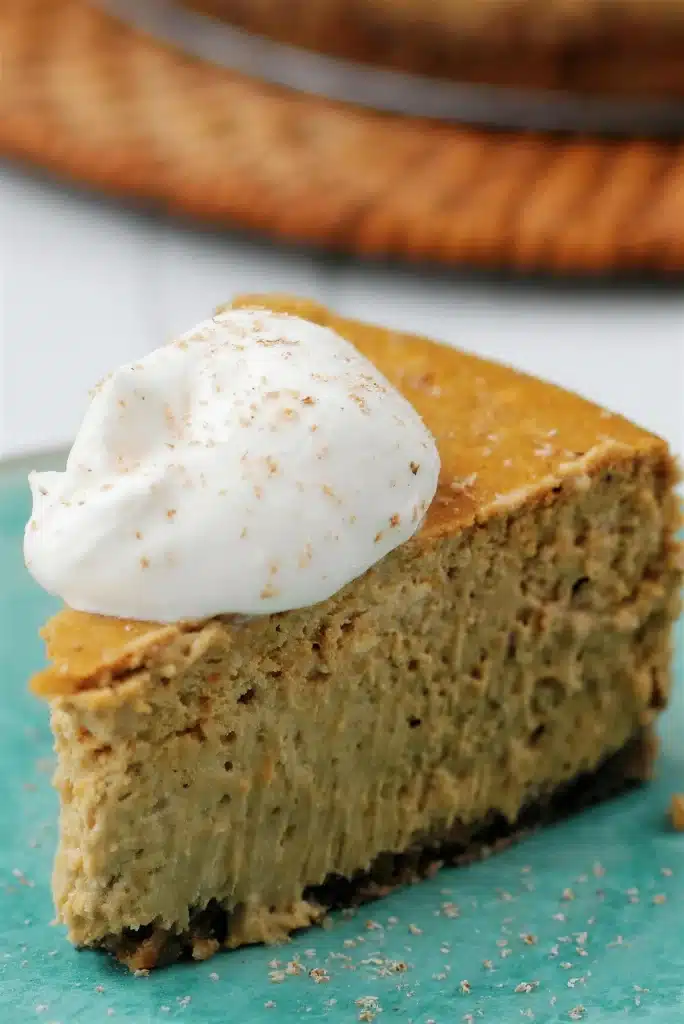
- Two pounds of cream cheese to one can of pumpkin, so it tastes like cheesecake rather than pie filling
- A ground pecan crust that stays crisp instead of a praline topping that goes sticky
- Bourbon and brown sugar instead of white sugar, which is where the depth comes from
- One ten-inch cake gives twelve generous slices for a holiday table
- It has to be made a day ahead, which is a feature on Thanksgiving morning
- The whole spice mix is built from scratch, so nothing tastes of a jar of pie spice

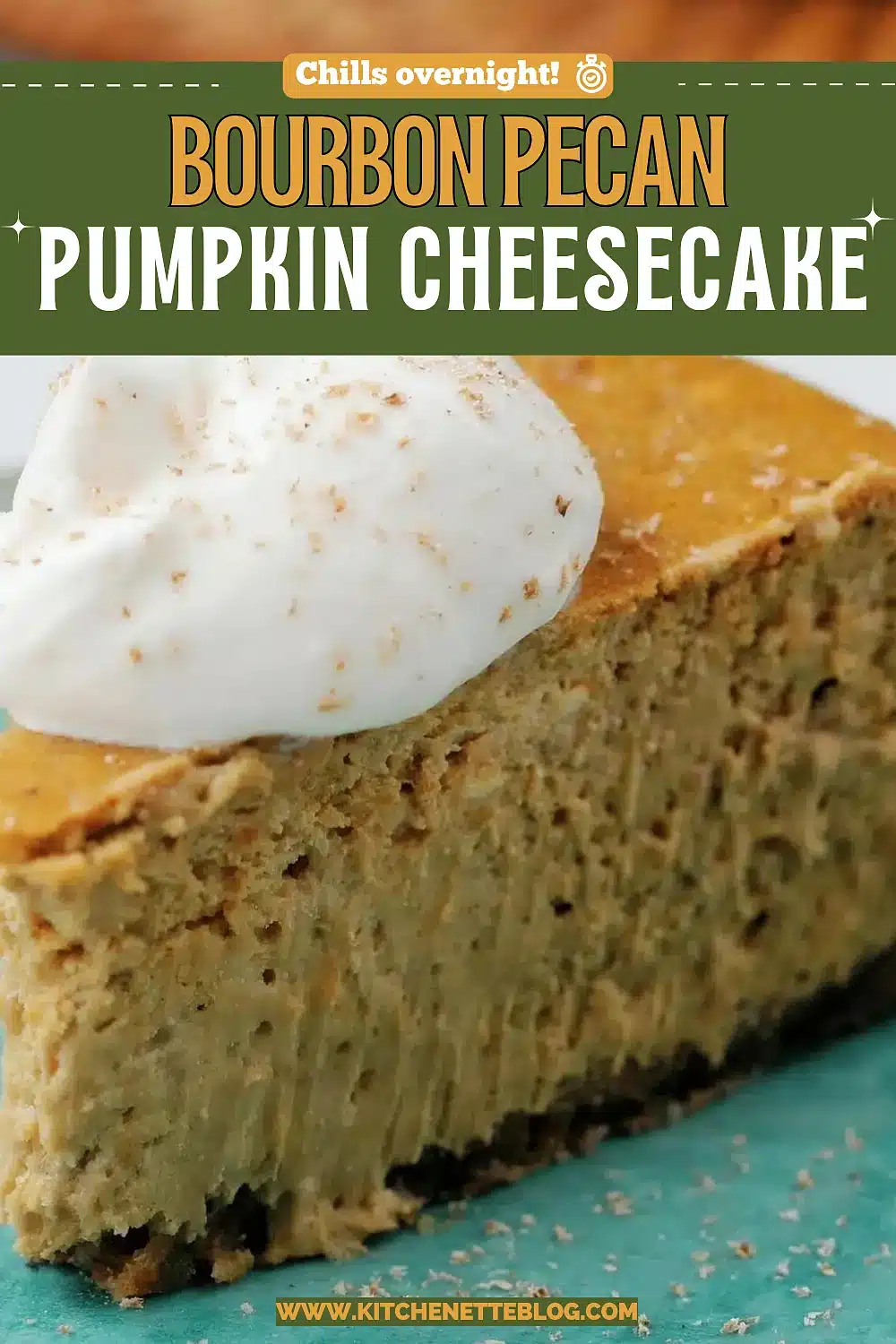
Two things separate a good version from a merely sweet one, and neither is the pumpkin.
- What Makes This Pumpkin Cheesecake Different
- Ingredient Notes
- Why the Pecan Crust Matters
- How To Make Pumpkin Cheesecake
- The Water Bath, and What Happens Without One
- How To Tell When Pumpkin Cheesecake Is Done
- Why Cheesecakes Crack
- Make It Ahead
- Storing Pumpkin Cheesecake
- Variations and Substitutions
- What to Serve with Pumpkin Cheesecake
- Pumpkin Cheesecake FAQ
What Makes This Pumpkin Cheesecake Different
Most pumpkin cheesecake recipes use a pound and a half of cream cheese with a cup of sugar. This one uses two pounds and two cups of brown sugar, in a ten-inch pan rather than a nine.
The extra half pound of cream cheese changes the category. At the usual ratio, a can of pumpkin dominates and what you get is a pumpkin pie with a cheesecake texture. At two pounds, the tang of the cheese sits in front and the pumpkin reads as spice and color and body.
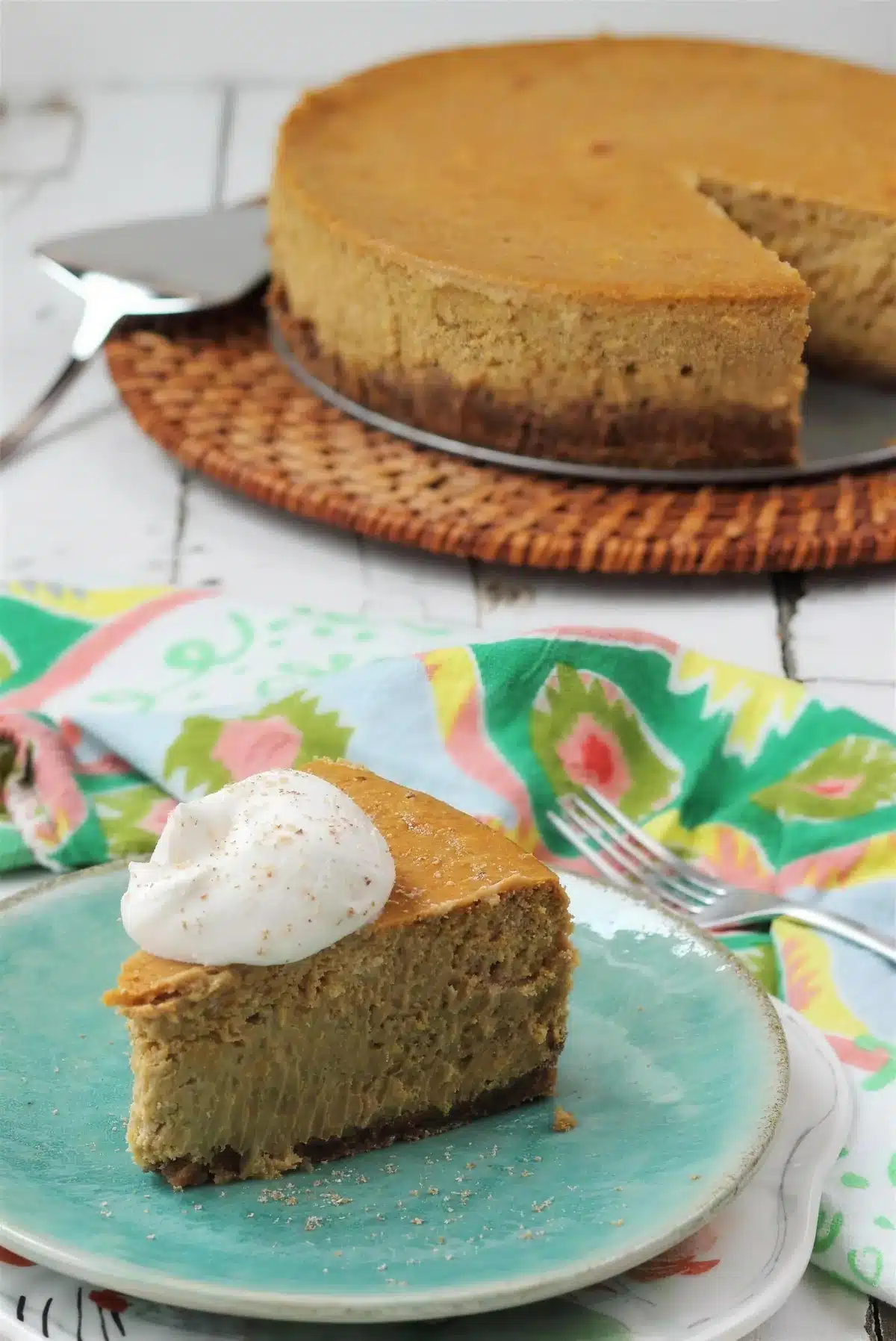
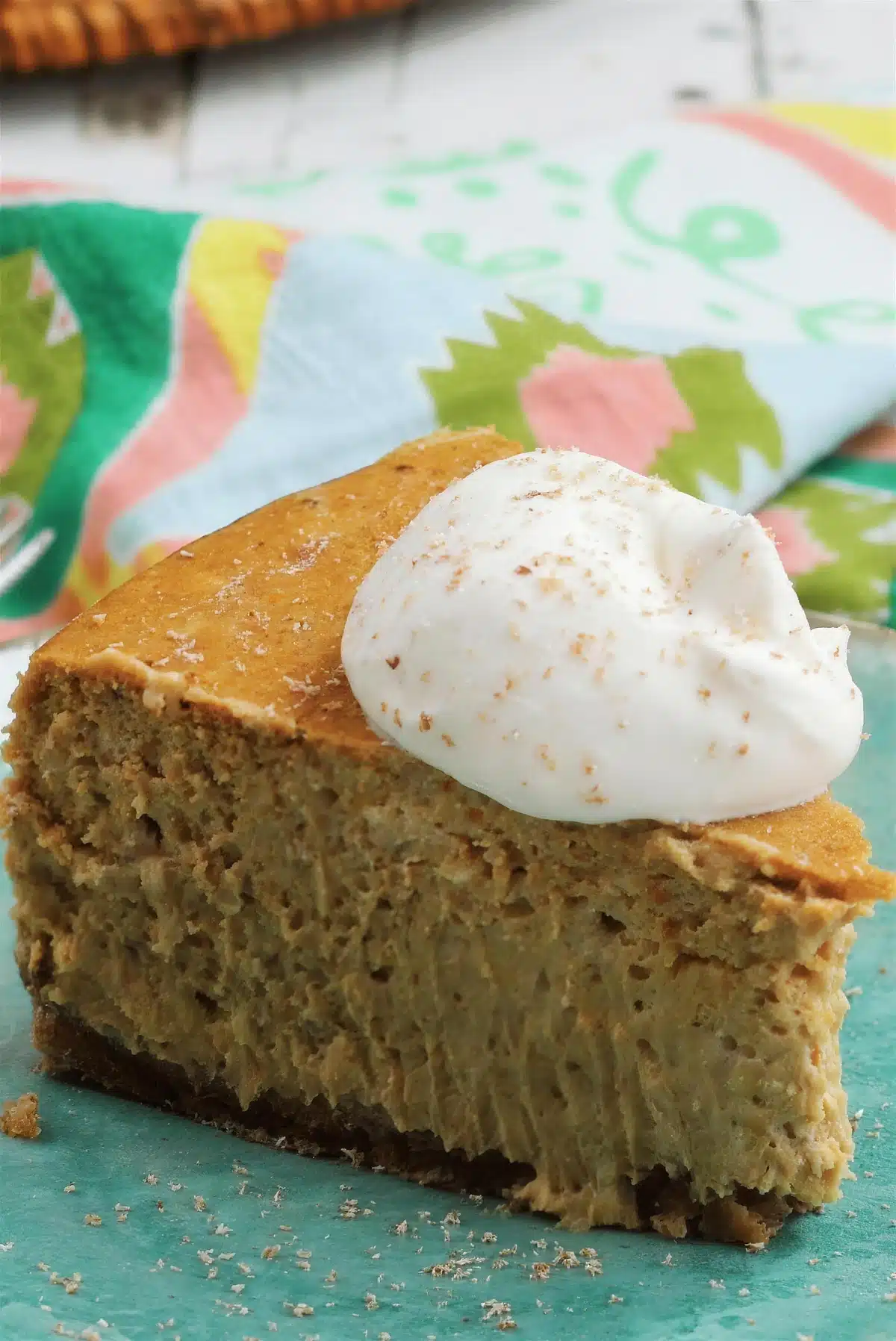
Brown sugar rather than white puts molasses behind the spices. It also darkens the filling, which is why the finished pumpkin cheesecake is the deep ochre in the photographs rather than the pale orange most pumpkin cheesecake comes out.
The pecans are in the crust, not on top. A praline topping is the traditional move and it goes tacky within a day in the refrigerator. A cup of pecans ground into the base browns during the prebake and stays crisp under the filling for three days.
The trade-off is time. A ten-inch cake with this much filling needs the best part of two hours in the oven and a full night in the refrigerator. There is no shortcut, and any recipe that promises one is describing a smaller cake.
Save this recipe
Enter your email and I’ll send this recipe straight to your inbox.
Ingredient Notes
Nothing in a pumpkin cheesecake is unusual, but four items reward being fussy. Exact amounts are in the recipe card below.
- Cream cheese: two pounds, which is four standard blocks, at genuine room temperature. Cold cream cheese will not smooth out, and the lumps you beat in at the start are still there after baking. Full fat only; the whipped and reduced-fat tubs carry extra water and will not set.
- Pumpkin puree: one fifteen-ounce can of plain puree, not pie filling, which is already sweetened and spiced. Canned is genuinely better than homemade here because it is consistent and much drier. If you do roast your own, drain it in a sieve for an hour first. Illinois Extension’s pumpkin pages are worth reading on why the field pumpkins sold for carving make poor eating.
- Brown sugar: two cups, packed. Light or dark both work; dark gives a noticeably more molasses-heavy cake.
- Pecans: a cup, about four ounces, ground fine in a food processor but stopped before they turn to butter. Pulse rather than run it.
- Bourbon: three tablespoons. Enough to be present, not enough to taste of alcohol after ninety minutes in an oven. A basic Kentucky bourbon is fine; nothing is gained by using anything you would drink neat.
- Eggs: six large, at room temperature. Cold eggs seize the beaten cream cheese back into lumps.
- Spices: cinnamon, ginger, cloves, nutmeg and allspice, measured separately. Premixed pumpkin pie spice is mostly cinnamon and it tastes flat next to this.
- Graham crackers: a cup of crumbs, from about eight whole crackers. Digestive biscuits work and are slightly less sweet.
Why the Pecan Crust Matters
Half the crust here is ground nuts, which is more than most pumpkin cheesecake recipes dare.
Nuts brown, crumbs do not. Fifteen minutes in a hot oven takes ground pecans from raw to properly toasted, and toasted pecan is a completely different flavor from raw pecan. That happens during the prebake, before any wet filling touches it.
Fat in the nuts waterproofs the base. A pure graham crust sitting under this much filling for two hours goes soft. The pecan oil, plus the seven tablespoons of butter, keeps the bottom of a pumpkin cheesecake crisp enough to hold a fork.
Press it up the sides a little. An inch is plenty. It gives the filling something to climb and it hides the join where cheesecake meets pan.
Pack it hard. The base of a flat measuring cup, pressed down until the crumbs stop moving. A loosely pressed crust collapses when you cut it.
Let it cool before the filling goes in. Pouring cold batter onto a hot crust melts the butter out of it.
How To Make Pumpkin Cheesecake
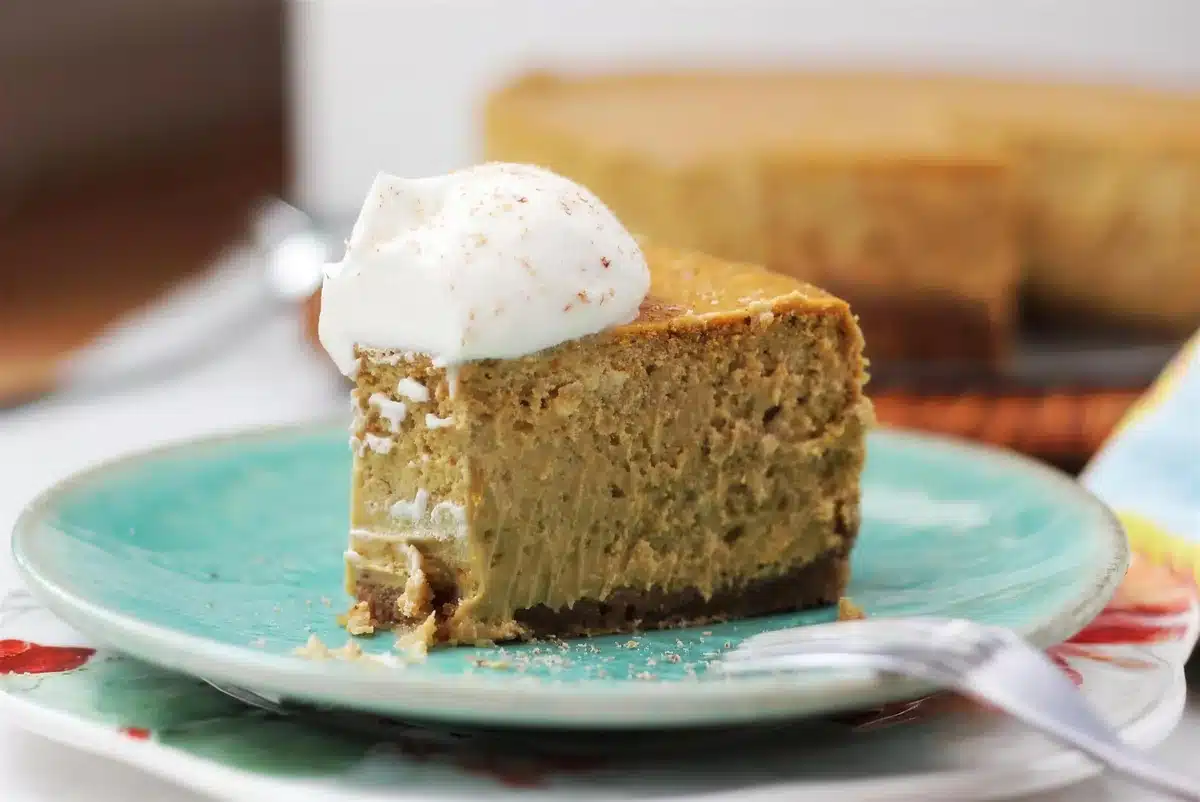
Read the whole method before you start, because a pumpkin cheesecake this size gives you no time to improvise. The water for the bath needs to be boiling at the moment the filling goes into the pan.
- First, heat the oven to 325F, wrap the outside of a 10-inch springform in two layers of heavy foil and brush the inside with melted butter. Put a kettle or a pot of water on to boil.
- Next, stir the graham crumbs, ground pecans, sugar and salt into the melted butter, press the mixture hard into the base and an inch up the sides, and bake for 15 to 20 minutes until it smells toasted. Cool it on a rack.
- Then beat the cream cheese and sour cream completely smooth before the sugar goes anywhere near them, scraping the bowl twice. Add the brown sugar and beat again.
- After that, whisk the pumpkin, eggs, bourbon, vanilla, salt and all five spices together in a separate bowl, then add that to the cream cheese on low speed and stop the moment it is uniform.
- Finally, pour it into the cooled crust, stand the pan in a roasting tin, pour boiling water halfway up the sides and bake 1 hour 45 minutes. Turn the oven off, crack the door and leave it 30 minutes, then cool and refrigerate overnight.
The Water Bath, and What Happens Without One
It is the step people skip and it is the reason their pumpkin cheesecake cracks.
What it actually does is cap the temperature around the pan at the boiling point of water and keep the oven humid. Custard sets at around 175F; a dry oven at 325F drives the outside far past that while the middle is still liquid, and the overcooked ring shrinks and tears.
Two layers of heavy foil, not one. Springform pans leak, and a single layer of standard foil tears on the clamp. Wide, heavy-duty foil, crimped up the sides, is the reliable version. An oven bag over the outside of the pan works even better.
Boiling water, not warm. Cold water in the tin drops the oven temperature for the first half hour and adds twenty minutes to the bake.
Halfway up the sides. Any more and it can breach the foil; any less and the top third of the pan is in dry heat again.
Without a bath, bake at 300F instead and put a pan of water on the shelf below. It is a real second best, and expect a crack.
How To Tell When Pumpkin Cheesecake Is Done
The clock is a guide. A ten-inch cake with this much filling takes somewhere between an hour and forty and two hours depending on the oven and how cold everything was going in.
The edges are set and matte for about two inches in from the pan, and slightly puffed.
The center still wobbles when you nudge the tin, but it wobbles as one mass, like a set jelly. If it ripples in waves it needs longer; if nothing moves at all it has gone too far.
An instant-read thermometer in the middle reads 150F. This is the only reliable test. Push it in about an inch, off center, and take the reading before the residual heat carries it up.
It is not done when the top looks dry. A pumpkin cheesecake surface dries long before the middle sets, which is what tempts people to pull it early.
It will still firm up considerably during the thirty minutes in the switched-off oven and again overnight in the refrigerator. Baking it until it is firm in the oven gives you a dense, grainy cake.
Why Cheesecakes Crack
A crack in a pumpkin cheesecake is cosmetic and this recipe hides it under whipped cream anyway, but the causes are worth knowing because most of them also affect texture.
Too much air beaten in. The batter is not a sponge. Air bubbles expand in the oven, push the surface up and leave a fault line when they collapse. Everything after the cream cheese goes in on low speed.
A sudden temperature change. The half hour in the switched-off oven with the door cracked exists purely for this. Taking a cheesecake from 325F to a cold kitchen contracts the outside faster than the middle.
Overbaking. The commonest cause by a distance. See the doneness section above.
The cake gripping the pan. As it cools it shrinks; if the sides are stuck it tears in the middle instead. Run a thin knife around the edge as soon as it comes out of the water bath, while it is still hot.
If it cracks anyway, whipped cream, or a thin layer of sour cream smoothed over the top, covers it completely.
Make It Ahead
A pumpkin cheesecake is one of the few desserts that genuinely has to be made ahead, which makes it the right choice for a holiday.
The whole pumpkin cheesecake, a day or two before. It needs a minimum of eight hours in the refrigerator to set and it is better after twenty-four. Two days ahead is comfortable.
The crust can be baked a day before that and left at room temperature, covered.
Grind the pecans and measure the spices whenever it suits. Both keep in a jar.
Take the cream cheese and eggs out two hours before you start. This is the only part of the plan people skip and it is the one that costs them a smooth filling.
Unmold it cold, not warm, and slice it cold with a hot dry knife, wiping the blade between cuts.
Storing Pumpkin Cheesecake
- Refrigerated, loosely covered: pumpkin cheesecake keeps 4 to 5 days, and the crust stays crisp for about three of them.
- Cover it properly once cut. Press plastic wrap onto the cut faces or the surface dries and cracks.
- Frozen, whole or in slices: 2 months. Freeze it unwrapped on a tray until solid, then double wrap.
- Thaw overnight in the refrigerator, never on the counter, which sweats the surface.
- Do not freeze it with whipped cream on. Add that after thawing.
Variations and Substitutions
The ratio of cheese to pumpkin in this pumpkin cheesecake is structural. The crust and the flavoring are not.
- No bourbon: use an extra tablespoon of vanilla, or dark rum, or leave it out entirely and add a tablespoon of molasses.
- Gingersnap crust: swap the graham crumbs for crushed gingersnaps and keep the pecans. Sharper and very good.
- Walnuts or hazelnuts in place of pecans, both toasted first.
- A nine-inch pan works if you hold back about a cup of filling; it will be taller and needs another fifteen minutes.
- Sour cream topping: a cup of sour cream with two tablespoons of sugar and a splash of bourbon, spread on and returned to the oven for five minutes at the end.
- Maple: replace half a cup of the brown sugar with maple syrup and cut the sour cream, which keeps the batter from getting loose.
What to Serve with Pumpkin Cheesecake
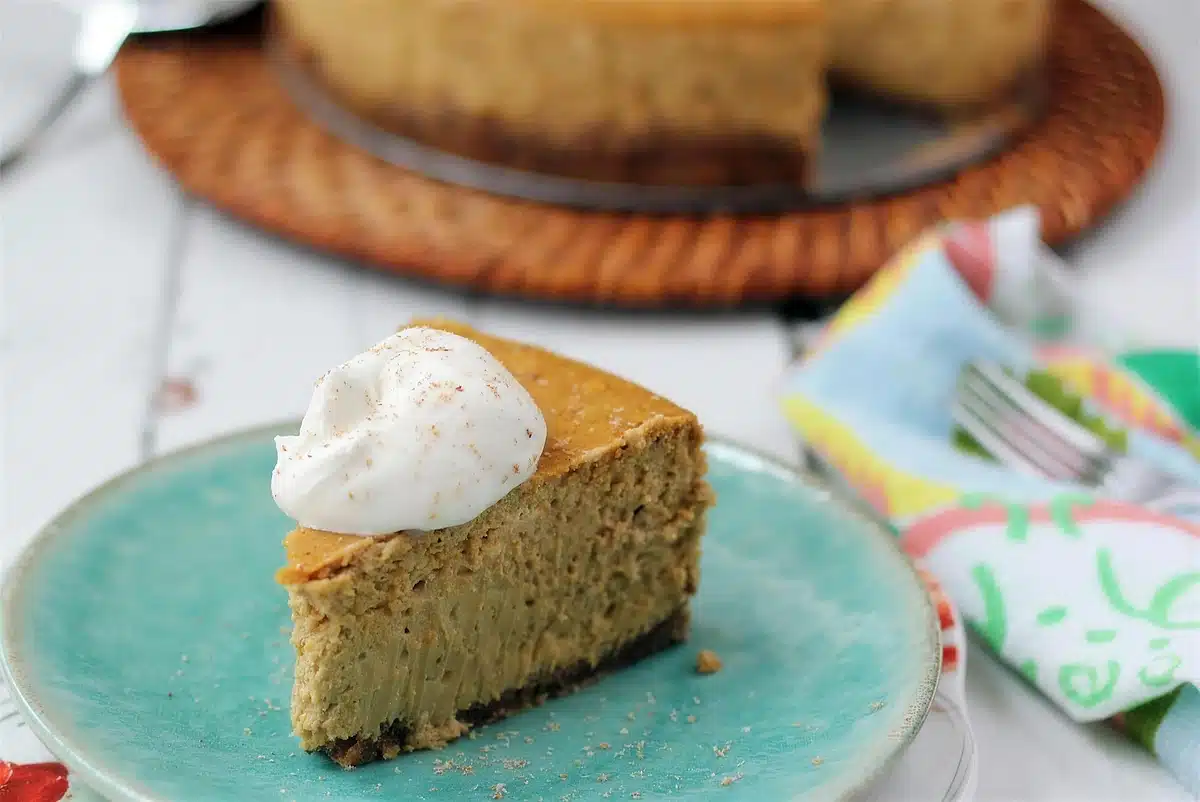
Pumpkin cheesecake is rich and sweet, so everything alongside it should be plain or sharp.
- Barely sweetened whipped cream, loosely whipped, with a grating of nutmeg.
- Creme fraiche, which is better than whipped cream if the table has already had a lot of sugar.
- Strong black coffee, or a small bourbon alongside to echo what is in the filling.
- A handful of pecan pie bark broken over the plate, if you want more crunch.
- Nothing at all. A slice this size does not need help.
For the rest of an autumn table there is pumpkin beer bread to start the day, pumpkin cinnamon rolls for the morning after, and bourbon caramel peanut butter cups for anyone still standing.
Here is what readers ask most often.
Pumpkin Cheesecake FAQ
Frequently Asked Questions
Do I really have to chill it overnight?
Yes. A pumpkin cheesecake this size is still soft in the middle when it comes out of the oven, and the set happens as it cools, not as it bakes. Eight hours is the minimum and twelve is better. Cut into it after three or four hours and you get a slumped wedge that tastes fine and looks like a landslide. Plan the bake for the day before you need it; this is the least negotiable part of the recipe.
Can I skip the water bath?
You can, and you will probably get a crack. Drop the oven to 300F, put a roasting tin of boiling water on the shelf below the cake, and expect to add twenty minutes or so. The humidity helps even if the pan is not sitting in the water. What you lose is the guarantee that the outside never goes above the boiling point of water, which is what keeps the edge of a pumpkin cheesecake from overcooking while the middle catches up.
Why is my filling lumpy?
Cold cream cheese, almost every time. A lumpy pumpkin cheesecake filling is nearly always a temperature problem rather than a mixing one. It needs a full two hours out of the refrigerator, and it needs beating smooth on its own before the sugar joins it. Once sugar and then liquid go in, the lumps are sealed and no amount of further beating breaks them down. Cold eggs do the same thing in reverse, seizing a smooth mixture back into curds, so take those out early too.
More Questions About Pans, Bourbon and Freezing
Good to Know
What if I only have a 9-inch springform?
Hold back about a cup of the filling and bake that separately in ramekins, or you will have batter over the oven floor. A nine-inch pan with the remaining filling bakes taller and needs roughly fifteen minutes longer, and the same doneness test applies: 150F an inch off center, edges set, middle wobbling as one piece.
Can I taste the bourbon?
Not as alcohol. Three tablespoons across twelve slices, after nearly two hours in a hot oven, reads as warmth and a slight caramel note behind the spice rather than as whiskey. If you want it to be obvious, put another tablespoon into the whipped cream instead, where it is not cooked off.
Can I use fresh pumpkin instead of canned?
You can, but drain it. Roasted fresh pumpkin holds far more water than canned puree, and that water thins the batter and lengthens the bake. Roast a sugar pumpkin, puree it, then let it drip through a sieve lined with muslin for an hour and measure fifteen ounces of what is left. Canned puree is one of the few processed ingredients that is genuinely more reliable than its fresh equivalent.
Slicing and Freezing a Pumpkin Cheesecake
Good to Know
How do I get clean slices?
Cold cake, hot knife. Dip a long thin blade in boiling water, wipe it dry, cut straight down and lift it out rather than dragging it. Wipe and redip between every slice. Twelve slices from a ten-inch cake is generous; sixteen is more realistic at the end of a large meal.
A pumpkin cheesecake built on two pounds of cream cheese is a serious dessert rather than a pie in disguise, and the ground pecan crust is what keeps it from being one-note. For the same flavors at breakfast, there is my pumpkin beer bread.
Pumpkin Cheesecake with Bourbon and a Pecan Crust
Save this recipe
Enter your email and I’ll send this recipe straight to your inbox.
Ingredients
Pecan Graham Crust
- 1 tablespoon unsalted butter melted, for brushing the pan
- 7 tablespoons unsalted butter melted, for the crust
- 1 cup graham cracker crumbs from about 8 whole crackers
- 1 cup pecans about 4 ounces, ground fine but not to a paste
- 3 tablespoons granulated sugar
- 1 pinch kosher salt
Bourbon Pumpkin Filling
- 2 pounds cream cheese four 8-ounce blocks, full fat, at room temperature
- 2 cups packed brown sugar light or dark
- 1/4 cup sour cream
- 1 can pumpkin puree 15 ounces, plain puree and not pie filling
- 6 large eggs at room temperature
- 2 teaspoons ground cinnamon
- 3 tablespoons bourbon
- 1 teaspoon kosher salt
- 2 tablespoons vanilla extract
- 3/4 teaspoon ground ginger
- 1/2 teaspoon ground cloves
- 1/2 whole nutmeg freshly grated, about 1/4 teaspoon
- 1/4 teaspoon ground allspice
Equipment
- Springform pan
- Mixing bowls
- Electric mixer
- Wire rack
- Roasting pan
- Spatula
- Whisk
- Aluminum foil
Instructions
Make the Pecan Crust
- Heat the oven to 325F with a rack in the center. Wrap the outside of a 10-inch springform pan in two layers of heavy foil, crimped up the sides, and brush the inside with 1 tablespoon of the melted butter. Put a kettle or a large pot of water on to boil.
- Stir the graham crumbs, ground pecans, granulated sugar and the pinch of salt into the remaining 7 tablespoons of melted butter. Press the mixture hard into the base and about an inch up the sides, using the flat base of a measuring cup, until the crumbs stop moving. Bake 15 to 20 minutes, until it is golden and smells toasted, then cool on a wire rack.
Mix the Filling
- Beat the cream cheese and sour cream on medium until completely smooth, about 2 minutes, scraping the bowl twice. Any lump still visible now will still be there in the baked slice. Add the brown sugar and beat until it is fully incorporated.
- Whisk the pumpkin puree, eggs, bourbon, vanilla, kosher salt, cinnamon, ginger, cloves, nutmeg and allspice together in a second bowl until smooth. Add this to the cream cheese with the mixer on low and stop the moment it is uniform. Beating air in at this stage is what makes a cheesecake dome and then crack.
Bake in a Water Bath
- Pour the filling into the cooled crust and smooth the top. Stand the springform inside a roasting pan and pour the boiling water into the roasting pan until it comes halfway up the sides of the springform.
- Bake about 1 hour 45 minutes. It is done when the outer 2 inches are set and matte, the center wobbles as one mass rather than rippling, and an instant-read thermometer pushed an inch off center reads 150F.
- Turn the oven off, prop the door open a few inches and leave the cheesecake inside for 30 minutes. This slow drop is what stops the surface contracting faster than the middle.
Cool and Chill
- Lift the pan out of the water bath, peel off the foil and run a thin knife around the edge straight away, while it is still hot, so the cake can shrink without tearing. Cool completely on a wire rack, about 2 hours.
- Refrigerate uncovered until cold, then cover loosely and chill at least 8 hours and preferably overnight. Unmold it cold and slice it cold, using a long thin blade dipped in boiling water and wiped dry between every cut.