
The three bread machine cake recipes below all run on the same cycle, in the same pan, in about the same two hours: a butter pound cake, a cocoa cake made with hot water, and a red velvet cake that starts with a boxed mix. What changes between them is the batter, and one number decides whether any of these bread machine cake recipes work at all.
That number is how full the pan is. A bread machine pan holds roughly six cups to the brim and a cake needs to stop at four, because a chemically leavened batter climbs and then wants somewhere to go. Overfill it and the top touches the lid, collapses in the middle and bakes into a dense ring. Every one of the bread machine cake recipes here is scaled to that limit, which is also why a whole boxed mix does not simply go in.

- Three cakes, one cycle, no oven and no mixer beyond a bowl and a whisk
- Every batter is scaled to the four cups a bread pan can actually hold
- Real measurements, since a “spoon” is not a unit and never was
- The leavening is corrected: one teaspoon of baking powder per cup of flour
- A doneness temperature, so you are not guessing at the end of a cycle
- What to do when the cycle ends and the middle is still wet

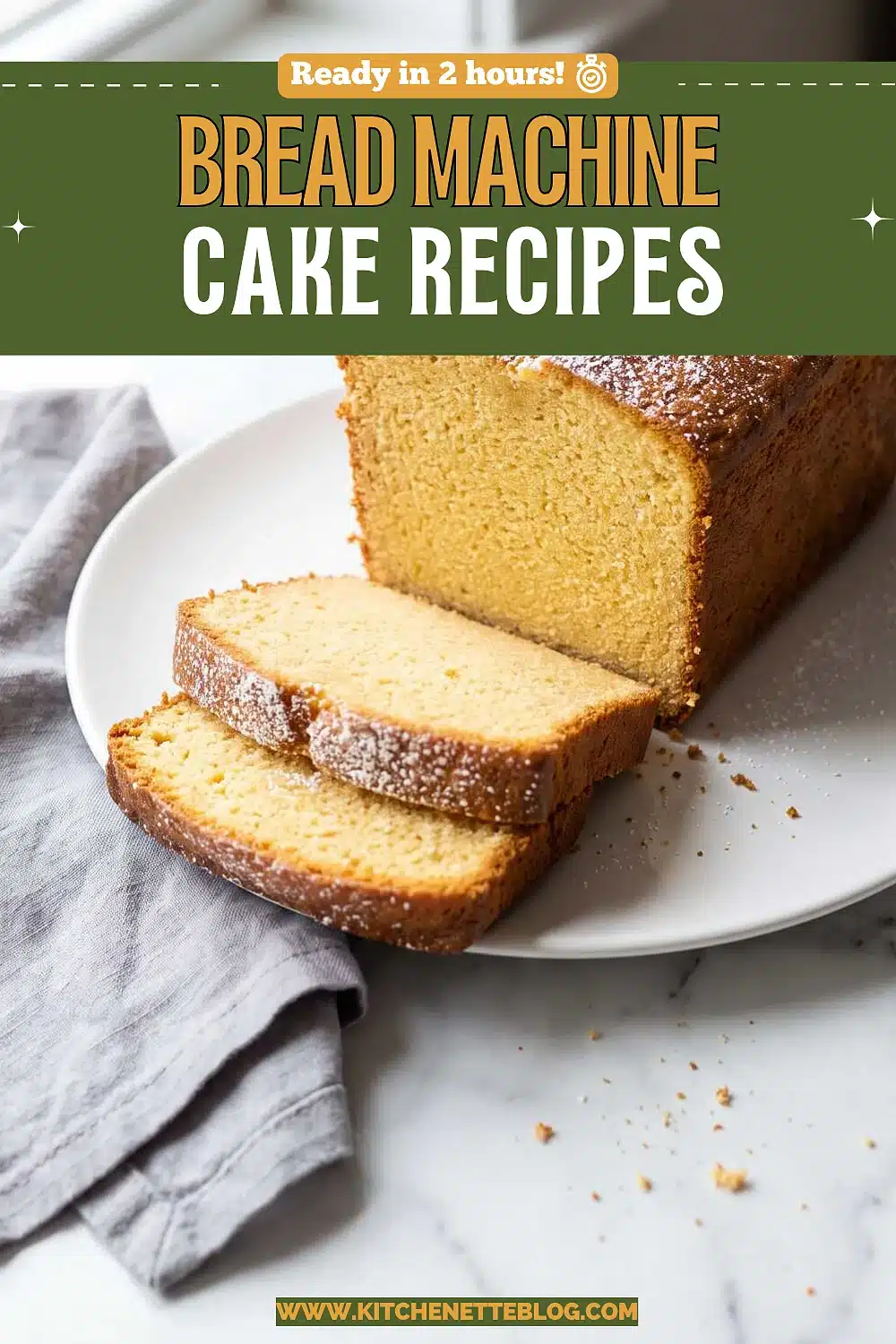
Three cakes, three different reasons to pick one, and one shared set of rules.
- The Three Bread Machine Cake Recipes at a Glance
- Does Your Machine Actually Have a Cake Cycle?
- Pound Cake in a Bread Maker
- Chocolate Cake in a Bread Machine
- Red Velvet Cake with a Bread Machine
- How To Make Bread Machine Cake Recipes Work Every Time
- Why Bread Machine Cake Recipes Fail
- Ingredient Notes for Bread Machine Cake Recipes
- Storing and Freezing a Machine-Baked Cake
- Variations and Substitutions
- What to Serve With Them
- Bread Machine Cake Recipes FAQ
The Three Bread Machine Cake Recipes at a Glance
| Cake | Hands-on | Total | The thing that goes wrong |
|---|---|---|---|
| Butter pound cake | 20 min | About 2 hours | Butter that was not properly soft, leaving lumps no paddle can beat out |
| Cocoa cake with hot water | 15 min | About 2 hours | Full-size chocolate chips, which sink into a band across the bottom |
| Red velvet from a mix | 10 min | About 2 hours | Tipping in the whole box, which is five cups of batter into a four cup pan |
Start with the pound cake if you have never tried bread machine cake recipes before. It is the most forgiving of the three, it slices cleanly the next day, and it tells you exactly how your particular machine behaves before you risk anything more expensive.
Save this recipe
Enter your email and I’ll send this recipe straight to your inbox.
Does Your Machine Actually Have a Cake Cycle?
This is the first question in any of these bread machine cake recipes and most people skip it. Look for a setting called Cake, Quick Bread, Batter Bread or Bake Only. Any of the four will do the job. What they have in common is a short mixing phase, no rising period, and a bake of roughly 50 to 80 minutes.
What will not work for bread machine cake recipes is the Basic, White, French or Whole Wheat cycle. Those spend an hour or more on kneading and rising, which a batter cannot do, and by the time the heat comes on you have a bowl of over-beaten flour paste.
The Quick or Rapid cycle is the trap. It sounds right and it is not. It is a fast yeast cycle, it still kneads, and it bakes for 50 to 60 minutes at a profile built for a bread dough.
If your machine has none of these but does have a Bake Only setting, you are fine. Mix the batter, pour it in, and run Bake Only for 60 minutes to start with. If it has no bake-only option and no cake cycle, your machine cannot do this, and no amount of improvising with the crust colors will change that.
One more thing to check before committing to any of these bread machine cake recipes: whether the paddle comes out. Most machines leave the paddle embedded in the base of the cake, which means a hole. It is cosmetic and it goes away when you slice.
Pound Cake in a Bread Maker
This is the recipe in the card at the bottom of the page, and it is the one to learn first among the bread machine cake recipes here. Two cups of all-purpose flour, two teaspoons of baking powder, four eggs, three quarters of a cup of butter and half a cup of milk.
Two details matter more than everything else in bread machine cake recipes built on butter. The butter has to be soft enough to take a fingerprint without resistance, because the machine’s paddle stirs rather than creams and it cannot rescue cold butter. And the eggs and milk should be at room temperature, or the cold liquid seizes the butter back into lumps you have just spent five minutes beating out.
Cream the butter and sugar in a bowl first, beat the eggs in one at a time, then alternate the flour mixture and the milk in three additions. Pour it into the greased pan, fit the paddle, and start the cake cycle. The short mixing phase at the beginning is gentle enough that it will not toughen anything.
The Wheat Foods Council’s rundown of the different types of wheat flour is worth a minute if you are tempted by the “baking flour” that older bread machine cake recipes ask for. Bread flour runs several points higher in protein, and in a cake that extra gluten is exactly what you do not want.
Chocolate Cake in a Bread Machine
The cocoa version is the best tasting of these bread machine cake recipes and it takes the least skill, because there is no creaming at all. Everything dry goes in one bowl, everything wet in another, and the two get whisked together.
Dry: 1 1/2 cups all-purpose flour, 1/2 cup unsweetened cocoa powder, 3/4 cup granulated sugar, 1/4 cup packed light brown sugar, 1 teaspoon baking powder, 1/2 teaspoon baking soda and 1/2 teaspoon fine salt.
Wet: 2 large eggs, 1/2 cup neutral oil, 3/4 cup buttermilk and 2 teaspoons vanilla extract.
Last: 1/2 cup of hot water or hot coffee, whisked in at the end, plus 1/2 cup of mini chocolate chips folded through.
The hot water is not optional and it is not there to thin the batter. Cocoa powder holds its flavor compounds in fat and starch that only release properly above about 160F, which is why a cocoa cake made entirely with cold liquid tastes thin and slightly dusty. Coffee does the same job and pushes the chocolate further.
Use mini chips. Full-size ones weigh enough to travel through a loose batter during the fifty minutes before the crumb sets, and they arrive as a solid layer along the bottom. Do not use the fruit and nut dispenser for chocolate, either. It melts in there and stays.
Pour it in, run the cycle, and expect a cake that is noticeably darker and moister than the pound cake. It keeps better too.
Red Velvet Cake with a Bread Machine
A boxed mix is a perfectly respectable route into bread machine cake recipes and much the fastest of the three. The problem is volume, not quality.
A standard 15.25 ounce box makes about five cups of batter, sized for two round pans. A bread machine pan can take four. So make up the full box exactly as the side of the box says, which is almost always 1 cup water, 1/2 cup oil and 3 large eggs, and then pour four cups into the bread pan and bake the last cup as three or four cupcakes in a conventional oven or a toaster oven at 350F for 18 minutes.
Versions of this recipe circulating online call for three tablespoons of oil instead of half a cup. That is about a fifth of the fat the mix is formulated around, and it produces something closer to a red bread roll.
For the frosting, beat 8 ounces of softened cream cheese with 4 tablespoons of softened butter until completely smooth, then add 2 cups of confectioners’ sugar a little at a time with a teaspoon of vanilla and a pinch of salt. It will never form soft peaks, whatever you may have read. Cream cheese frosting has no structure to whip into. Stop when it holds a soft swirl and spread it on a cake that is fully cold, because a warm loaf melts it straight off the top.
How To Make Bread Machine Cake Recipes Work Every Time
Exact amounts for the pound cake are in the recipe card at the bottom of the page.
- First, take the pan out of the machine before you do anything else and grease it, base and sides, with butter or baking spray. Fitting the paddle after greasing, not before, keeps the shaft clear.
- Next, mix the batter in a bowl rather than in the pan. The paddle stirs a corner of a rectangular pan and leaves flour banked in the ends, which is where the raw streaks in bread machine cake recipes come from.
- Then pour the batter in and check the level. Four cups, or two thirds of the way up, and no more. Scrape the sides down with a spatula so nothing bakes onto the wall above the batter line.
- After that, start the Cake or Quick Bread cycle. Leave the lid closed for the first hour. Every look costs heat, and a small sealed box loses it fast.
- Test with a thin skewer through the center at the end of the cycle. It should come out with a crumb or two and no wet batter, and an instant-read thermometer should show 200F to 205F.
- Finally, lift the pan out with mitts, stand it for 10 minutes, then turn the cake onto a rack and pull the paddle out of the base while the crumb is still warm and will let go of it.
Why Bread Machine Cake Recipes Fail
Nearly every complaint about bread machine cake recipes traces back to one of five things.
Too much leavening. The correct ratio is about one teaspoon of baking powder per cup of flour. Recipes floating around the internet call for three tablespoons in two cups, which is roughly six times that. The cake rises hard, hits the lid, and collapses into a wet seam. It also tastes faintly of metal.
The wrong cycle. Bread machine cake recipes need a cycle with no rise. Anything with a kneading and rising phase will beat a batter into gluten and then bake it flat.
An overfilled pan. Four cups. It is the single most common cause of a sunken middle in bread machine cake recipes and the easiest to avoid.
Cold ingredients. Bread machine cake recipes are less forgiving here than an oven is. Cold butter will not cream and cold milk seizes the butter that did. Twenty minutes on the counter fixes both.
Opening the lid. A conventional oven has thermal mass in its walls. A bread machine has a thin metal box and a small element, so lifting the lid at minute thirty drops the temperature far enough to sink a cake that had been fine.
Ingredient Notes for Bread Machine Cake Recipes
- Flour: all-purpose, spooned into the cup and leveled, never scooped. Scooping packs in up to an extra ounce and dries the crumb. Bread flour is the wrong tool here.
- Baking powder: one teaspoon per cup of flour, and check the date on the tin. Open baking powder loses strength in about six months and a dead tin looks exactly like a live one.
- Butter: unsalted, softened to about 65F. It should dent under a finger and hold its shape, not slump.
- Eggs: large, at room temperature. Sit them in warm water for five minutes if you forgot.
- Sugar: granulated for the pound cake. Brown sugar in the cocoa version adds a little acid and a lot of moisture, which is why it is in there.
- Milk and buttermilk: whole milk for the pound cake. If you have no buttermilk for the cocoa cake, stir 2 teaspoons of lemon juice into 3/4 cup of milk and wait five minutes.
- Cocoa: natural or Dutch-process both work, since the cocoa cake carries baking powder as well as soda.
Storing and Freezing a Machine-Baked Cake
- Room temperature: 3 days for the pound cake and 4 for the cocoa cake, wrapped in foil once completely cold. Warm cake in a sealed wrapper steams itself soggy.
- Refrigerator: only if it is frosted, and then bring slices back to room temperature before eating. Cold firms butter and mutes flavor.
- Freezer: up to 3 months. Freeze it whole and unfrosted, double wrapped, or in slices with parchment between them so you can take one at a time.
- Thawing: overnight on the counter in the wrapping, which lets the condensation form on the foil instead of on the cake.
- Reviving a dry slice: 12 seconds in a microwave, or 4 minutes wrapped in foil in a 300F oven.
Variations and Substitutions
- Lemon pound cake: add the zest of two lemons to the sugar and rub it in with your fingers before creaming, then brush the warm loaf with 1/4 cup of lemon juice mixed with 2 tablespoons of sugar.
- Marble: hold back a cup of pound cake batter, stir 2 tablespoons of cocoa and a tablespoon of milk into it, and spoon it over the top in two lines before the cycle starts.
- Banana: replace the milk in the pound cake with 3/4 cup of mashed very ripe banana and drop the sugar to 3/4 cup, along the lines of my chocolate coconut banana bread.
- Coconut: swap 1/2 cup of the flour for desiccated coconut and the milk for coconut milk, as in this coconut bread with glaze.
- Spice: 2 teaspoons of cinnamon, 1/2 teaspoon of nutmeg and 1/4 teaspoon of cloves into the dry ingredients.
- Gluten-free: a cup-for-cup blend works in all three bread machine cake recipes, and the cake wants about 10 extra minutes and a rest of a full hour before slicing.
What to Serve With Them
Bread machine cake recipes come out as a tall narrow loaf rather than a round, which changes how you serve them. Thin slices, toasted, with butter is the best thing you can do with day-old pound cake.
Whipped cream and macerated berries turn any of these bread machine cake recipes into a dessert with about four minutes of work. For the cocoa cake, a scoop of vanilla ice cream and a spoonful of the hot coffee you had left over.
If you want a proper layer cake for an occasion, this is not the appliance for it, and my Brooklyn blackout cake is the one I make instead. For something between the two, the pina colada pound cake uses the same butter-and-egg structure in a conventional pan.
Here is what readers ask most often.
Bread Machine Cake Recipes FAQ
Frequently Asked Questions
Can you really make cake in a bread machine?
Yes, on the Cake, Quick Bread, Batter Bread or Bake Only cycle. What you get is a tall rectangular loaf rather than a round layer, with a slightly firmer crust than an oven cake and a hole in the base where the paddle sat. The crumb itself is very good, because a sealed box holds a steadier humidity than an oven vent does. What a machine cannot do is anything that needs creaming, folded egg whites or a delicate batter, so genoise and angel food are out and butter cakes, cocoa cakes and boxed mixes are all in.
Can I just use a boxed cake mix?
Yes, and it is the easiest of the three bread machine cake recipes here. Make the batter up exactly as the box directs, usually 1 cup water, 1/2 cup oil and 3 eggs, then put only four cups of it into the bread pan. A standard box makes about five. The extra cup bakes as three or four cupcakes in 18 minutes at 350F. Tipping the whole box in is the single most common way people ruin this, because the batter climbs into the lid and then falls.
Which cycle should I use?
Cake or Quick Bread, and Bake Only if your machine has neither. Avoid Basic, White, French, Whole Wheat and, most importantly, Quick or Rapid, which sounds correct and is a fast yeast cycle with a full kneading phase. If you are unsure, find the cycle chart in the manual and pick the one with no rise time and a bake of 50 to 80 minutes.
More Questions About Cake Cycles and Pans
Good to Know
Why did my cake sink in the middle?
Four causes, in order of likelihood. The pan was overfilled past four cups, so the cake rose into the lid and had nowhere left to go. There was too much baking powder, which makes a batter rise fast and then exhaust itself before the crumb sets. The lid was opened during baking. Or it came out before it reached 200F in the center, and a cake that is not set will fall as it cools no matter how good it looked in the pan.
Do I leave the paddle in?
Leave it in. Without it the batter never gets mixed and the cake bakes with a band of dry flour in one end. Take it out of the base of the loaf while the cake is still warm, using the hook that came with the machine or the handle of a teaspoon, because a cold crumb grips it and tears. The hole it leaves disappears as soon as you slice.
Bread Machine Cake Recipes: Doneness and Batch Size
Good to Know
How do I know when it is done?
An instant-read thermometer in the center should read 200F to 205F, and a thin skewer should come out with a few moist crumbs and no wet batter. Do not rely on the cycle finishing. Machines vary by a wide margin, and a batter that started cold can easily need 10 or 15 minutes more than the program allows.
Can I halve or double these?
Halve, yes, though a shallow batter bakes faster and wants checking 15 minutes early. Double, no. The pan is the limit, not the recipe, and the second half will not fit however carefully you pour it. Bake two loaves back to back instead, and let the machine cool for 20 minutes with the lid open in between.
One cycle, one pan and four cups of batter. Get those right and the bread machine cake recipes above are as reliable as anything you would bake in an oven. For a loaf that uses the same shape without a machine, try my easy hummingbird bread.
Bread Machine Pound Cake
Save this recipe
Enter your email and I’ll send this recipe straight to your inbox.
Ingredients
Butter and Sugar
- 3/4 cup unsalted butter softened to about 65F, so it dents under a finger without slumping
- 1 cup granulated sugar
- 4 large eggs at room temperature, added one at a time
- 2 teaspoons vanilla extract
Flour and Milk
- 2 cups all-purpose flour about 8 1/2 ounces, spooned into the cup and leveled, never scooped
- 2 teaspoons baking powder one teaspoon per cup of flour, and check the date on the tin
- 1/2 teaspoon fine salt
- 1/2 cup whole milk at room temperature, or it will seize the creamed butter
Instructions
Mix the Batter in a Bowl
- First, lift the pan out of the machine and grease it thoroughly, base and sides, then fit the paddle. Greasing before the paddle goes in keeps the shaft clear.
- Next, beat the softened butter and the sugar together for 3 to 4 minutes, until pale and noticeably lighter. The machine's paddle stirs rather than creams, so this has to happen in a bowl.
- Then beat in the eggs one at a time, waiting until each disappears before adding the next, and stir in the vanilla.
- After that, whisk the flour, baking powder and salt together in a second bowl and add them to the butter mixture in three goes, alternating with the milk and finishing with flour. Stop as soon as the last streak vanishes.
Bake, Test and Turn Out
- Pour the batter into the greased pan, scrape the sides down, and check that it sits about two thirds of the way up and no higher.
- Set the pan in the machine and start the Cake or Quick Bread cycle. Keep the lid closed for the first hour, since a thin metal box loses heat fast and a cake that is cooling will sink.
- Test at the end of the cycle with a thin skewer through the center and an instant-read thermometer. You want a few moist crumbs and 200F to 205F. If it is short, run Bake Only for another 10 to 15 minutes rather than the keep-warm setting.
- Finally, lift the pan out with mitts, stand it for 10 minutes, then turn the cake onto a rack and work the paddle out of the base while the crumb is still warm enough to release it.