
Most toffee cookies are a chocolate chip cookie with toffee bits swapped in for the chips. These are not that. There is no chocolate in them at all, and the toffee shares the bowl with crushed pretzels and salted roasted peanuts.

- No dough chilling, so the first tray goes in about twelve minutes after you start
- Three mix-ins doing three different jobs, so no two bites of these toffee cookies match
- One bowl of dry, one bowl of wet, and a wooden spoon finishes it
- Makes about forty, which is a cookie swap or two full tins
- The scooped dough freezes for six weeks and bakes from frozen
- An extra yolk keeps the middles soft for three days rather than one
That is the whole idea. Toffee on its own is a one-note mix-in, sweet and buttery and gone. Give it something salty to push against and it turns into the best kind of cookie: the sort you eat standing at the counter telling yourself you are only having one, while your hand is already moving. The dough needs no chilling, it makes about forty toffee cookies, and they are on a rack in thirty-five minutes.

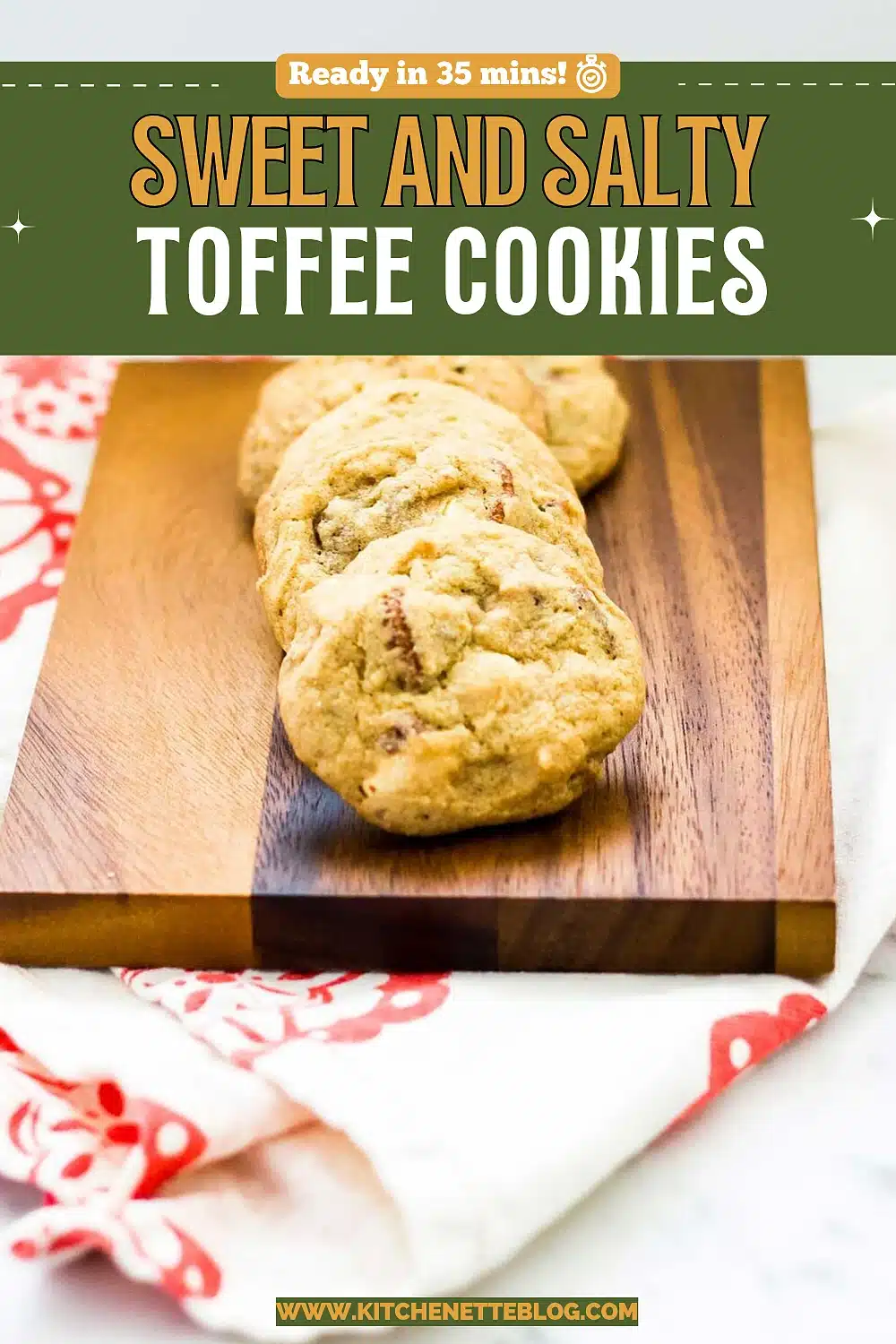

Sweet and salty is a balance rather than a garnish, and in toffee cookies it comes down to the ratio of the three crunchy things.
- What Makes These Toffee Cookies Sweet and Salty
- Toffee Bars or Toffee Bits
- Ingredient Notes
- How To Make Toffee Cookies
- Why Cookies Spread Flat, and How To Stop It
- How To Tell When Toffee Cookies Are Done
- Make It Ahead
- Storing Toffee Cookies
- Variations and Substitutions
- Packing Toffee Cookies for a Cookie Swap
- Toffee Cookies FAQ
What Makes These Toffee Cookies Sweet and Salty
There are four separate sources of salt in these toffee cookies, and each one lands in a different place.
The kosher salt in the dough is the base layer. At one and three-quarter teaspoons it is roughly double what a standard drop cookie carries. That sounds aggressive written down, and it is exactly right once the sugar is in.
The pretzels bring salt that sits on the surface of a crumb rather than dissolved through it, which is why you taste them as distinct bursts. They also go soft over a day or two, which is the one genuine drawback of the whole cookie and the reason to crush them coarse.
The peanuts are the only mix-in that stays properly crunchy for the full life of the cookie. Buy salted roasted, not raw and not honey roasted, and chop them roughly so you get halves and quarters rather than dust.
The flaky salt on top goes on before baking, not after, so it partly melts into the surface. Added after, it falls off in the tin.
What does not work is skipping any one of them and doubling another. The pretzels cannot do the peanuts’ job and the salt in the dough cannot do either, because none of them is really about saltiness. They are about where in the bite the salt shows up.
Save this recipe
Enter your email and I’ll send this recipe straight to your inbox.
Toffee Bars or Toffee Bits

This is the question nobody answers properly, and it changes toffee cookies more than the flour does.
Chopped chocolate-covered toffee bars are what I use. Five ounces, roughly three and a half standard bars, cut into pieces about a quarter of an inch across. The chocolate coating melts into the crumb and the toffee inside stays as hard shards that soften slightly. You get pockets rather than an even distribution, which is the point.
Bagged toffee bits are uniform, uncoated and much smaller. They dissolve almost completely into the dough during baking, which gives you a butterscotch-flavored cookie rather than a cookie with toffee in it. Perfectly nice, and not what we are after here.
Bagged toffee bits with chocolate sit in between and are the reasonable shortcut if you cannot face chopping.
Homemade toffee is the best of all if you happen to have some, broken to the same rough quarter-inch scale.
One warning that applies to all of them. Toffee melts at a lower temperature than the cookie finishes baking, so any piece touching the sheet pan will run out into a lace edge and weld itself to the parchment. Keep the pieces inside the dough ball when you scoop, and use parchment rather than a bare pan.
Ingredient Notes

Toffee cookies run to eleven items, most of them already in the cupboard. Exact amounts are in the recipe card below.
- All-purpose flour: three cups, spooned into the cup and leveled rather than scooped, which is a difference of about forty grams over three cups. The Wheat Foods Council puts the protein in all-purpose flour at 8 to 11 percent, and anything in that band works here. Bread flour makes these tougher, not chewier.
- Butter: one cup, unsalted, genuinely at room temperature. Cool butter will not hold air when you cream it and the cookies come out dense.
- Dark brown sugar: one cup, packed, and dark rather than light. The extra molasses is where the chew comes from.
- Eggs plus one yolk: the extra yolk is the single change I would not skip. Fat and lecithin without extra water, so the middles stay soft into the third day.
- Baking soda and a little powder: soda alone browns the edges nicely but leaves them flat. Half a teaspoon of powder gives just enough lift to keep a domed center.
- Kosher salt: one and three-quarter teaspoons of Diamond Crystal. Morton is about twice as salty by volume, so use a single teaspoon of that instead.
- Toffee, pretzels and peanuts: five ounces, two-thirds of a cup and two-thirds of a cup. That ratio is deliberate, and there is more on it above.
How To Make Toffee Cookies
Chop everything before you start creaming these toffee cookies, because the dough wants folding while it is still soft.
- First, heat the oven to 350F and line two sheet pans with parchment. Whisk the flour, baking soda, baking powder and salt together in a bowl and leave it.
- Next, beat the butter with both sugars for a full 3 minutes on medium, until it is pale and looks noticeably bigger. Add the eggs one at a time, then the yolk, then the vanilla.
- Then add the dry mixture in three goes on low, stopping the moment the last streak of flour disappears. Overmixing here is what makes a tough cookie.
- After that, fold in the toffee, pretzels and peanuts by hand with a wooden spoon. A mixer will pulverize the pretzels into powder in about four seconds.
- Finally, scoop tablespoon-and-a-half balls twelve to a sheet, press a few flakes of salt onto each, and bake 12 to 14 minutes, rotating once.
Why Cookies Spread Flat, and How To Stop It

A flat, greasy, joined-up tray is the most common failure with a no-chill dough, and with toffee cookies it is almost always one of five things.
The butter was too warm. Room temperature means about 65F and still holding a dent when you press it, not glossy and slumping. If your kitchen is hot, cut the butter into cubes straight from the refrigerator and beat it a minute longer.
The dough sat on a hot pan. Scooping onto a sheet that just came out of the oven starts the butter melting before it ever gets heat from below. Keep a third pan in rotation, or run the hot one under cold water and dry it.
The flour was measured light. Dipping the cup into the bag compacts it, and scooping loosely under-measures it. Spoon and level, or weigh.
The oven runs cool. Most do. An oven thermometer costs almost nothing and solves more baking problems than any other single purchase.
They were overbaked, which reads as flat. A cookie that spreads and then sets is a different animal from one that spread because it baked too long and collapsed.
If it is too late and the tray is already a single sheet, cut them apart with a knife or a round cutter while they are hot. Nobody will know.
The Pan Bang, and When It Helps
Dropping the pan on the counter partway through baking deflates the risen center of toffee cookies and gives you the rippled, wrinkled edge that photographs so well. It works, and it is worth knowing when it is a good idea.
Bang at around the eight minute mark, once, from about four inches up. Repeating it every two minutes gives you a thin, crisp, almost lacy cookie, which is a legitimate style but a different one.
Do not bang a tray of these if you have loaded the mix-ins heavily, because the toffee shards travel outward with the spread and end up on the parchment.
Skip it entirely if you want a thicker, more domed cookie, which is what the half teaspoon of baking powder is there to produce.
How To Tell When Toffee Cookies Are Done
The timer is a suggestion. Toffee cookies carry more sugar than a plain drop cookie, so they brown at the edge before the middle is anywhere near set, and the visual cues matter more than usual.
The edges should be properly golden and the ring about half an inch in from the edge should look matte rather than wet.
The center should still look underdone and slightly puffed. It will look wrong. Take them out anyway.
The whole cookie should slide if you nudge it with a spatula. If it tears, it needs another minute.
They finish on the pan. Five minutes on the hot sheet does as much cooking as the last two minutes in the oven would have, and it does it gently. Move them to a rack after that or the bottoms go greasy.
Make It Ahead
Toffee cookies are unusually cooperative in this respect, which is why this is my default dough when something needs baking for a crowd.
Refrigerated dough keeps three days in a covered bowl. It firms up considerably, so let it sit out twenty minutes before scooping or you will fight it.
Frozen dough balls are the real answer. Scoop the whole batch onto a sheet, freeze until solid, then tip them into a bag. Six weeks, and they bake straight from frozen at 350F with three extra minutes.
Baked and frozen works too. Cool completely, freeze flat, then stack. They thaw in twenty minutes and taste fresher than three-day-old cookies do.
The one thing not worth doing in advance is crushing the pretzels. They pick up moisture from the air within a few hours and go leathery.
Storing Toffee Cookies
- Airtight at room temperature: toffee cookies are at their best for 3 days, five before anyone would call them stale. The peanuts hold; the pretzels soften from day two.
- Add a slice of bread to the tin. It gives up moisture to the cookies and keeps them soft, and you replace it when it goes hard.
- Do not refrigerate. The refrigerator is drying, and it firms the toffee into something that cracks a filling.
- Freezer, baked: 3 months in a sealed bag with parchment between the layers.
- Humid kitchens are the enemy of this particular cookie. If yours is damp, store them with a little rice in a twist of paper towel in the corner of the tin.
Variations and Substitutions
The dough behind these toffee cookies is a good base. The three mix-ins are a suggestion in a way the dough is not.
- Add chocolate: six ounces of chopped dark chocolate turns this into a full kitchen sink cookie. Drop the pretzels to half a cup if you do.
- Potato chips instead of pretzels: two cups, crushed. Saltier, greasier, better, and they go soft faster.
- Pecans instead of peanuts: toast them first and salt them yourself. A more grown-up cookie and a less interesting one.
- Brown the butter: cook it to nut brown, chill it back to a soft solid, then cream as usual. Adds about forty minutes and a lot of flavor.
- Espresso powder: two teaspoons in the dry mix, which does not taste of coffee and makes the toffee taste more of itself.
- Half batch: halves cleanly except the egg. Use one whole egg and skip the extra yolk.
Packing Toffee Cookies for a Cookie Swap
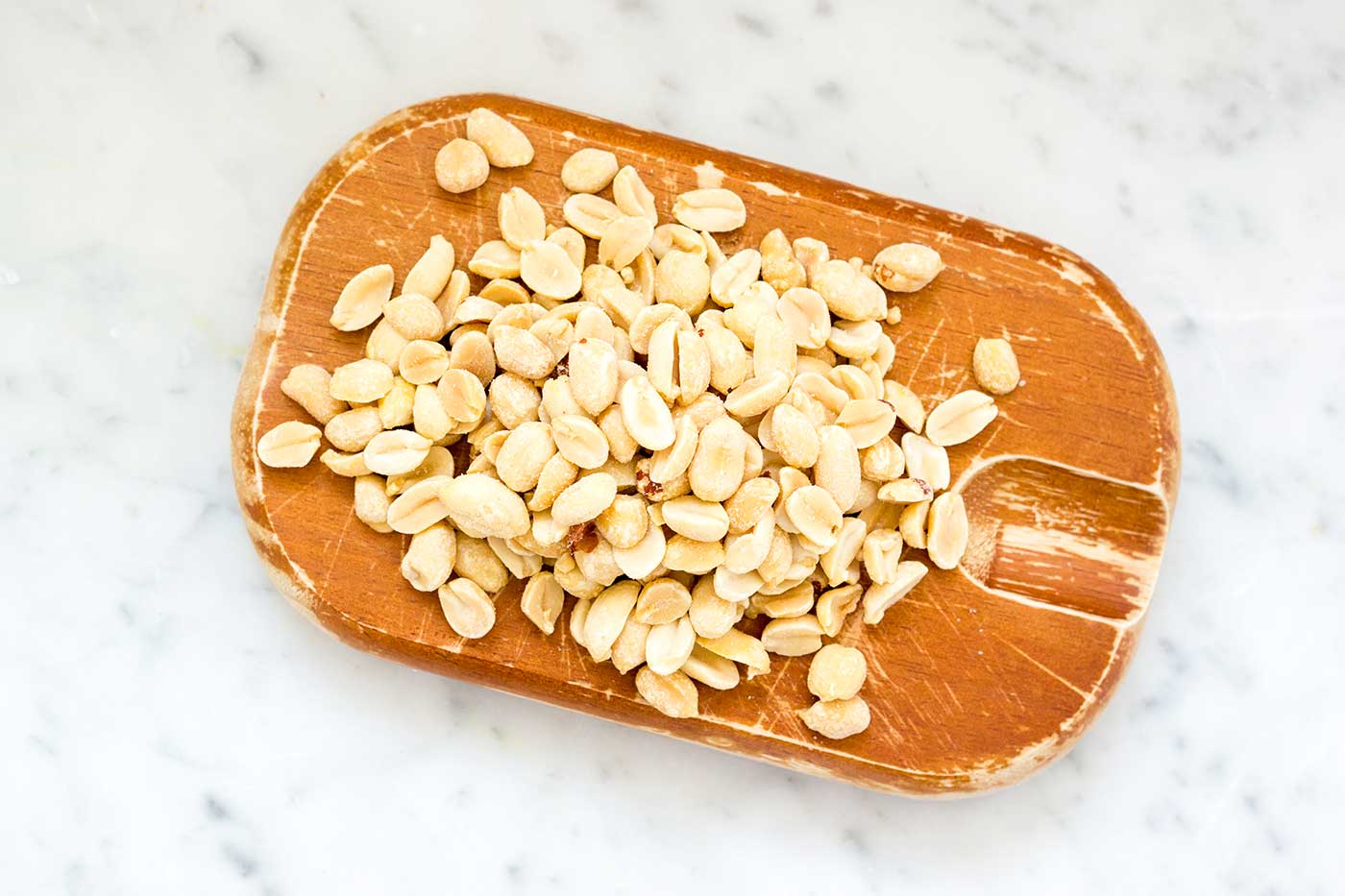
These were built for a swap, and toffee cookies travel better than most because there is no frosting and no filling.
- Cool them completely. Warm cookies steam inside a box and arrive soft and stuck together.
- Stack them on edge in a tin like records rather than flat, and they arrive whole.
- Parchment between the layers, and crumpled parchment in any gap so nothing shifts.
- Write the mix-ins on the label. Peanuts are the one that matters.
- Send them with something plainer, like my glazed lemon cookies, so the tin has some contrast.
For a softer cookie to sit alongside them, my chocolate chip pudding cookies stay tender for days, and the Texas sheet cake cookies are the ones people ask about afterward.
Here is what readers ask most often.
Toffee Cookies FAQ
Frequently Asked Questions
Do I have to chill the dough?
No, and that is deliberate. Chilling is the usual fix for a dough that spreads, but this one carries three cups of flour against a cup of butter and holds its shape without help. If your kitchen is warm or your butter went past soft into greasy, twenty minutes in the refrigerator will not hurt anything. It just is not a requirement the way it is for most brown butter recipes.
Can I use toffee bits instead of chopped bars?
You can, and the toffee cookies change. Uncoated bagged bits are small and dissolve almost entirely into the crumb during baking, so you get an overall butterscotch flavor rather than distinct pockets of toffee. Chopped chocolate-covered bars keep their shape and give you shards. If bits are what you have, look for the kind with chocolate in them and use a cup.
Why did my toffee stick to the pan?
Because a piece was sitting on the outside of the dough ball. Toffee melts well below the temperature these finish at, so any shard touching parchment runs out into a thin lace that hardens as it cools. Tuck stray pieces into the ball before you bake, always use parchment, and lift the cookies while they are still warm.
More Questions About Toffee and Texture
Good to Know
How do I keep the pretzels crunchy?
Crush them coarse, to about pea size rather than crumbs, and fold them in at the last possible moment. Bigger pieces have less surface area for moisture to work on. Even so they soften from about day two, which is the honest answer, and it is why the peanuts are in there doing the long-term crunch job.
Can I make them gluten-free?
A cup-for-cup gluten-free blend with xanthan gum works well in the dough, and the extra yolk helps with the texture that blends often lack. The pretzels are the problem, since most are wheat. Gluten-free pretzels exist and behave the same way. Check the toffee bars too, as some brands contain barley.
How many cookies does one batch make?
About forty toffee cookies with a tablespoon-and-a-half scoop, which is the size that gives a cookie of roughly three inches. A two-tablespoon scoop takes it down to around thirty and needs an extra two minutes in the oven. Anything larger than that and the middle will not set before the toffee at the edges burns.
Are these very salty?
Toffee cookies should read as sweet first and salty second, which is a narrower target than it sounds. If you are nervous, leave the flaky salt off the top for the first tray and taste one before you commit the rest. Going the other way, a few more flakes is the easiest adjustment in the whole recipe.

Toffee cookies with something salty folded through them are the ones that disappear first off any table. For another that uses peanuts in a dessert, try my peanut butter cheesecake with an Oreo crust.

Salted Toffee Cookies with Pretzels and Peanuts
Save this recipe
Enter your email and I’ll send this recipe straight to your inbox.
Ingredients
The Dough
- 1 cup unsalted butter 2 sticks, room temperature and still firm enough to hold a dent
- 3 cups all-purpose flour about 375 grams, spooned into the cup and leveled
- 1 teaspoon baking soda
- 1/2 teaspoon baking powder
- 1 3/4 teaspoons Diamond Crystal kosher salt or 1 teaspoon Morton
- 1 cup packed dark brown sugar dark, not light
- 1/2 cup granulated sugar
- 2 large eggs room temperature
- 1 large egg yolk the extra yolk is what keeps the middles soft
- 2 teaspoons vanilla extract
The Mix-Ins
- 5 ounces chocolate-covered toffee bars about 1 cup, chopped into rough 1/4-inch pieces
- 2/3 cup pretzel sticks crushed coarse, to about pea size
- 2/3 cup salted roasted peanuts roughly chopped, not honey roasted
- 1 tablespoon flaky sea salt for pressing onto the tops before baking
Instructions
Mix the Dough
- Heat the oven to 350F and line two sheet pans with parchment. Whisk the flour, baking soda, baking powder and kosher salt together in a bowl and set it aside.
- Beat the butter with both sugars on medium for a full 3 minutes, until it is visibly paler and has grown in volume. This is the only aeration the cookies get, so do not cut it short.
- Add the eggs one at a time, beating well after each, then the extra yolk and the vanilla. Add the dry mixture in three additions on low speed, stopping the moment the last streak of flour disappears.
Fold in the Crunch
- Take the bowl off the mixer. Fold in the chopped toffee, crushed pretzels and peanuts by hand with a wooden spoon until they are evenly spread, no longer.
- A mixer will grind the pretzels to powder in seconds, which costs you the texture the whole cookie is built around.
Scoop and Bake
- Scoop tablespoon-and-a-half balls onto the pans, 12 to a sheet. Tuck any toffee shards sticking out of a ball back into the dough, then press a few flakes of sea salt onto each top.
- Bake 12 to 14 minutes, rotating the pans once, until the edges are golden and matte and the centers still look slightly underdone and puffed. They will look wrong. Take them out anyway.
- Leave them on the hot pan for 5 minutes to finish setting, then move them to a rack. Cool the pans between batches so the dough does not start melting before it hits the oven.
Dot Test
Test