
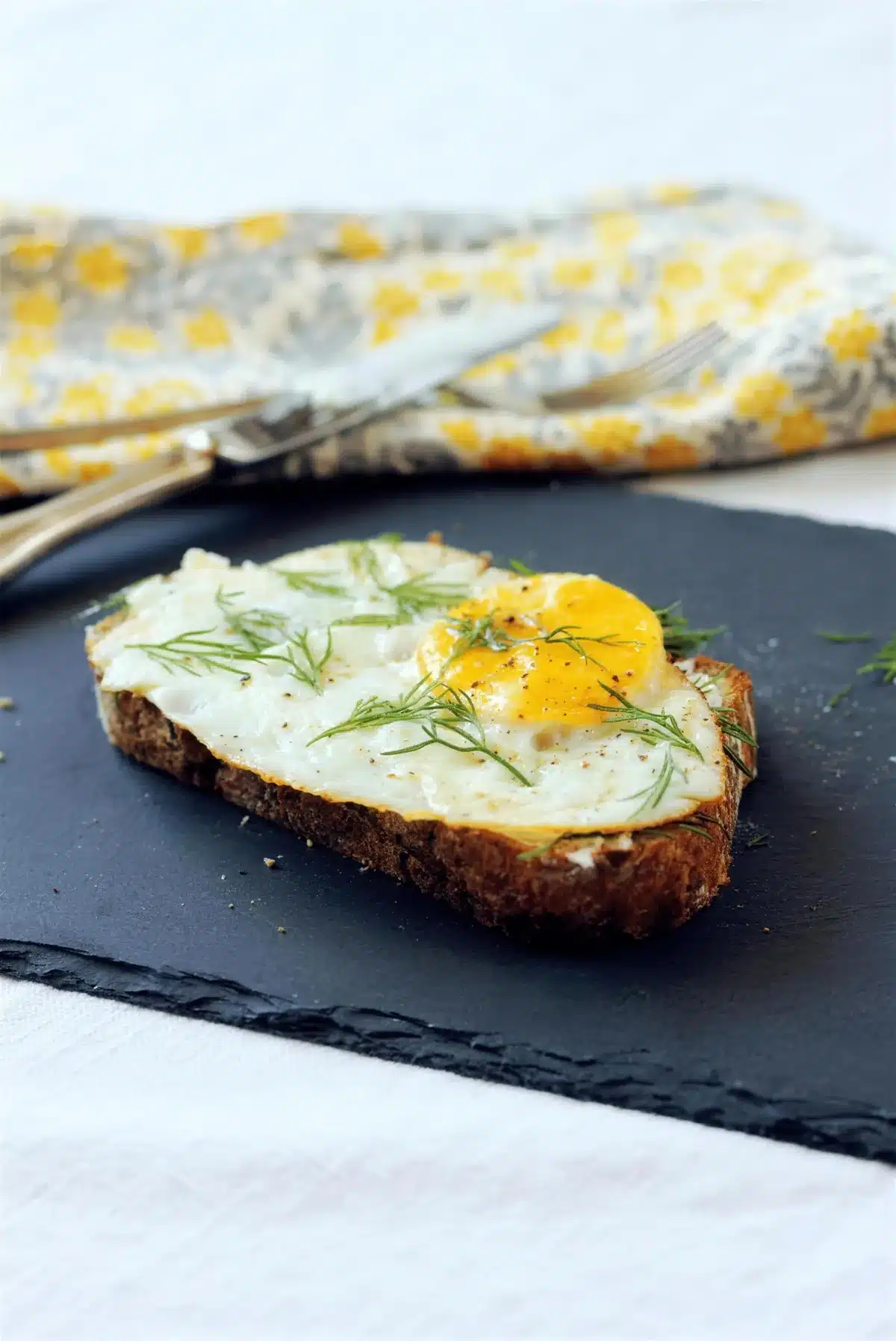
An open faced egg sandwich is what happens when you admit that the second slice of bread was never doing anything useful. One slice, toasted hard, spread with goat cheese while it is still hot, and a fried egg laid over the top with the yolk still liquid.
I ate this open faced egg sandwich most mornings for a whole summer and never got tired of it, which is unusual for something that takes eight minutes. The reason is the cheese. Goat cheese spread onto hot toast melts into the surface and seals the crumb, so the bread stays crisp underneath a runny yolk instead of turning to paste the way plain toast does. Dill on top is not decoration either. It is sharp and grassy and it cuts the richness of the yolk and the cheese together.
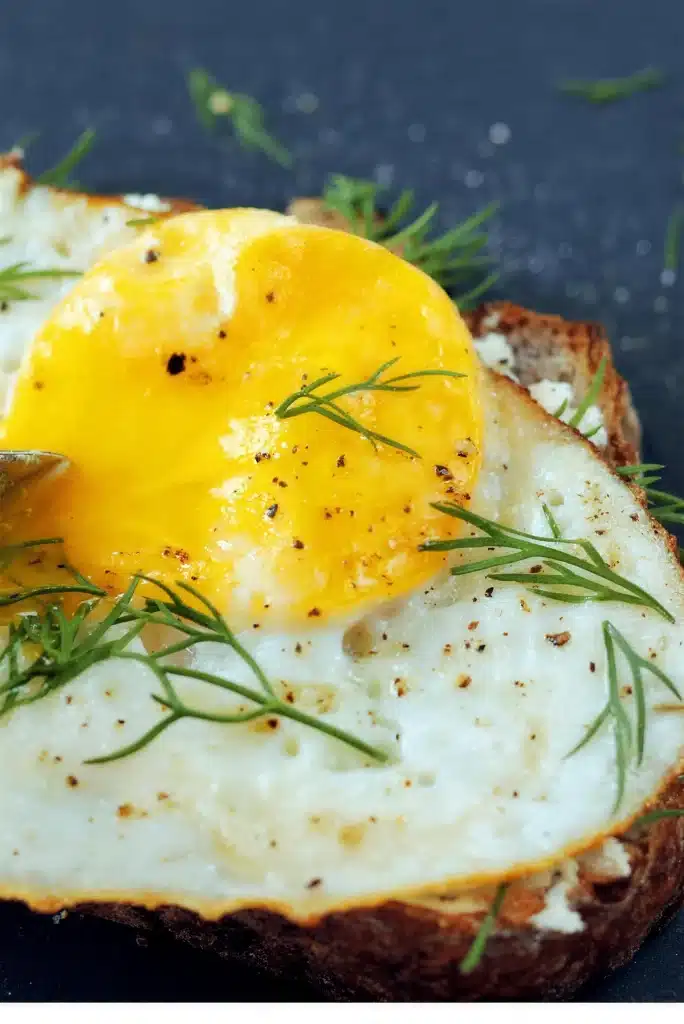
- Eight minutes from cold pan to plate, with one pan and one toaster
- Four ingredients you probably already have, and none of them are unusual
- The goat cheese waterproofs the toast, so it stays crisp under the yolk
- It works as breakfast, as lunch, or as the thing you eat standing up at eleven at night
- Nothing is chopped, measured or preheated for longer than the toast takes
- One slice of bread means the yolk is the point rather than a filling

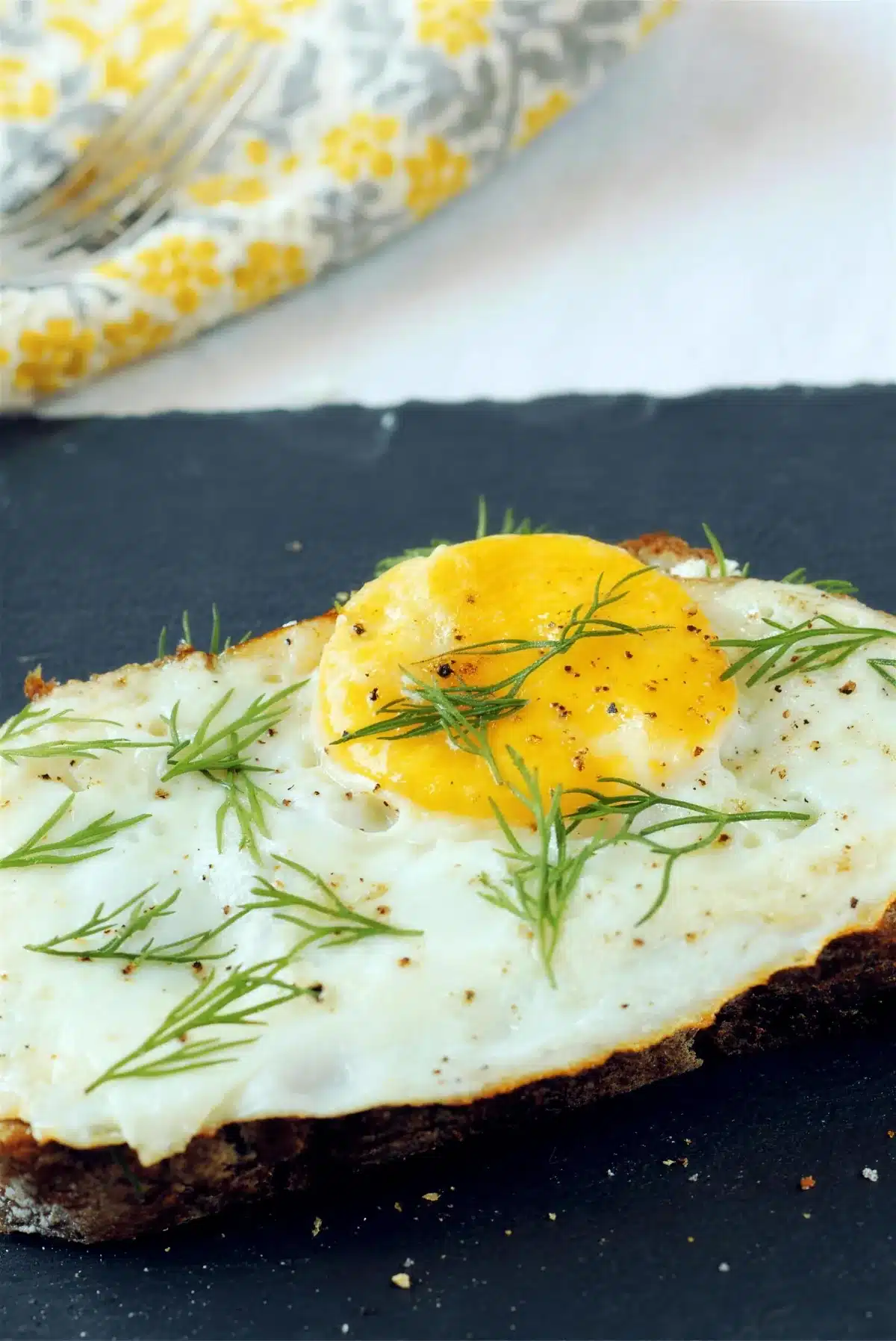
Everything below assumes you want the yolk liquid and the toast still crunchy when it reaches the table.
- What Makes an Open Faced Egg Sandwich Work
- Ingredient Notes
- Choosing the Bread
- How To Make an Open Faced Egg Sandwich
- How To Fry the Egg So the Yolk Stays Runny
- Making an Open Faced Egg Sandwich Ahead
- Turning It Into a Closed Fried Egg Sandwich
- Variations and Substitutions
- What to Serve with an Open Faced Egg Sandwich
- Open Faced Egg Sandwich FAQ
What Makes an Open Faced Egg Sandwich Work
A fried egg on toast is not a recipe. An open faced egg sandwich is, because three small decisions separate the good version from the sad one.
The cheese goes on hot. Spread goat cheese onto toast straight out of the toaster and it softens, sinks a little way into the open crumb and sets there as a barrier. Spread it onto cool toast and it sits on top as a cold lump, and the yolk soaks straight through to the bread.
The toast has to be darker than you think. A pale slice has no structure. It bends under the egg and goes limp in about a minute. Take it to a solid brown so the surface is genuinely crisp, because that crust is the only thing standing between a liquid yolk and a soggy plate.
The egg is fried, not poached or scrambled. A fried egg brings a lacy, browned edge and a set white, and that contrast against soft cheese is most of the pleasure. Poaching gives you two soft things on one crisp thing, which is less interesting.
Get those three right and this open faced egg sandwich stops being toast with an egg on it.
Save this recipe
Enter your email and I’ll send this recipe straight to your inbox.
Ingredient Notes

Five things go into an open faced egg sandwich and two of them do all the work. Exact amounts are in the recipe card below.
- Bread: one thick slice per person of something with structure. Sourdough, a seeded country loaf or a walnut bread all hold up. Sandwich bread collapses.
- Goat cheese: a soft, fresh log, about 3 tablespoons for two slices. Take it out of the refrigerator ten minutes ahead so it spreads without tearing the toast.
- Fresh dill: torn, not chopped, so the fronds stay feathery. Chopping bruises it and turns it grassy in a dull way rather than a bright one.
- Eggs: the freshest you can find. Fresh whites hold together in the pan and spread less, which matters when the egg has to sit on a slice of bread. The American Egg Board’s nutrition breakdown puts a large egg at roughly 70 calories with 6 grams of protein, most of it in the white.
- Butter: 2 teaspoons for two eggs in a nonstick pan. More than that and the whites fry rather than set, and you lose the tender edge.
- Flaky salt and black pepper: salt the cheese, then salt the egg again at the end. Two small seasonings taste better than one large one.
A nonstick skillet, a toaster and a spatula are the whole equipment list.
Choosing the Bread
Bread is the only ingredient in an open faced egg sandwich that can ruin the whole thing, so it is worth thirty seconds of thought.
Thickness matters more than variety. Cut at about 3/4-inch. Thinner and the slice has no thermal mass, so it goes cold and floppy under a hot egg. Thicker and you are eating mostly bread.
An open crumb is an advantage. Big irregular holes give the softened cheese somewhere to go. A tight, fine crumb keeps the cheese sitting on the surface.
Stale is better than fresh. Day-old bread toasts drier and crisper because there is less water to drive off. A loaf straight from the bakery steams inside its own crust.
Skip anything sweet. Brioche, challah and raisin bread all fight the goat cheese. Save them for french toast.
Toast it last. Toast goes soft on a plate faster than almost anything, so start it when the pan is already hot rather than before.
How To Make an Open Faced Egg Sandwich
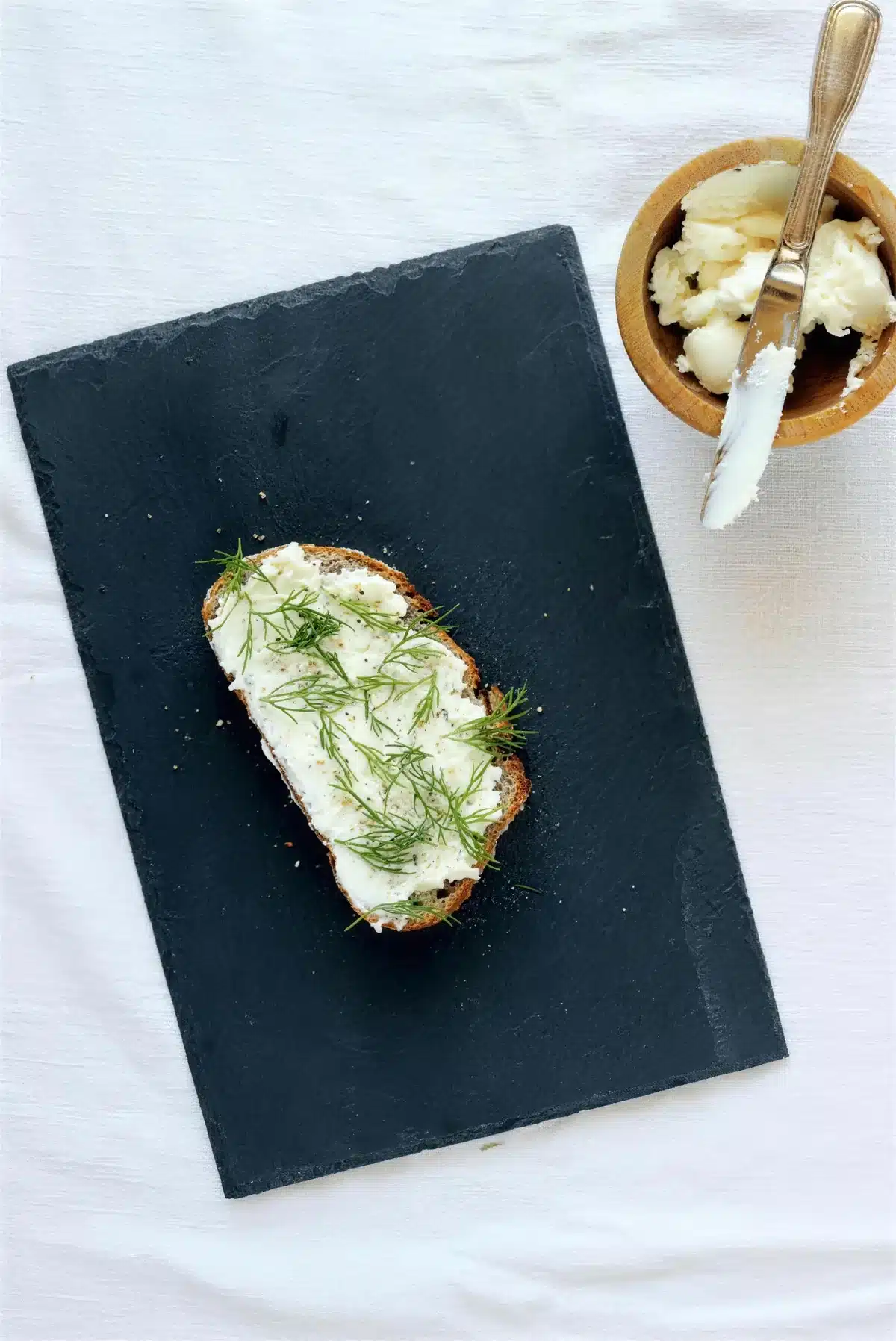
The whole open faced egg sandwich is two things happening at once, so read it through before you start the toaster.
- First, set a nonstick skillet over medium heat with the butter in it, and drop the bread into the toaster at the same time. The pan needs about two minutes to come up to temperature.
- Next, when the toast is a solid brown, spread the goat cheese straight onto the hot surface, right to the edges, and season it with flaky salt, pepper and about half the dill.
- Then crack the eggs into the foaming butter and let them sit undisturbed for about 90 seconds, until the whites have gone opaque and the edges have taken on a little color.
- After that, cover the pan for 30 to 45 seconds. The trapped steam sets the top of the white without ever touching the yolk, which is the whole trick.
- Finally, slide each egg onto its slice, season again, and scatter over the rest of the dill. Eat it standing up if you like, but eat it now.
How To Fry the Egg So the Yolk Stays Runny
The egg is the part people get wrong, and it is almost always a heat problem rather than a timing problem.
Medium heat, not high. High heat browns the underside of the white before the top has set, so you end up flipping it and breaking the yolk. Medium gives you a set white and a crisp edge in about two minutes.
Do not touch it for the first 90 seconds. Nudging the egg tears the white while it is still loose and spreads it into a thin, papery skirt.
Use the lid instead of a flip. Thirty to forty-five seconds under a lid sets the film of white on top of the yolk. The yolk itself stays liquid because steam at that temperature reaches it far more slowly than direct contact with the pan would.
Judge it by the white, not the clock. When the white is completely opaque with no clear jelly left around the yolk, it is done. Any translucent patch means it needs another twenty seconds.
If you want a firmer yolk, leave the lid on for a full 90 seconds, which gives you a jammy center that still runs slowly.
Making an Open Faced Egg Sandwich Ahead
You cannot make this ahead, and pretending otherwise would be dishonest. What you can do is get everything to the point where assembly takes eight minutes flat.
The cheese: up to a week. Mash the goat cheese with the dill, a little olive oil, salt and pepper and keep it in a small jar. It is better on day two than on day one and it turns an open faced egg sandwich into a two-step job.
The bread: slice it when you buy it. Cut the whole loaf into 3/4-inch slices, freeze them flat in a bag and toast from frozen. They toast better than refrigerated bread, which goes stale faster than either fresh or frozen.
The dill: three days. Stand the stems in a glass of water in the refrigerator with a bag over the top.
What does not survive is the assembled thing. Ten minutes after it is built the toast has absorbed yolk and the crust has gone leathery, so build it at the last possible moment.
Turning It Into a Closed Fried Egg Sandwich
Sometimes you want something you can carry, and an open faced egg sandwich closes up fine with two changes.
Toast both slices and butter the outsides. A closed sandwich traps steam, so the exterior needs to be dry and hot.
Cook the yolk to jammy, not runny. A liquid yolk in a closed sandwich ends up on your sleeve. Ninety seconds under the lid gets it to the point where it thickens rather than pours.
Add something sharp. Closing the sandwich mutes everything, so a smear of dijon or a few drops of hot sauce on the second slice restores the contrast the open version gets from the dill sitting on top.
Press it briefly. Thirty seconds in the still warm pan under a small plate welds it together and it travels.
Variations and Substitutions
The toast, the soft cheese and the fried egg are the structure of an open faced egg sandwich. Everything else moves.
- Swap the cheese: ricotta, whipped feta or a soft blue all work. Cream cheese is the one to avoid, because it never softens into the crumb.
- Swap the herb: tarragon with a little lemon zest, chives, or basil in high summer.
- Add heat: a pinch of urfa or aleppo pepper over the yolk, or chili crisp if you have it.
- Add something green underneath: a handful of arugula or watercress between the cheese and the egg, dressed with nothing but the yolk.
- Make it richer: a slice of prosciutto or a spoonful of the chorizo from my Mexican chorizo hash under the egg.
- Make it a crostini board: cut the bread small, quail eggs on top, in the spirit of my roasted fennel and white bean crostini.
What to Serve with an Open Faced Egg Sandwich
An open faced egg sandwich is rich and small at once, so it wants something acidic or something bulky beside it.
- A handful of dressed bitter leaves, which is the classic answer and still the best one.
- Roasted or fried potatoes, if this is standing in for a full breakfast.
- Sliced tomatoes with salt, from about July onward.
- Cold beer, oddly, more successfully than coffee, when this is lunch rather than breakfast.
- A second egg cooked the same way, since the pan is already hot and nobody has ever regretted it.
- Or scale the whole idea up for a crowd with a tray of toaster oven eggs and let people build their own.
Here is what readers ask most often.
Open Faced Egg Sandwich FAQ
Frequently Asked Questions
Why does the toast go soggy under the egg?
Because the yolk reached the bread. The fix is the goat cheese, spread onto the toast while it is still hot so it melts into the surface and seals the crumb. Take the toast darker than you normally would as well, and spread the cheese right to the edges rather than leaving a bare border for the yolk to find. Assemble at the table, not at the stove.
Can I use a different cheese in an open faced egg sandwich?
Any soft, spreadable, slightly acidic cheese works. Ricotta, whipped feta and fresh chevre all behave the same way on hot toast. What does not work is anything that stays firm, because it will not sink into the crumb and seal it, and anything sweet or very mild, because the yolk simply swallows it.
How do I keep the yolk runny but cook the white through?
Cover the pan for the last 30 to 45 seconds. Steam sets the thin film of white on top of the yolk without cooking the yolk itself, so you never have to flip the egg. Judge it by looking: when there is no clear jelly left anywhere around the yolk the white is done, whatever the clock says.
More Questions About Eggs and Toast
Good to Know
Is one slice really enough?
For breakfast, yes, and that is rather the point. One thick slice of a real loaf with an egg and cheese on it comes to about 300 calories and eats like a proper meal. If it is standing in for lunch, make two, or serve it with potatoes and a salad. Two open slices are more satisfying than one closed sandwich built from the same amount of bread.
Can I scramble the egg instead?
You can, and it becomes a different and perfectly good breakfast, but you lose the contrast that makes an open faced egg sandwich worth doing. If you are going that way, fold the goat cheese through the eggs off the heat rather than spreading it on the toast, and pile them on. Separating the yolks first is easier than it sounds if you follow the three-bowl method.
What size skillet should I use?
An 8-inch nonstick pan for two eggs, so they have room to spread without running into each other. A 10-inch pan works and needs an extra teaspoon of butter to keep the whites from catching at the edges. Anything larger and the butter thins out and browns before the eggs go in.
Nobody needs a recipe to fry an egg, but this particular open faced egg sandwich is better than the sum of its parts, and the reason is entirely the order you do things in. For the other end of the same idea, a whole tray of eggs and potatoes at once, try my chorizo hash with crispy potatoes.

Open Faced Egg Sandwich with Goat Cheese and Dill
Save this recipe
Enter your email and I’ll send this recipe straight to your inbox.
Ingredients
The Toast
- 2 slices rustic sourdough or seeded country bread cut about 3/4-inch thick
- 3 tablespoons soft goat cheese at room temperature
- 1 teaspoon extra virgin olive oil optional, for the cheese
- 2 tablespoons fresh dill torn into small fronds, not chopped
- 1/4 teaspoon flaky sea salt divided
The Fried Egg
- 2 large eggs as fresh as you can find
- 2 teaspoons unsalted butter
- 1 pinch kosher salt
- 1/8 teaspoon black pepper freshly ground
Equipment
- Nonstick Pan
- Toaster
Instructions
Toast and Spread
- Set an 8-inch nonstick skillet over medium heat with the butter in it, and drop the bread into the toaster at the same moment. The pan needs about two minutes to come up to temperature and the toast takes about the same.
- When the toast is a solid brown, spread the goat cheese onto the hot surface right to the edges, working it in with the back of a spoon. Trickle over the olive oil if you are using it, then season with half the flaky salt, a grind of pepper and half the dill.
Fry the Egg and Finish
- Crack the eggs into the foaming butter and leave them undisturbed for about 90 seconds, until the whites have turned opaque and the edges have taken a little color. Season the whites with the kosher salt and the rest of the pepper.
- Cover the pan for 30 to 45 seconds so the steam sets the thin film of white over each yolk. Check by eye rather than by clock: no clear jelly should be left anywhere around the yolk. For a jammy yolk, leave the lid on for a full 90 seconds.
- Slide an egg onto each slice, scatter over the rest of the dill and the remaining flaky salt, and eat immediately. The toast starts softening from the moment the yolk lands on it.