
The whole recipe for french crepes is a ratio you can hold in your head: 100 grams of flour, 300 milliliters of milk, 3 eggs. Salt, a spoonful of sugar and a little melted butter finish it, and there is nothing else.
That is the version taught in French home kitchens, and it is why nobody there owns a crepe recipe card. Once the numbers are in your memory you can scale up for a crowd on the spot, and the batter comes together with a whisk in about four minutes. Everything difficult about crepes happens afterwards, at the pan, and almost all of it is solved by resting the batter and by accepting that the first one is going in the trash.
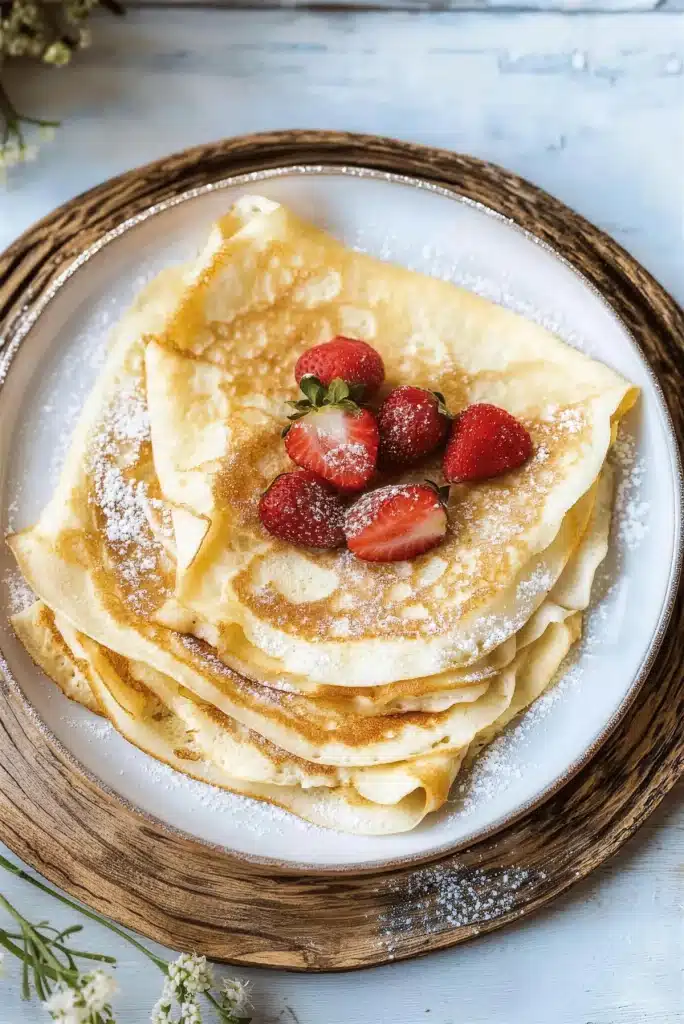
- Four core ingredients, all of them already in the kitchen
- A ratio simple enough to memorize and scale without a recipe
- No blender needed, just a bowl and a whisk
- Sweet or savory from the same batter, with one small change
- They stack, refrigerate and freeze better than any pancake
- Around forty seconds a side once the pan is hot


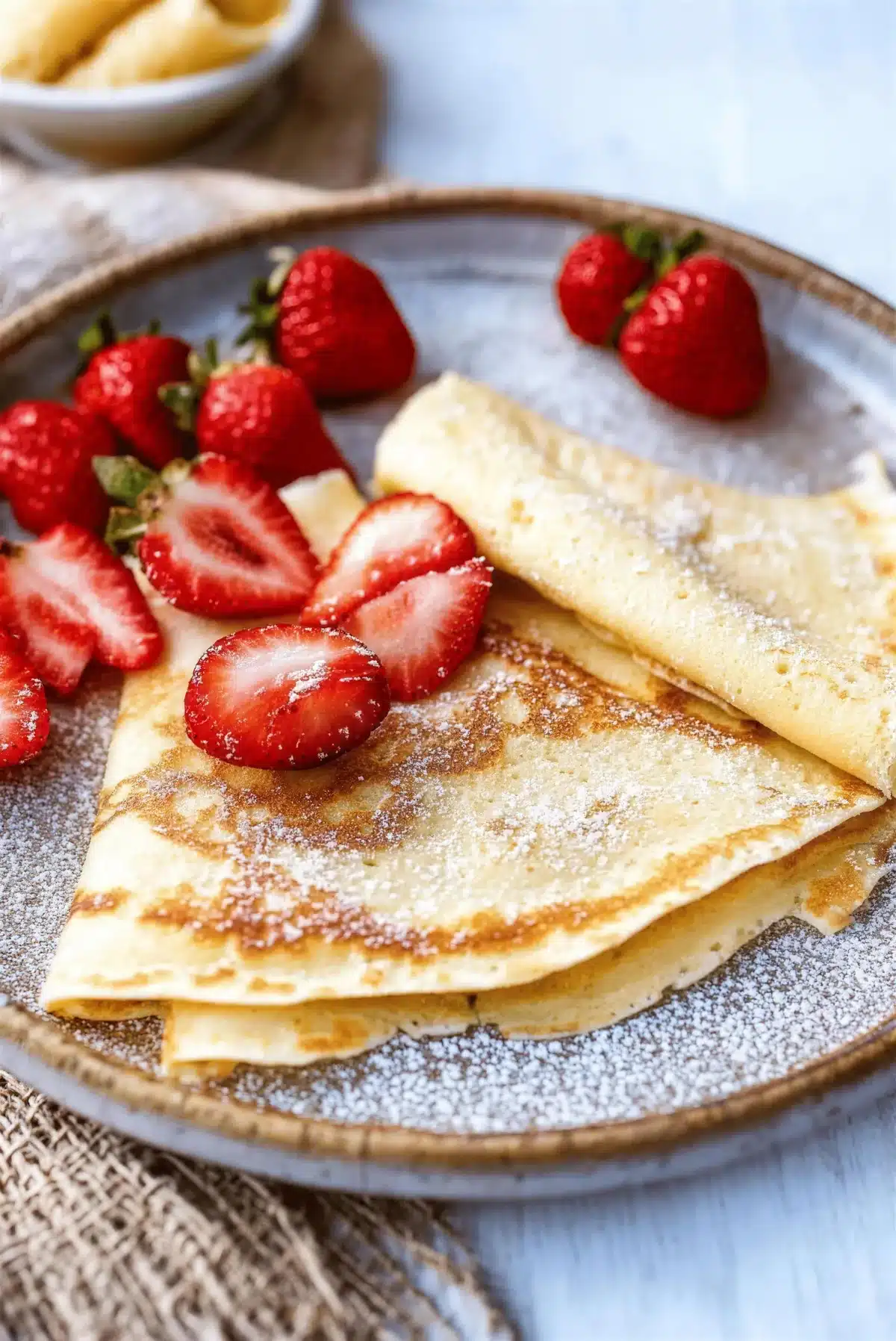
Makes about seven thin crepes in a 10-inch pan, which is two people for breakfast or four as dessert.
- Are Crepes French, and Where Do They Come From?
- French Crepes vs Pancakes
- Ingredient Notes
- The Ratio Behind French Crepes
- How To Make French Crepes
- Resting the Batter
- How To Tell When French Crepes Are Done
- Can You Make Crepes with Pancake Mix?
- Fillings, Sweet and Savory
- Make It Ahead
- Storing French Crepes
- Variations and Substitutions
- What to Serve with French Crepes
- La Chandeleur, the Day France Eats French Crepes
- French Crepes FAQ
Are Crepes French, and Where Do They Come From?
Crepes are French, and specifically Breton. Brittany has been making them since buckwheat arrived in the region in the thirteenth century, and the distinction the rest of the world flattens is worth keeping.
A galette de sarrasin is buckwheat, unsweetened, savory, and traditionally filled with ham, cheese and an egg. A crepe de froment is wheat flour, lightly sweetened, and the one you fill with sugar, lemon, jam or chocolate. In Brittany they are two different foods with two different meals attached to them.
What traveled abroad was the wheat one, which is what this recipe makes. The word itself comes from the Latin crispa, meaning curled or crimped, which describes the lacy browned edge you are aiming for rather than the smooth center.
Save this recipe
Enter your email and I’ll send this recipe straight to your inbox.
French Crepes vs Pancakes
The difference is not thickness. The difference is that french crepes contain no chemical leavening at all.
An American pancake has baking powder, a thick batter and a short rest, and the whole design is aimed at trapping bubbles so it rises. A crepe batter is deliberately thin, closer to heavy cream than to a pourable dough, and it has nothing in it to make it puff. It sets into a flexible sheet rather than a cake, which is why it can be folded, rolled or stacked.
Crepes also run far higher on egg, roughly three times the proportion a pancake carries, which is what gives them their tenderness and pale gold color.
The practical consequence is heat. Pancakes want a medium pan and patience while the middle cooks through. French crepes want a properly hot pan and about forty seconds, because there is no interior to cook. If you like the thicker style too, my sheet pan pancakes take the opposite approach entirely.
Ingredient Notes
There are six things in the bowl and every one of them earns its place.
- All-purpose flour: 100 grams. The Wheat Foods Council’s guide to the types of wheat flour puts all-purpose in the middle of the protein range, which is what you want here: enough gluten to hold a paper-thin sheet together, not so much that it turns rubbery.
- Whole milk: 300 milliliters. Skim gives you a paler, more fragile crepe. Half milk and half water is the traditional Breton trick for an even thinner result.
- Eggs: Three large. They are the structure, the color and the tenderness all at once.
- Melted butter: 30 milliliters in the batter, which means you barely have to grease the pan between crepes.
- Sugar: 20 grams, enough to brown properly. Drop it to a teaspoon for savory fillings, because it is browning rather than sweetness that you would lose.
- Salt: A pinch, and do not leave it out. Unsalted crepes taste of nothing.
The Ratio Behind French Crepes
Write down 100, 300, 3 and you never need this page again.
One hundred grams of flour, three hundred milliliters of milk, three eggs. That makes seven crepes in a 10-inch pan. Double it for fourteen, triple it for a party, and the numbers stay just as easy.
The ratio matters more than the measurements, which is the argument for weighing the flour. A cup of scooped flour can vary by twenty percent, and twenty percent is the difference between a lacy crepe and a leathery one. Without a scale, spoon the flour into the cup and level it rather than dipping.
Consistency is the real test. The batter should coat a spoon and run off quickly, about the thickness of heavy cream. Too thick and it will not swirl to the edges; too thin and it tears.

How To Make French Crepes
Mix, rest, then cook fast. The active time is under twenty minutes.
- First, whisk the flour, sugar and salt together in a bowl, crack in the eggs and whisk until completely smooth before any milk goes near it. Lumps form when flour meets liquid too fast, and this order prevents them.
- Next, pour the milk in gradually while whisking, then whisk in the melted butter. The batter should be thin enough to run off the whisk in a ribbon.
- Then cover the bowl and rest it for at least 30 minutes at room temperature, or overnight in the fridge.
- After that, heat a 10-inch nonstick or seasoned pan over medium heat and wipe it with a little butter. A drop of batter should sizzle on contact.
- Pour in a scant quarter cup, lift the pan off the heat and swirl immediately so the batter runs to the edges in a thin, even sheet.
- Cook for 40 to 50 seconds, until the edges lift and turn lacy brown, then flip with a thin spatula or your fingers and give it 30 seconds more.
- Finally, slide it onto a plate and stack the rest on top as they come. They steam each other soft, which is exactly what you want.
Why the First Crepe Never Works
The fix is patience with the pan rather than with the batter. Give it a full two minutes of preheating, wipe out any pooled butter with a paper towel, and adjust the heat after the first one rather than before.
Resting the Batter
Thirty minutes is the minimum and it is the step with the highest return for the least effort.
Two things happen while it sits. The flour hydrates completely, so any small lumps dissolve on their own and the batter thickens slightly as the starch swells. And the gluten you developed while whisking relaxes, which is what stops the cooked crepe from shrinking back and turning chewy.
An overnight rest in the fridge is better still, and it makes french crepes a genuine weekday breakfast. Whisk the batter after a cold rest, since the butter will have separated slightly, and let it lose its chill for ten minutes before the first pour.
Within two days there is no upper limit worth worrying about. Beyond that the batter turns sour.
How To Tell When French Crepes Are Done
With french crepes you are watching the edges, not the clock.
The first side is ready when the border dries out, curls up from the pan and turns a lacy golden brown, while the top surface changes from wet and glossy to matte. Slide a thin spatula under an edge and it should release with no resistance at all. If it drags, give it another ten seconds.
The second side needs about thirty seconds and will never brown evenly. It goes blotchy, pale gold in patches, and that is correct. The Breton name for the first side is the good side, and it is the one that faces out when you fold.
Two failure modes to watch for. Pale and floppy after a minute means the pan is not hot enough. Dark and brittle in under thirty seconds means it is too hot, so pull it off the burner for a moment rather than turning the dial down and waiting.
Can You Make Crepes with Pancake Mix?
You can, and the result is a decent thin pancake rather than a crepe. It is worth knowing exactly what you are trading.
Boxed mix contains baking powder, which is the one thing a crepe batter must not have. The batter will puff slightly, the texture goes cakey rather than silky, and the sheet is less flexible when you fold it. Some of that can be mitigated but none of it can be removed.
If you are doing it anyway, use roughly one cup of dry mix, two eggs and one and a quarter cups of milk, rested for twenty minutes so the leavening partly exhausts itself, plus a tablespoon of melted butter.
The honest advice is that proper french crepes need flour, milk and eggs you already own, and four minutes of whisking. The mix saves you nothing.
Fillings, Sweet and Savory
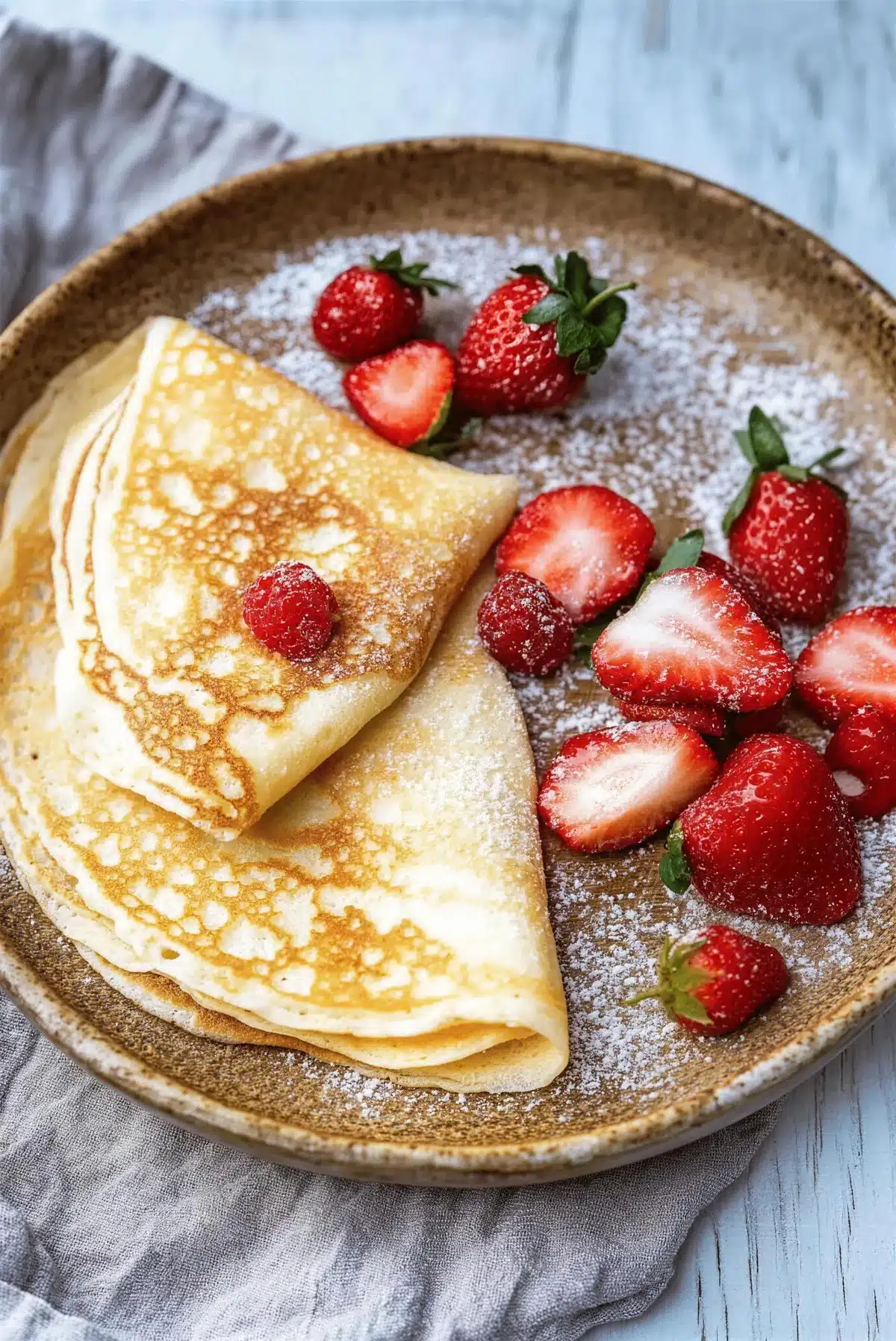
The classic filling for french crepes is the simplest: sugar and a squeeze of lemon, folded into quarters and eaten with your hands.
- Sucre citron: granulated sugar and lemon juice, the standard order at every street stall in Paris.
- Chocolate: a spoonful of chocolate hazelnut spread while the crepe is still hot in the pan, so it melts. The same flavor turns up in my Nutella brownies.
- Fruit and cream: macerated strawberries or roasted apple with whipped cream or creme fraiche.
- Salted caramel: the Breton one, made with their salted butter, and the most convincing argument for the region.
- Complete: the savory standard, with ham, grated gruyere and an egg cracked into the middle as it finishes.
- Mushroom and cheese: sauteed mushrooms with thyme and a soft cheese, folded into a square.
Make It Ahead
Almost every part of french crepes can be handled in advance, which is why creperies work at all.
The batter keeps in the fridge for up to two days, covered, and improves for the first twelve hours. Whisk it before use and let it warm up for ten minutes.
Cooked crepes hold for hours at room temperature under a clean cloth, stacked. They will not dry out because each one is sealed by the next, and they are perfectly good lukewarm with a cold filling.
For a brunch, cook the whole batch the day before, refrigerate the stack wrapped in plastic, then warm the pile in a low oven for ten minutes while people arrive. Nobody wants to stand at a pan while their guests eat in shifts.
Storing French Crepes
They store better than almost any other breakfast, which is worth exploiting.
- Fridge: stacked, wrapped in plastic, up to 3 days. No parchment needed between them.
- Freezer: up to 2 months, with parchment squares between each one so you can take out four.
- Reheating: fifteen seconds a side in a dry pan, or thirty seconds in the microwave under a damp paper towel.
- Batter: 2 days refrigerated. Do not freeze it, since the emulsion breaks and never comes back.
Variations and Substitutions
The ratio survives most substitutions, so treat these as departures rather than compromises.
- Buckwheat galettes: swap all the flour for buckwheat, drop the sugar entirely and use water in place of half the milk.
- Dairy-free: oat or almond milk and a neutral oil for the butter, which works with almost no change in texture.
- Gluten-free: a cup-for-cup blend, rested for a full hour so the starches hydrate.
- Blender method: everything in at once for thirty seconds, then rest as usual to let the foam settle.
- Boozy: a tablespoon of dark rum, Grand Marnier or Calvados in the batter, which is standard in France and makes the kitchen smell wonderful.
- Herbed savory: a tablespoon of chopped chives or parsley whisked in after the rest, for galettes and savory fillings.
What to Serve with French Crepes
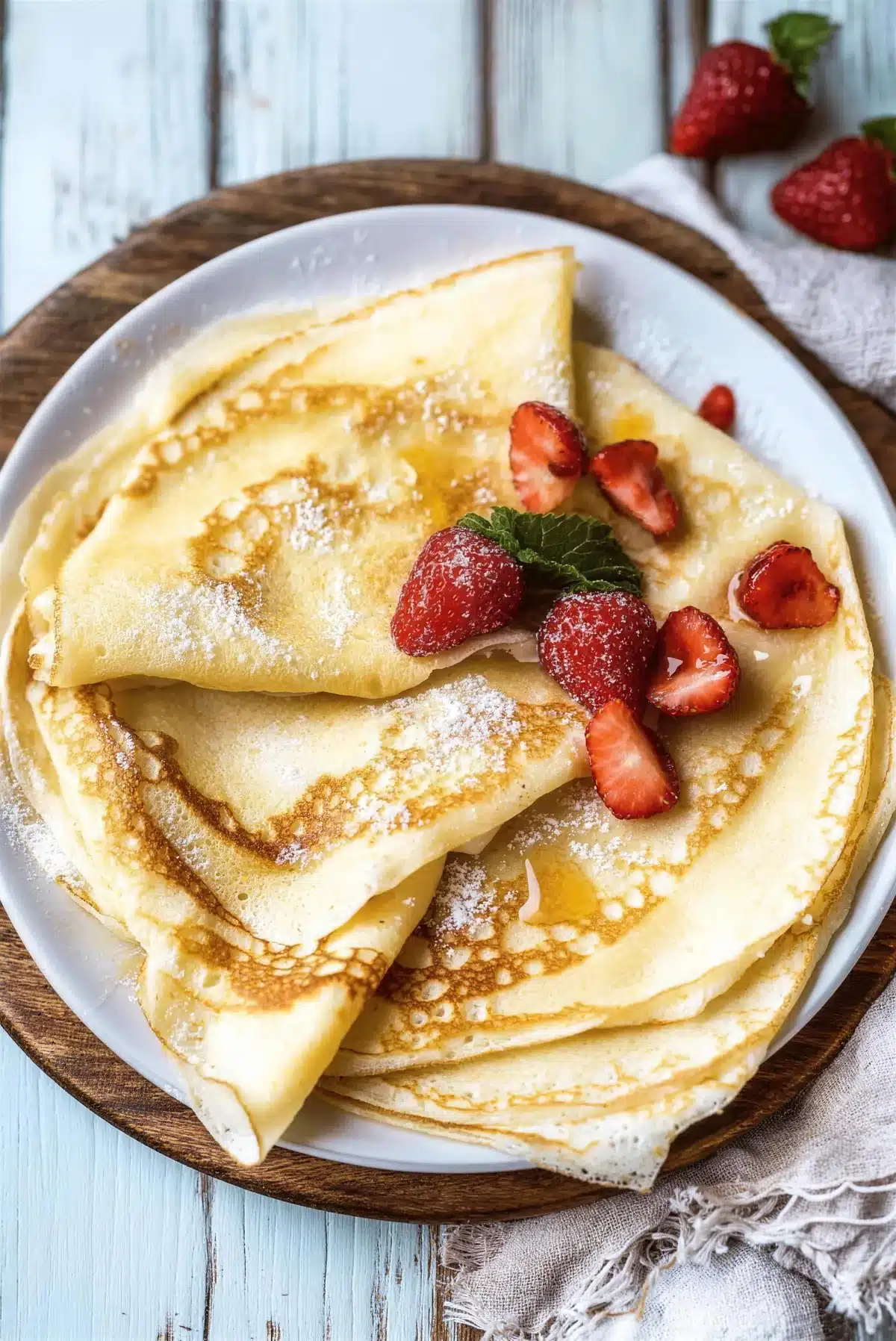
For a proper brunch, build around them rather than serving them alone.
- Cider from Brittany, dry and served in a ceramic bowl, which is the traditional pairing with galettes.
- Something cold and sharp for the table, like a jug of boozy mint lemonade.
- A savory anchor if you are feeding a crowd, such as a breakfast grilled cheese for the people who do not want anything sweet.
- Strong coffee, and a bowl of berries with nothing on them.
La Chandeleur, the Day France Eats French Crepes
Every February 2nd, France eats crepes for Candlemas, and the tradition is odd enough to be worth knowing.
The round golden shape is usually explained as a symbol of the returning sun after winter, and there is a farming story attached about using up the last of the previous year’s flour before spring sowing. Either way, on that day creperies queue out of the door and supermarkets stack pallets of flour by the entrance.
The superstition is the good part. You hold a coin in your left hand and flip the crepe with your right, and if it lands cleanly the household has money all year. That is why so many French adults can flip a crepe and so few tourists can.
None of it affects how french crepes are made. It is simply why the recipe is so widely known in France that nobody writes it down.
Here is what readers ask most often about french crepes.
French Crepes FAQ
Frequently Asked Questions
Why are my crepes rubbery?
Almost always too much gluten development and not enough rest. Whisking hard and then cooking immediately leaves the gluten tight, so the sheet contracts in the pan and turns chewy. Rest the batter for a full thirty minutes, and if you use a blender, rest it for an hour. The other cause is too much flour from scooping rather than weighing.
Do I have to rest the batter?
Yes, if you want the texture right. Thirty minutes lets the flour hydrate fully and the gluten relax, and the difference is obvious side by side. If you are genuinely out of time, a blender for thirty seconds followed by a ten-minute rest is the least bad shortcut.
What pan should I use?
A 10-inch nonstick skillet with low sloping sides is ideal, and a well-seasoned carbon steel pan is better still once you are practiced. A dedicated crepe pan is genuinely unnecessary. What matters is a flat base, sides low enough to get a spatula under, and even heat.
More Questions About Crepes
Good to Know
How many crepes does this make?
About seven in a 10-inch pan. As a rule of thumb, count three per person for a main course, two for dessert and four for a hungry teenager. The ratio doubles and triples cleanly, so scale the flour first and follow it with the milk and eggs.
Can I make the batter the night before?
Yes, and it will be better for it. Cover it and refrigerate for up to two days. Whisk it before you cook, because the melted butter separates when cold, and let it sit out for ten minutes so the first crepe is not fighting a chilled pan.
Sweet or savory from the same batter?
Both, with one change. Cut the sugar to a teaspoon for savory fillings, keep the pinch of salt, and add chopped herbs after the rest if you want them. Do not remove the sugar altogether, since a little is what gives you the browning.
Why is my second side blotchy?
Because it always is. The first side sits in an even film of fat and browns smoothly, while the second cooks on a surface that is already partly dry. Blotchy pale gold is correct, and that side goes on the inside when you fold.
Get the ratio into your head and crepes stop being a project. For another brunch bake that runs on the same short list of ingredients, try my lemon poppyseed scones.
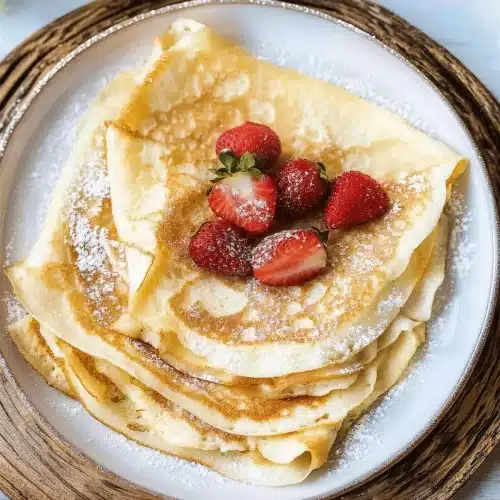
French Crepes
Save this recipe
Enter your email and I’ll send this recipe straight to your inbox.
Ingredients
For the Batter
- 100 grams all-purpose flour about 3/4 cup plus 1 tablespoon
- 20 grams granulated sugar about 1 1/2 tablespoons
- 1 pinch fine salt
- 3 large eggs
- 300 ml whole milk about 1 1/4 cups
- 30 ml unsalted butter melted and cooled, about 2 tablespoons
For Cooking and Serving
- 1 tablespoon unsalted butter softened, for wiping the pan
- powdered sugar for dusting
- 1 lemon cut into wedges
Equipment
- Mixing bowl
- Whisk
- Measuring cups
- Non-stick pan or cast iron skillet
- Spatula
- Ladle or measuring scoop
Instructions
Mix the Batter
- First, whisk the flour, sugar and salt together in a large bowl. Crack in the eggs and whisk until the mixture is completely smooth before any milk goes near it, which is the order that keeps lumps from forming.
- Next, pour the milk in gradually while whisking, then whisk in the melted butter. The batter should be thin enough to run off the whisk in a ribbon, about the thickness of heavy cream.
Rest the Batter
- Then cover the bowl and rest it for at least 30 minutes at room temperature, or up to 2 days in the fridge. The flour hydrates and the gluten relaxes, which is what stops the cooked crepes shrinking back and turning chewy.
Cook the Crepes
- After that, heat a 10-inch nonstick or seasoned pan over medium heat for a full 2 minutes and wipe it with a little softened butter. A drop of batter should sizzle on contact. Expect the first crepe to come out patchy.
- Pour in a scant 1/4 cup, lift the pan off the heat and swirl straight away so the batter runs to the edges in a thin, even sheet. Cook for 40 to 50 seconds, until the edges lift and turn lacy brown and the surface goes matte.
- Flip with a thin spatula and give the second side 30 seconds. It will brown in blotches rather than evenly, which is correct, and that side goes on the inside when you fold.
Stack and Serve
- Finally, stack them on a plate as they come, so they steam each other soft. Serve dusted with powdered sugar and a squeeze of lemon, or fold around any filling you like.