
Dense, glossy and closer to melted truffle than to any pudding you have had from a box, chocolate pots de creme are the dessert I make when there are two of us and the evening deserves something.
This is a small batch on purpose: three quarters of a cup of cream, one egg yolk, an ounce and a half of bittersweet chocolate and a single teaspoon of sugar. Espresso powder goes in with the cream, not to make it taste of coffee but to make the chocolate taste more like itself. It bakes in a water bath, chills for four hours, and takes about twenty minutes of actual work.
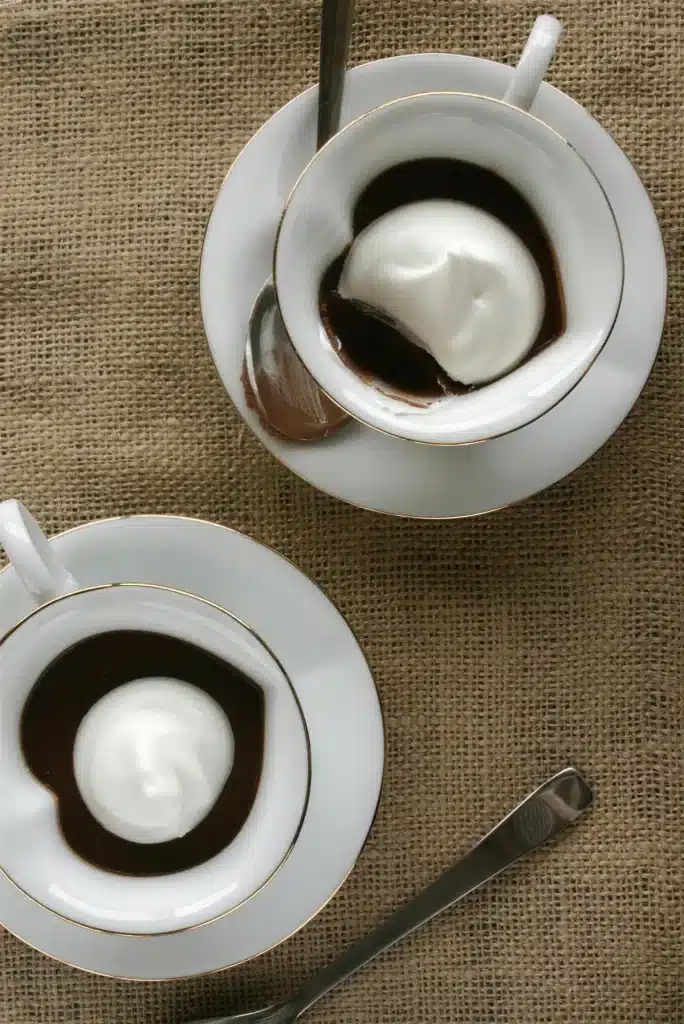
- Five ingredients make chocolate pots de creme, and one is a teaspoon of sugar
- Has to be made ahead, which makes it the easiest dinner party dessert there is
- Baked, not blended, so the texture is silk rather than ganache
- Scaled for two, and it multiplies cleanly for six or eight
- No special dishes needed: teacups, ramekins or small glasses all work
- Barely sweet, because the chocolate is doing the talking

Chocolate pots de creme have a reputation for being temperamental. Most of that comes from stovetop versions, where you are stirring over direct heat and a moment of inattention scrambles the eggs. A water bath in a low oven removes that risk almost entirely, which is why this method is worth the extra dish.
- What Are Chocolate Pots de Creme?
- Pots de Creme vs Pudding, Mousse and Custard
- Ingredient Notes
- How To Make Chocolate Pots de Creme
- Water Bath vs the Blender Method
- How To Tell When Chocolate Pots de Creme Are Done
- Scaling Up to a Dinner Party
- Make It Ahead
- Storing Chocolate Pots de Creme
- Variations and Substitutions
- What to Serve with Chocolate Pots de Creme
- Chocolate Pots de Creme FAQ
What Are Chocolate Pots de Creme?
The name means pots of cream, and it refers to the little lidded porcelain cups the dessert was traditionally baked and served in. Say it roughly as poh-duh-KREM. Written properly it carries a grave accent, pots de crème, and you will see it both ways on menus.
Chocolate pots de creme are a baked custard, one of the oldest desserts in the French repertoire, dating back to seventeenth century France. What sets them apart from other custards is the ratio: far more cream than milk, more yolk than white, and very little sugar.
That richness is why the portions are small. A pot de creme is served in something the size of a coffee cup, and the traditional pots hold about four ounces. Anything larger and it becomes too much of a good thing, which is a real risk with a dessert that is essentially chocolate suspended in cream.
Chocolate pots de creme are the most common version now, though vanilla, coffee, butterscotch and lemon are all classics. The method below works for any of them.
Save this recipe
Enter your email and I’ll send this recipe straight to your inbox.
Pots de Creme vs Pudding, Mousse and Custard
These four names get used interchangeably, and chocolate pots de creme are genuinely a different thing from the other three. The distinction is what sets each one, and it explains why they feel so different in the mouth.
Pots de creme are set by egg yolk alone, gently, usually in the oven. No starch, no gelatin and no whipped anything. That gives a dense, seamless texture that holds the mark of a spoon.
Pudding is set with cornstarch and cooked on the stove. Starch makes it thicker but also slightly cloudy and a little bouncy, and it is why a no-bake pudding comes together in ten minutes rather than five hours.
Mousse is lightened with whipped cream or whipped egg whites folded in at the end. It is aerated, which makes it lighter and paler, and it holds its shape by virtue of the foam rather than by setting.
Baked custard and creme brulee are the near relatives. Creme brulee is essentially the same mixture under a torched sugar crust, and it is usually baked in a shallow dish so there is more surface to caramelize.
Ingredient Notes
Chocolate pots de creme run on five things, so each has to earn its place. Exact amounts are in the recipe card below.
- Heavy cream: Three quarters of a cup, split. Most of it goes into the custard and two tablespoons are held back for the whipped cream on top.
- Bittersweet chocolate: An ounce and a half at around 70 percent, finely chopped. Chop it small, since it melts in residual heat rather than over a flame. Chips resist melting because of the stabilizers in them.
- Egg yolk: One large. It is the only thing setting this, so use a fresh egg and separate it carefully.
- Espresso powder: Half a teaspoon. It will not taste of coffee at this quantity. What it does is deepen the chocolate, the same way salt does in a cookie.
- Sugar: One teaspoon in the custard, and a pinch in the cream if you want it. Bittersweet chocolate already carries sugar, and the point here is depth rather than sweetness.
- Salt: A pinch of coarse salt with the yolk. Leave it out and the whole thing tastes flat.
- Vanilla: A quarter teaspoon, warmed with the cream so it disperses evenly.
You need two teacups or four-ounce ramekins, a baking dish deep enough to hold them, a fine sieve and foil.
How To Make Chocolate Pots de Creme
Chop the chocolate before anything else and have the boiling water ready for the chocolate pots de creme. Everything after that moves in one continuous sequence.
- First, heat the oven to 325 degrees F and bring the cream, espresso powder and vanilla just to a simmer.
- Next, pour the hot cream over the chopped chocolate, leave it for 3 minutes without touching it, then whisk smooth.
- Then whisk the egg yolk, sugar and salt together in a second bowl and add the warm chocolate mixture in a slow, steady stream, whisking the whole time.
- After that, strain the custard through a fine sieve into a measuring jug and let it cool for about 15 minutes, stirring now and then.
- Stand the cups in a baking dish, divide the custard between them, and pour boiling water into the dish until it reaches halfway up their sides.
- Cover the dish tightly with foil, poke several holes in it and bake for about 25 minutes, until set at the edges and still wobbly in the center.
- Finally, lift the cups out, cool on a rack for 1 hour, then refrigerate for at least 4 hours before topping with softly whipped cream.
Tempering the Yolk
Tempering means raising the temperature of the yolk slowly enough that it thickens rather than scrambles. It sounds fussy and takes about ninety seconds.
Egg yolk protein sets between 149 and 158 degrees F, according to the American Egg Board, and sugar raises that threshold slightly. Pour the hot chocolate cream straight onto a cold yolk and the parts it touches first go past that range instantly, which is where those little curds come from.
So keep whisking with one hand and pour with the other, in a thin stream rather than a glug. Once about half the hot mixture is in, the yolk is warm enough that the rest can go faster.
Then strain it anyway. Even a well tempered custard has a few solids in it, and pushing it through a sieve is the cheapest insurance in the recipe.
Water Bath vs the Blender Method
There is a popular shortcut where hot cream is poured over chocolate and egg yolks in a blender and the whole thing is chilled without baking. It works, and it is fast. It is also a different dessert.
The blender version sets mostly because chocolate is solid at room temperature, so what you get is closer to a soft ganache: smooth, but with a slight waxiness on the palate and a texture that firms up hard in the fridge.
Baking in a water bath sets the yolk instead. Water cannot exceed its boiling point, so the custard around it climbs slowly and evenly to setting temperature and stops there. That is what gives baked chocolate pots de creme their particular quality, dense and yielding at the same time, and it is why the difference is worth an extra dish and twenty-five minutes.
Two details make the water bath work. Pour the water in after the cups are in the oven if you are nervous about splashing, and cover the dish tightly with foil so no skin forms on top.
How To Tell When Chocolate Pots de Creme Are Done
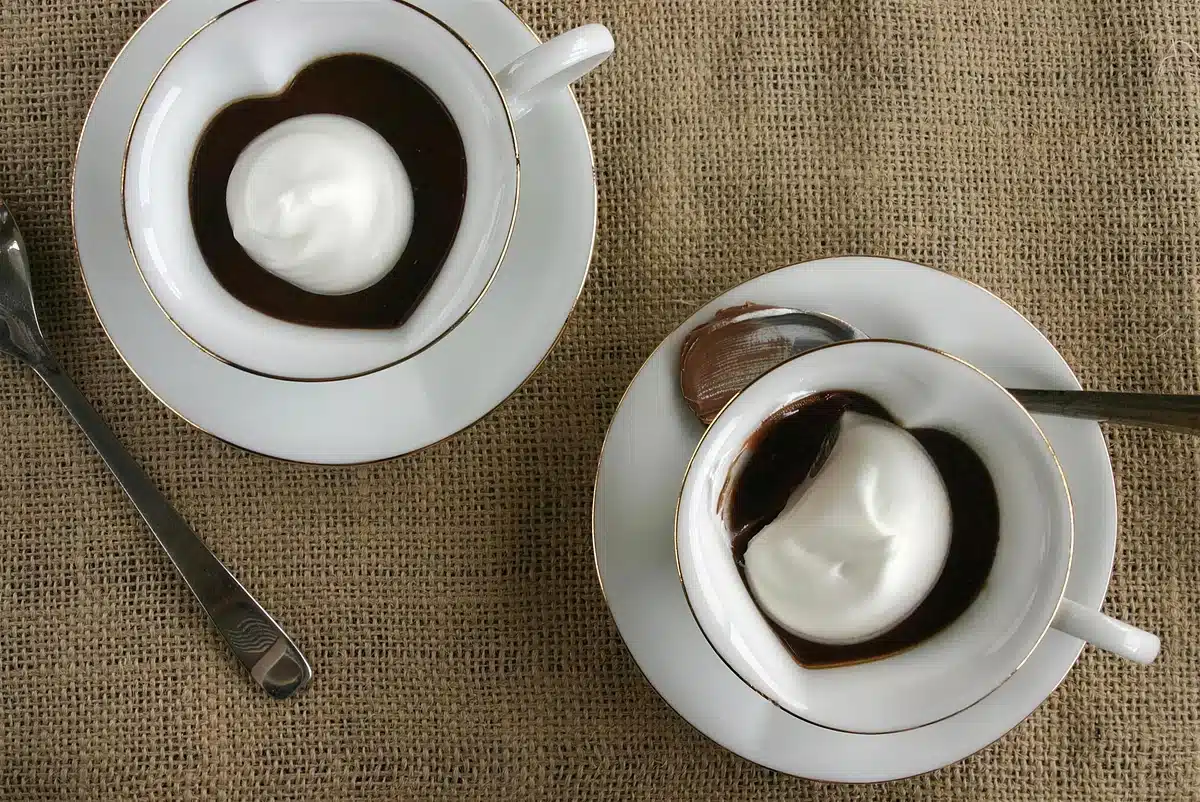
The visual cue with chocolate pots de creme is a wobble, and it is worth being precise about what that means.
Nudge the dish at 25 minutes. The outer half inch of each custard should be set and matte, and the center should move as one soft mass, the way a set jelly does. If it ripples in waves like liquid, give it another five minutes. If nothing moves at all, it has gone slightly too far.
Overbaked custard tells you afterwards. It weeps a thin, watery liquid at the edge and the texture turns grainy rather than glossy, because the proteins have tightened and squeezed out the water they were holding.
Remember that the center keeps cooking after the cups come out of the water. Pulling chocolate pots de creme while the middle still wobbles is not caution, it is the actual instruction. They finish setting over the hour on the rack and firm properly in the fridge.
Scaling Up to a Dinner Party
The chocolate pots de creme below serve two, which is deliberate, but the recipe multiplies cleanly with no adjustment to the method.
Multiply every ingredient by the number of servings you want, using one egg yolk and one and a half ounces of chocolate per person. Six servings need six yolks, nine ounces of chocolate and two and a quarter cups of cream. The teaspoon of sugar scales the same way.
Baking time barely changes. What matters is the depth of the custard rather than the number of cups, so as long as everything is in four-ounce vessels, twenty-five minutes still holds. Use two baking dishes rather than crowding one, since cups packed tight against each other bake unevenly.
The one thing that does change is the pouring. Strain the custard into a jug with a spout and fill the cups in the oven if you can reach, because carrying a tray of full cups across a kitchen rarely ends tidily.
Make It Ahead
Chocolate pots de creme have to be made ahead, and that is their greatest virtue.
Four hours in the fridge is the minimum, and they are better at eight. Overnight is ideal: the chocolate flavor rounds out and the texture becomes noticeably silkier than it is at the four-hour mark.
They hold at their best for two days, covered. Press plastic wrap onto the surface only if you are keeping them longer than a day, since custard picks up refrigerator smells with alarming efficiency.
Whip the cream on the day, though, and only to soft peaks. Whipped cream made the night before weeps and separates, and a firm peak sits awkwardly on something this soft. Thirty seconds with a whisk is all two tablespoons need.
Storing Chocolate Pots de Creme
Chocolate pots de creme keep for a short time, and the freezer is not an option worth taking.
- Fridge: covered, up to 2 days at their best and 3 days at a push. Add the whipped cream only as they go to the table.
- Covering: a lid or plastic wrap pressed to the surface. Uncovered custard forms a skin and absorbs whatever else is in the fridge.
- Freezing: not recommended. The emulsion breaks on thawing and you get a grainy custard sitting in a pool of liquid.
- Serving temperature: straight from the fridge is a little tight. Ten minutes on the counter first lets the chocolate flavor open up.
- Leftover custard: if you have half a cup spare, bake it alongside in an extra cup rather than saving the raw mixture, which will not keep.
Variations and Substitutions
The chocolate pots de creme base takes flavoring easily, as long as nothing wet goes in.
- Milk chocolate: use the same weight and drop the sugar entirely, since milk chocolate carries far more of its own.
- Coffee: raise the espresso powder to a full teaspoon for a genuine mocha.
- Orange: steep a wide strip of zest in the cream as it heats, then lift it out before pouring.
- Spiced: a pinch of cinnamon and a smaller pinch of cayenne warmed with the cream.
- Boozy: a teaspoon of bourbon, dark rum or Grand Marnier stirred in after straining.
- Salted: flaky salt over the whipped cream at the table, which is the version I make most often. My chocolate smoked salt ice cream came from the same idea.
- Dairy-free: full fat coconut milk works in place of the cream, though the texture is softer and the coconut is detectable.
What to Serve with Chocolate Pots de Creme
Something crisp, because chocolate pots de creme are entirely soft.
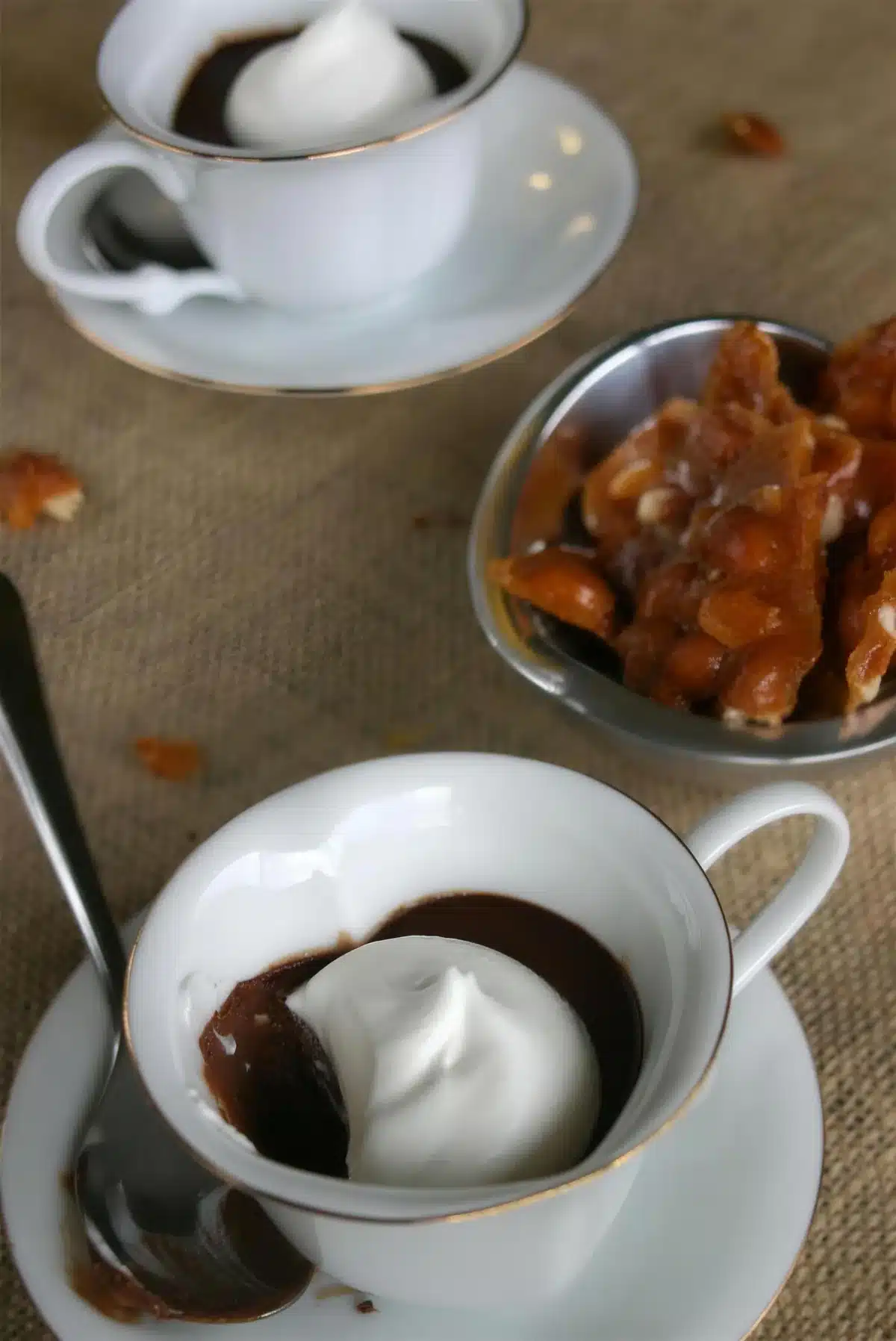
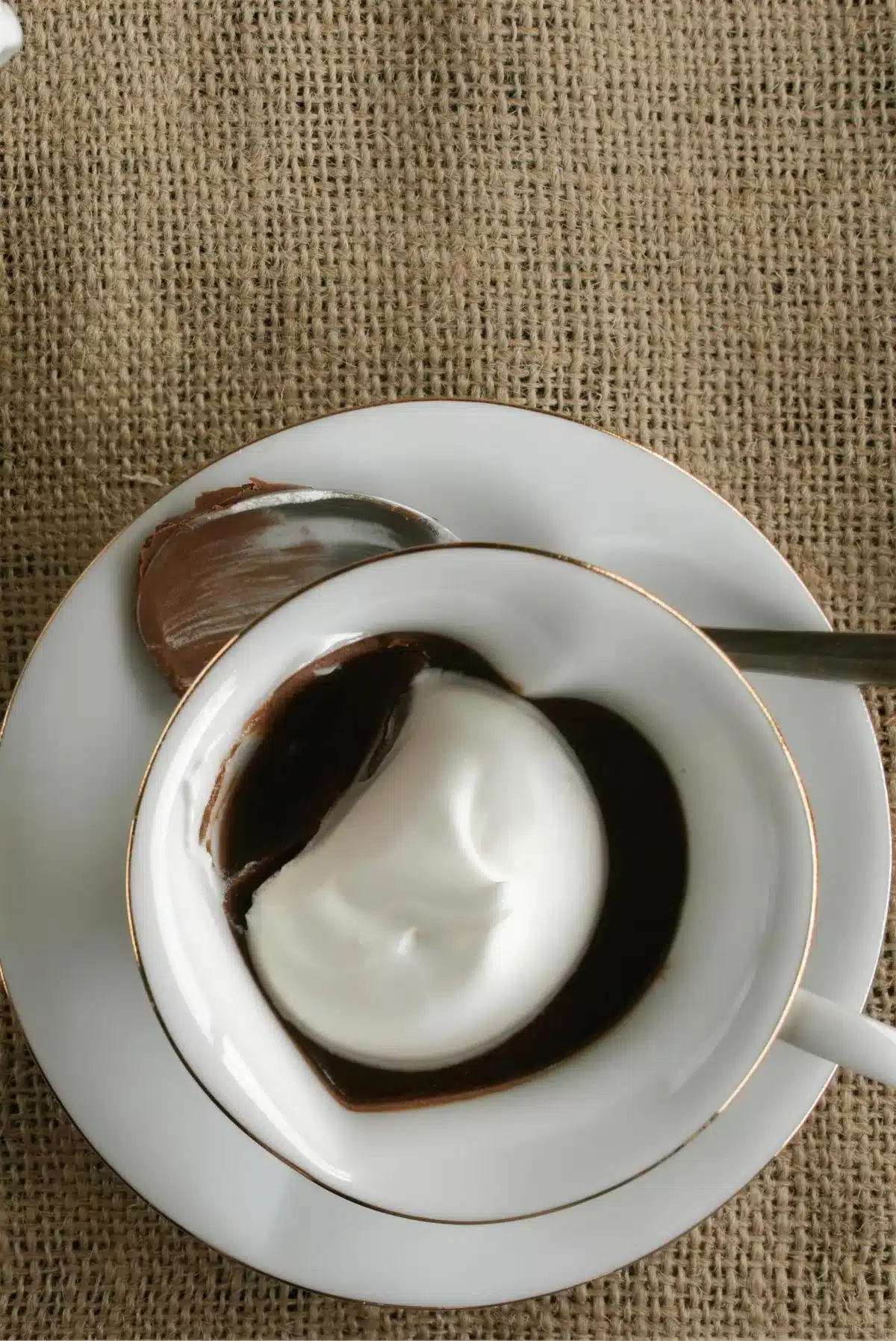
- Peanut brittle or honeycomb broken into shards, which is what is in the photographs.
- A thin, crisp cookie for scooping. Biscotti, langues de chat or a shortbread finger.
- Fresh raspberries, whose sharpness cuts straight through the cream.
- Toasted hazelnuts or candied orange peel scattered over the top.
- Something light alongside if the meal was heavy, such as mini pavlovas.
- Espresso, or a small glass of tawny port.
Here is what readers ask most often about chocolate pots de creme.
Chocolate Pots de Creme FAQ
Frequently Asked Questions
What is the difference between pots de creme and pudding?
Pots de creme are set with egg yolk and usually baked, while pudding is thickened with cornstarch on the stove. That gives pots de creme a denser, seamless texture and pudding a slightly bouncier, cloudier one. Pudding is also considerably faster, since it needs no baking and no long chill.
Why did my custard turn out grainy?
The yolk went past its setting point somewhere. Either the hot cream hit it too fast at the tempering stage, or the cups spent too long in the oven. Pour the hot mixture in a thin stream while whisking constantly, strain the custard before it goes into the cups, and pull the dish while the centers still wobble.
Do I have to use a water bath?
For this method, yes. Direct oven heat sets the outside long before the middle catches up, and you end up with a firm rim around a liquid center. The water holds the whole thing at a steady temperature, which is exactly what a custard needs.
More Questions About Pots de Creme
Good to Know
How far ahead can I make them?
Up to two days, and they are genuinely better on day two than on the day they were baked. Keep them covered in the fridge and hold the whipped cream back until serving. Anything past three days starts to pick up refrigerator flavors, however well wrapped.
What can I use instead of ramekins?
Teacups, small glass tumblers, espresso cups or little jars all work, and teacups are what these were baked in. The only requirements are that they hold about four ounces, that they are ovenproof, and that they are all the same depth so everything sets at the same rate.
Can I double or triple the recipe?
Yes, and it scales without any change to the method. Work on one egg yolk and one and a half ounces of chocolate per serving. Baking time stays the same because it depends on the depth of the custard, not on how many cups are in the oven.
Can I use chocolate chips?
You can, but chop them first and expect a slightly less smooth result. Chips contain stabilizers that help them hold their shape in a cookie, and those same stabilizers resist melting cleanly into hot cream. A bar of good bittersweet chocolate is a real upgrade here.
Make chocolate pots de creme once and they become the dessert you fall back on whenever someone is coming over. For another chocolate recipe that tastes far more involved than it is, try my Guinness chocolate cupcakes.
Chocolate Pots de Crème
Save this recipe
Enter your email and I’ll send this recipe straight to your inbox.
Ingredients
For the Custard
- 1/2 cup plus 2 tbsp heavy cream
- 1/2 teaspoon instant espresso powder
- 1/4 teaspoon pure vanilla extract
- 1 1/2 ounces bittersweet chocolate 70 percent, finely chopped, about 1/4 cup
- 1 large egg yolk
- 1 teaspoon granulated sugar
- 1 pinch coarse salt
For the Whipped Cream
- 2 tablespoons heavy cream reserved from above
- 1 pinch granulated sugar optional, to taste
Equipment
- Medium Bowl
- Fine Sieve
- 2 Teacups or Small Ramekins
- Baking Dish
- Foil
- Wire rack
Instructions
Melt and Temper
- First, heat the oven to 325 degrees F and put a kettle on. Bring the 1/2 cup plus 2 tablespoons of cream, the espresso powder and the vanilla just to a simmer in a small pot.
- Next, pour the hot cream over the finely chopped chocolate in a medium bowl. Leave it undisturbed for 3 minutes, then whisk until completely smooth.
- Then whisk the egg yolk, sugar and a pinch of coarse salt together in a second bowl. Add the warm chocolate mixture in a slow, thin stream, whisking constantly, so the yolk warms gradually rather than setting on contact.
- After that, strain the custard through a fine sieve into a 2-cup measuring jug and let it cool completely, stirring occasionally, about 15 minutes.
Bake in a Water Bath
- Stand 2 teacups or 4-ounce ramekins in the center of a baking dish and divide the custard between them. Pour boiling water into the dish until it reaches halfway up the sides of the cups.
- Cover the dish tightly with foil and poke several holes in it. Bake for about 25 minutes, until the custard is set around the edges and still wobbles as one soft mass in the center.
Chill and Serve
- Lift the cups out of the water bath and cool them on a wire rack for 1 hour. Cover and refrigerate for at least 4 hours, and up to 2 days.
- Finally, whisk the reserved 2 tablespoons of cream to soft peaks with a pinch of sugar if you want it, and dollop it over each cup as they go to the table. Let them stand 10 minutes out of the fridge first.