
Good baked empanadas are not a compromise. They are a different pastry from the fried kind, and the thing that makes them work is an oven hot enough to set the dough before the butter inside it has finished melting.
This is the batch I make at the end of August, when the corn is still sweet and the heirloom tomatoes have gone slightly too soft to slice. These are baked empanadas filled with ground pork, charred sweetcorn, poblano and a handful of Monterey Jack, folded into an all-butter dough and cooked on two sheet pans. Twenty-four of them, most of which go into the freezer raw.

- Twenty-four from one batch of dough, and no pot of oil to deal with afterward
- The filling is whatever the last week of summer produced, so it changes every year
- They freeze raw and bake straight from the freezer, which makes them a party dish you build in September
- An all-butter dough that stays pliable enough to crimp shut without cracking, which is most of the battle with baked empanadas
- Baking gives you both hands back, since the oven does not need watching the way a fryer does

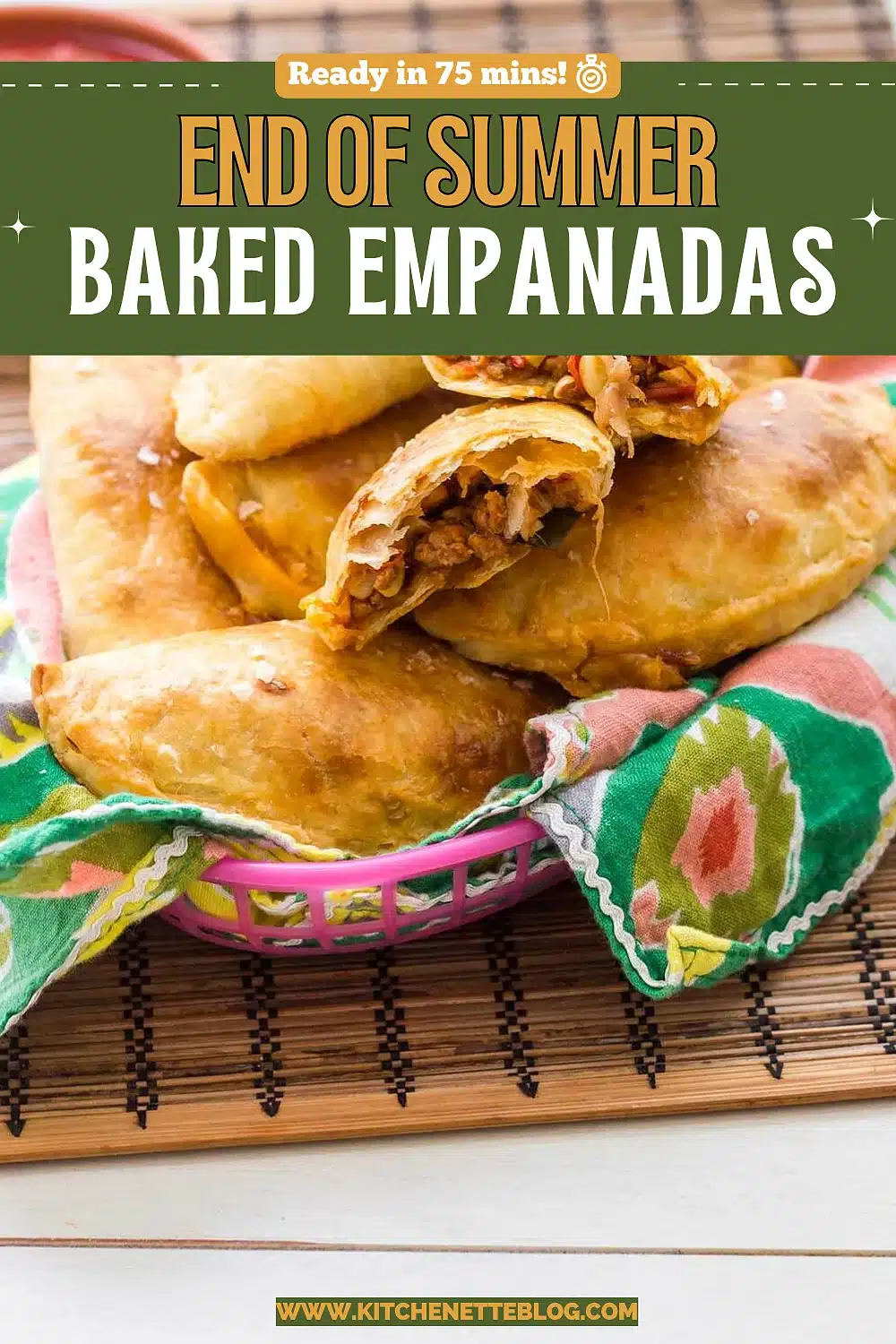
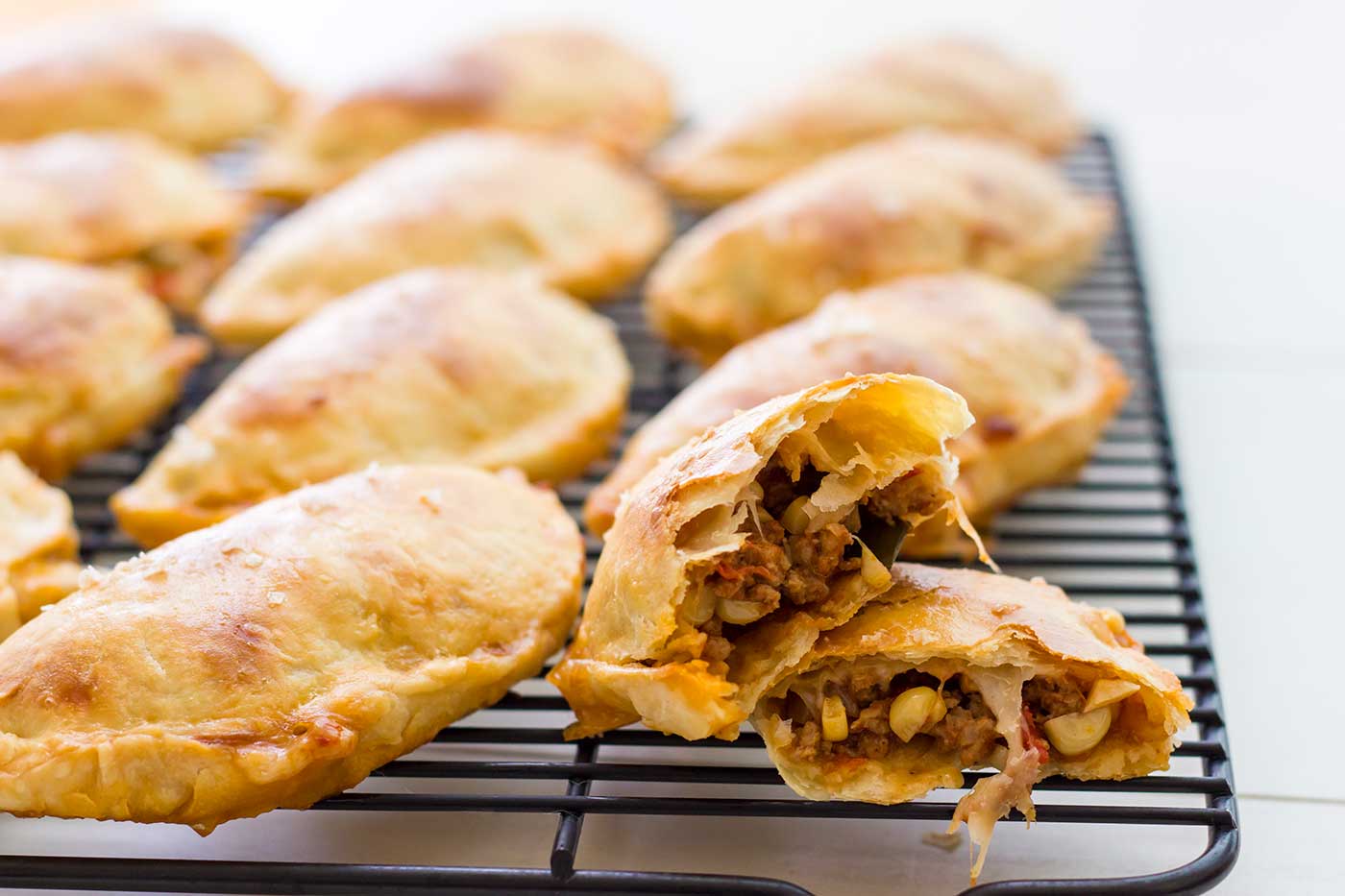
Two things decide whether this works: how dry you get the filling, and how cold the dough is when you roll it.
- Baked Empanadas vs Fried Empanadas
- Ingredient Notes
- The Dough Is Not Pie Crust
- How To Make Baked Empanadas
- Sealing Empanadas So They Do Not Leak
- How Long To Bake Empanadas, and at What Temperature
- Make It Ahead and Freezing
- Storing Baked Empanadas
- Variations and Substitutions
- What to Serve with Baked Empanadas
- Baked Empanadas FAQ
Baked Empanadas vs Fried Empanadas
Fried empanadas blister. The dough hits 350F oil, the surface water flashes off in seconds, and the crust puffs into those uneven bubbles that are the whole appeal. Baked empanadas cannot do that, and pretending otherwise is why so many oven versions disappoint.
What baked empanadas do instead is layer. In a hot oven the butter in a cold dough steams into the flour around it, and you get flake rather than blister, closer to a hand pie than to a fritter. That is a genuinely good texture. It is simply not the same one.
There are three practical arguments for the oven. You can cook all twenty-four at once instead of six at a time. The filling has time to heat through without the crust darkening past the point of pleasure. And nobody has to stand over a pan while everyone else is eating.
There is one real argument against, and it is worth saying plainly: baked empanadas dry out faster on the counter. Fried ones stay good for about four hours; these are best within the first hour and then want ten minutes back in the oven. Plan the timing around that and the oven wins easily.
Save this recipe
Enter your email and I’ll send this recipe straight to your inbox.
Ingredient Notes
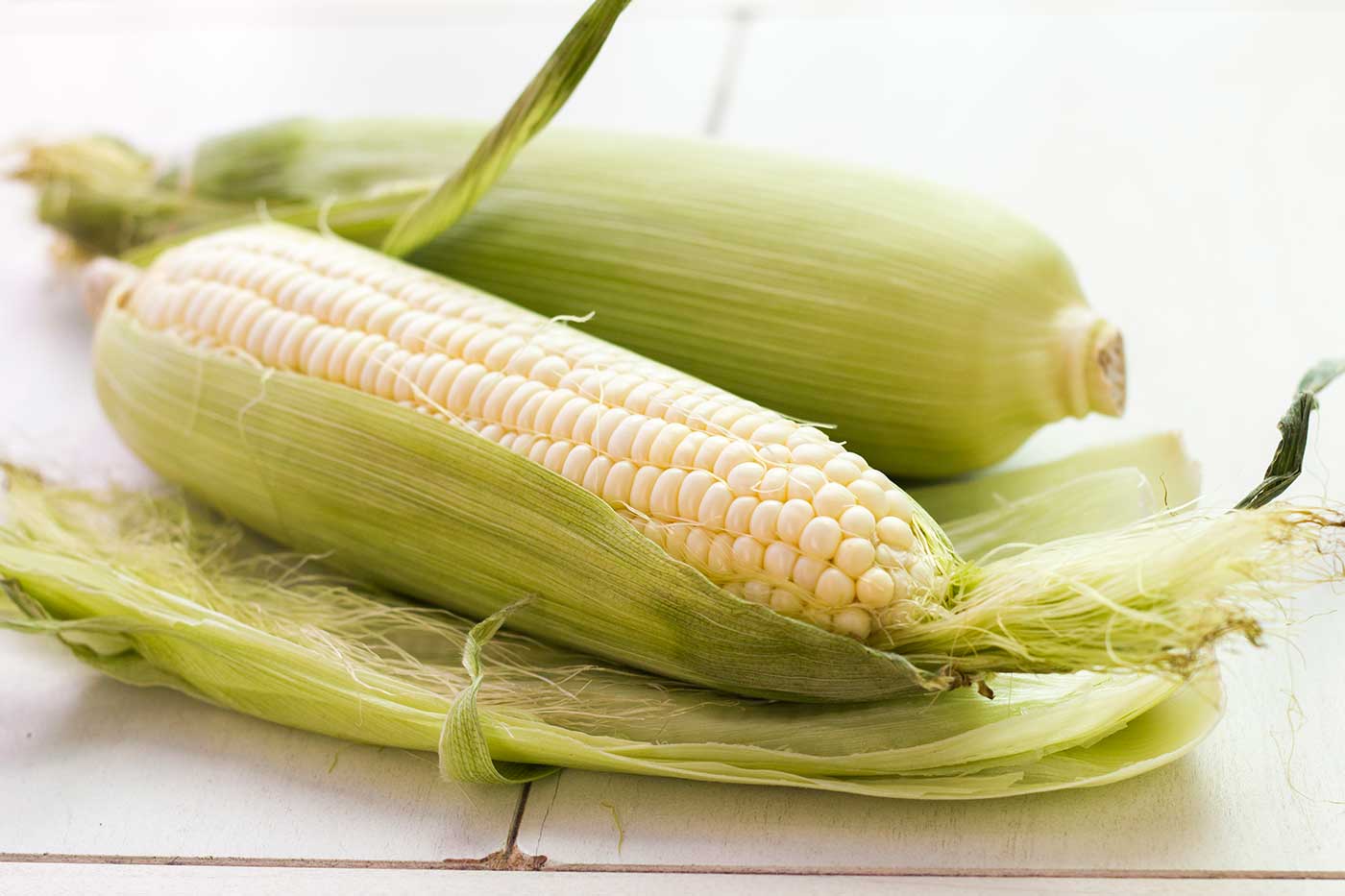
Nothing in these baked empanadas is unusual. Exact amounts are in the recipe card at the end.
- Ground pork: a pound and a quarter, and not the leanest you can find. Fat is what keeps the filling from turning to gravel inside a pastry that is also losing moisture. The National Pork Board is clear that ground pork should always be cooked to 160F, which the skillet does well before it ever sees the oven.
- Sweetcorn: two ears, kernels cut off. Frozen works and does not need thawing, but late-summer corn cut off the cob that morning is the reason this recipe exists.
- Poblanos: two, diced. Mild, faintly smoky, and they hold their shape through a bake in a way bell peppers do not.
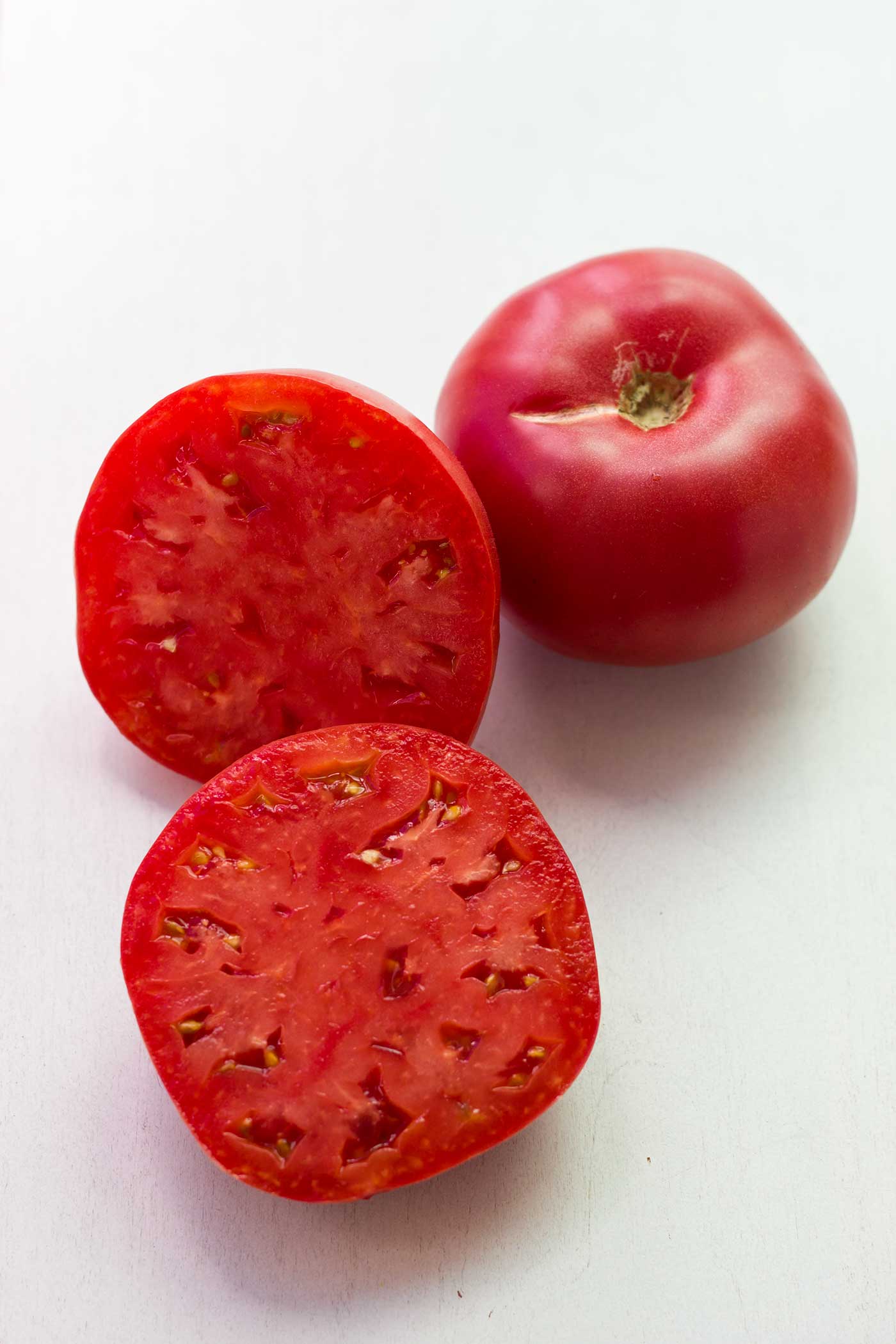
- Heirloom tomatoes: two medium, seeded and diced. Seeding is not optional here. The seed jelly is most of the water, and water is the enemy of every filled pastry.
- Monterey Jack: about a cup, shredded, added at assembly rather than in the skillet. Melted into the filling it disappears; scattered on at the last moment it makes the string you want when someone tears one open.
- Butter: twelve tablespoons, cold and cubed. Not shortening, not lard. Lard makes a superb fried dough and a slightly waxy baked one.
- Milk and vinegar: whole milk for tenderness, a tablespoon of cider vinegar to keep the gluten relaxed so the dough rolls without fighting back.
- Flaky salt: scattered on the egg-washed tops. It is the one seasoning that lands on the outside, and it is what makes people eat four.
The Dough Is Not Pie Crust
Plenty of recipes hand you a pie dough and call it done. That dough is built to be flaky and short, which means it is also built to crack, and a cracked seam is a leak.
The dough for these baked empanadas carries more liquid and slightly less butter than a pie crust, plus a teaspoon of baking powder. That extra liquid makes it pliable, so a rolled circle folds over a mound of filling and crimps shut without splitting at the outer edge. Baking powder gives the top a faint lift, so the finished pastry reads as bread-adjacent rather than as a tart.
Vinegar is in there for structure, not flavor. An acid slows gluten development just enough that the dough relaxes on the counter instead of springing back every time you roll it, which matters when you are rolling twenty-four circles in a row.
It needs an hour in the refrigerator, and it is better after two. Cold butter in a warm kitchen turns greasy inside ten minutes, and greasy dough sticks to everything.
How To Make Baked Empanadas
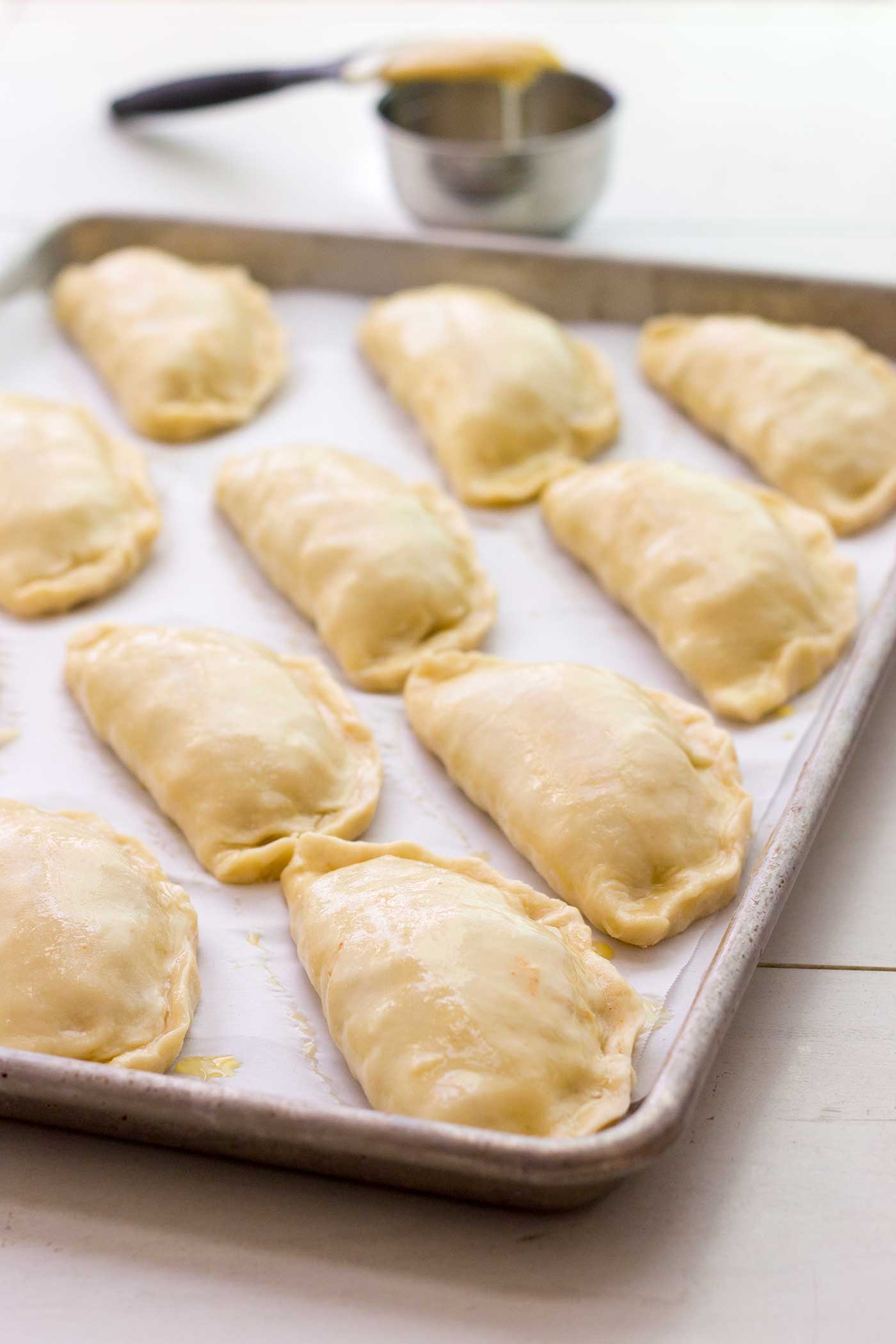
With baked empanadas the order matters more than the technique. Make the dough first so it chills while you cook, and cook the filling early so it cools while the dough rests.
- First, cut the cold butter into the flour, salt and baking powder until it looks like coarse meal, stir in the egg, milk and vinegar, then knead three or four times and chill two discs for at least an hour.
- Next, brown the pork hard in a wide skillet, take it out, then cook the onion, poblano and corn in the same pan until the corn picks up some color.
- Then add the tomatoes, jalapeno, garlic and spices and keep cooking until the pan is visibly dry, with no liquid pooling when you drag a spoon across the bottom. Return the pork, spread it all on a sheet pan and cool it completely.
- After that, roll each disc into twelve 5-inch circles, put a scant ice cream scoop of filling and a pinch of cheese on each, and fold and crimp them shut.
- Finally, brush the tops with beaten egg, scatter flaky salt over, and bake at 400F for 25 to 28 minutes until deeply golden.
Sealing Empanadas So They Do Not Leak
Almost every failure with baked empanadas is a seam failure, and there are only four causes.
Too much filling. A scant ice cream scoop on a 5-inch circle is right. It looks mean. Add a spoonful more and the two edges cannot meet cleanly, which is exactly where it will split.
A wet edge. Keep the outer half inch of every circle clean and dry. Filling smeared onto the rim acts as a lubricant and the seal slides apart in the oven.
No press before the crimp. Fold the circle over and press the two edges together flat with your fingertips first, all the way around, then crimp. Crimping an unpressed edge traps air, and trapped air expands.
A hot filling. Covered above, and it is the one people skip.
As for the crimp itself, a fork works. Press the tines down around the folded edge, going once around, and that is a finished empanada. The braided repulgue is beautiful and takes a while to learn, and it seals no better than a fork does. If you want to try it, fold a small corner of the edge over on itself and keep folding along the seam, each fold overlapping the last.
How Long To Bake Empanadas, and at What Temperature
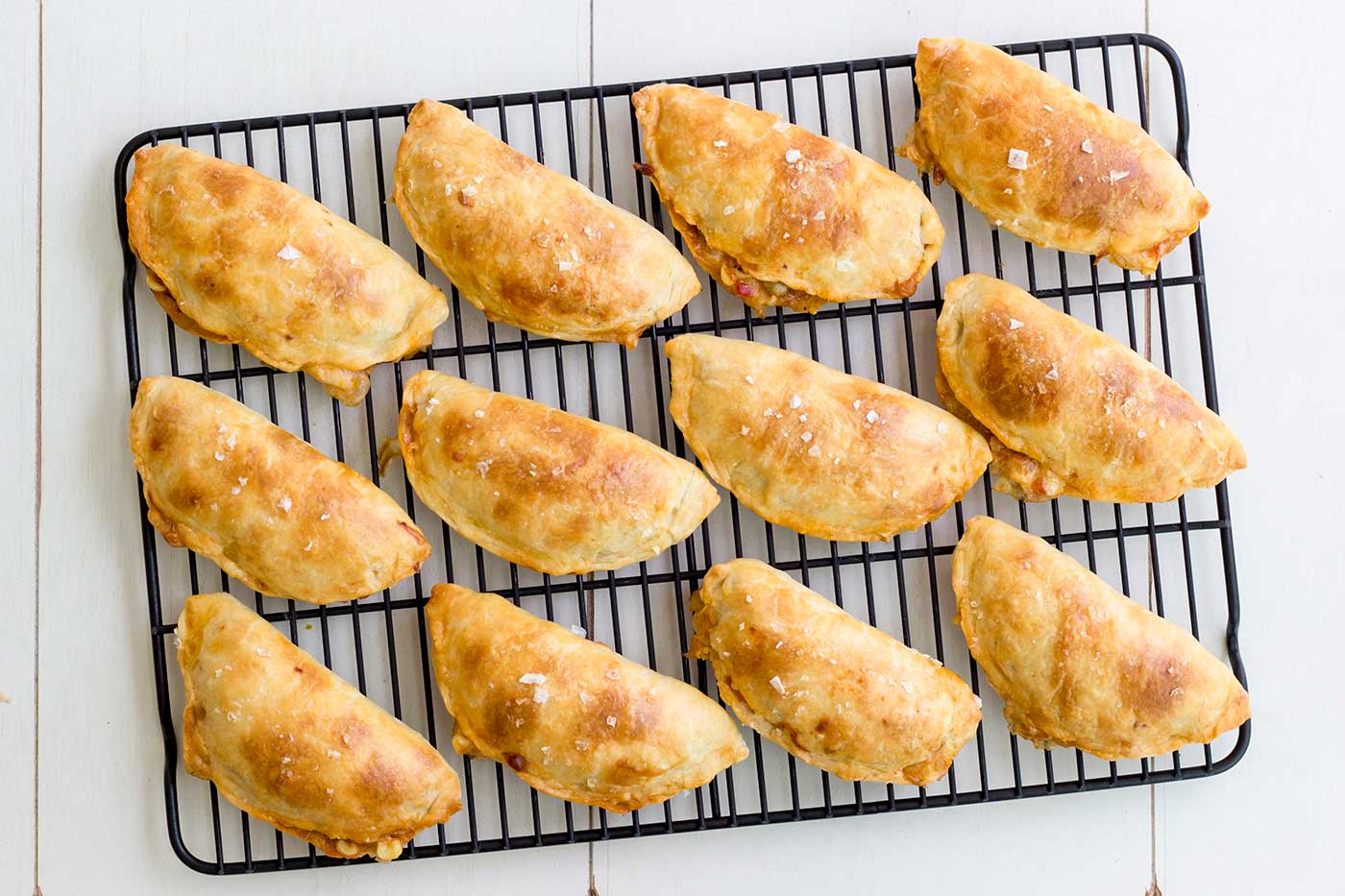
Baked empanadas want 400F for 25 to 28 minutes on the middle rack, with the sheet pans rotated once at the halfway mark.
Hotter than that and the edges brown before the thickest part of the seam has cooked through, which leaves a pale doughy strip exactly where two layers overlap. Cooler than 375F and the butter melts and runs out before the flour around it has set, so the pastry goes flat and slightly greasy instead of layered.
The color tells you more than the clock. You are after deep gold across the whole dome, not just at the crimped edge, and the underside should be dry and firm when you lift one with a spatula. If the tops are perfect and the bottoms are pale, the pan was too low in the oven.
Two pans at once is fine on separate racks as long as you swap their positions when you rotate them. Everything in these baked empanadas is already cooked, so you are only cooking the pastry.
Make It Ahead and Freezing
Baked empanadas are a make-ahead recipe pretending to be a same-day one, and the freezer step is the whole reason to bother making two dozen.
The dough keeps three days wrapped in the refrigerator and three months in the freezer. The filling keeps three days refrigerated and is arguably better on day two, once the cumin has settled into the pork.
Assembled and unbaked is the version worth planning around. Crimp them, freeze them in a single layer on a sheet pan until solid, then bag them. They keep three months. Bake straight from frozen at 400F, egg wash and all, and add five to seven minutes.
Do not freeze them after baking. The pastry survives it, but the corn goes watery on thawing and undoes everything the dry filling was for.
Storing Baked Empanadas
- Counter: baked empanadas are at their best for about an hour, and safe for up to four if the room is cool.
- Refrigerator: 3 days in a sealed container, though the pastry softens noticeably after the first day.
- Reheating: 350F for 8 to 10 minutes on a rack, never a microwave, which turns the crust to leather in under a minute.
- Freezer, baked: possible for a month but not recommended, for the reason above.
- Air fryer: 325F for 4 minutes brings a refrigerated one back better than the oven does, if you are only reheating two or three.
Variations and Substitutions
In baked empanadas the dough and the dryness of the filling are structural. What goes inside is not.
- Ground beef or turkey: both work directly. Turkey needs an extra tablespoon of oil in the skillet and a little more salt.
- Vegetarian: swap the pork for a drained can of black beans and a small diced potato, cooked with the same spices. It is a different dish and a good one.
- Roasted poblano: char and peel them instead of dicing them raw. Half an hour of extra work for a much deeper smoke.
- Cheese: Oaxaca or a mild cheddar in place of the Jack. Feta is too salty against the corn.
- Store-bought discs: frozen empanada discs are a legitimate shortcut and most of them are made for frying, so brush them with butter as well as egg or they bake up dull.
- Heat: leave the jalapeno seeds in, or add a chipotle in adobo, minced, with the tomatoes.
What to Serve with Baked Empanadas
A pile of baked empanadas is an appetizer, a picnic, or dinner with a salad. They want acid next to them more than anything else.
- A bowl of salsa or chimichurri, which is what the photographs show and what I make nine times out of ten.
- Next to Jack Stack cheesy corn if you have gone all in on the last of the season.
- With black bean hummus on the same board, so there is something to eat while the second pan bakes.
- Alongside Mexican street corn soup, which turns two dozen empanadas into a proper meal for eight.
- Cold beer or a dry cider. Anything sweet fights the cumin.
Here is what readers ask most often.
Baked Empanadas FAQ
Frequently Asked Questions
Can empanadas be baked instead of fried?
Yes, and most Argentinian ones are. The texture changes rather than degrades: you get flaky layers instead of the blistered bubbles that only hot oil produces. Baked empanadas need a dough with enough liquid to stay pliable, kept cold, and a hot oven at 400F so the pastry sets before the butter runs. Fried dough tolerates being lukewarm; baked dough does not.
How long to bake empanadas at 350 in the oven?
About 35 to 40 minutes at 350F, and I would not do it. That temperature is low enough that the butter melts and drains before the flour sets, so the pastry ends up flat and a little greasy rather than layered. If your oven runs hot and 400F scorches the crimped edge, drop to 385F and check at 25 minutes instead.
Why did my empanadas leak?
Four causes, in order of likelihood: too much filling, filling smeared onto the outer half inch of the circle, the edges crimped without being pressed flat first, or the filling still warm when it went in. The warm one catches everybody, because a filling that feels fine to the hand is still hot enough to steam inside a sealed pastry.
More Questions About Dough and Filling
Good to Know
Can you bake frozen empanadas instead of frying?
Yes, and with homemade ones you should bake them straight from frozen rather than thawing. Thawing lets the dough soften and the filling weep, and you lose the seal. Egg wash them before freezing, arrange them frozen on a parchment-lined pan and bake at 400F, adding five to seven minutes.
Can I use store-bought empanada discs?
Yes. Look for the frozen discs sold for baking rather than frying if your store carries both, thaw them just until they separate, and work quickly because they dry out and crack faster than homemade dough. Brush them with melted butter as well as egg wash, since most use a fat that browns poorly on its own.
How far ahead can I make them?
Dough three days ahead, filling three days ahead, assembled unbaked empanadas three months ahead in the freezer. On the day itself the only work is the oven. If you want baked empanadas ready early, bake them that morning and reheat at 350F for eight minutes rather than serving them cold.
Do I have to seed the tomatoes?
For this filling, yes. The seed jelly is where nearly all the water sits, and any water left in the filling turns to steam in the oven and pushes the seam apart. Halve them across the equator, squeeze the seeds out over the sink, then dice what is left and cook it until the pan is dry.
Two dozen baked empanadas, most of them still frozen, is the best insurance against an unplanned evening I know of. For more pork, my Cuban mojo pork uses the same cumin logic on a larger scale.
End of Summer Baked Empanadas
Save this recipe
Enter your email and I’ll send this recipe straight to your inbox.
Ingredients
The Empanada Dough
- 4 cups all-purpose flour about 500 grams, plus more for rolling
- 1 teaspoon baking powder
- 2 teaspoons fine sea salt
- 12 tablespoons cold unsalted butter cubed, straight from the refrigerator
- 1 large egg
- 3/4 cup whole milk cold
- 1 tablespoon apple cider vinegar keeps the dough relaxed and easy to roll
Corn and Poblano Filling
- 2 tablespoons vegetable oil divided
- 1 1/4 pounds ground pork not the leanest available
- 1 small yellow onion diced
- 2 poblano peppers seeded and diced
- 2 ears sweetcorn kernels cut off, about 1 1/2 cups, or the same frozen
- 2 medium heirloom tomatoes seeded and diced, seeding is not optional
- 1 jalapeno seeds and ribs removed, minced
- 2 cloves garlic minced
- 1 tablespoon chili powder
- 2 teaspoons ground coriander
- 1 teaspoon ground cumin
- 1/2 teaspoon dried oregano
- 1 1/2 teaspoons kosher salt divided, plus more to taste
- 1/2 teaspoon freshly ground black pepper
- 1 cup shredded Monterey Jack cheese added at assembly, not in the skillet
- 1 large egg beaten, for the egg wash
- 2 teaspoons flaky sea salt for scattering over the tops
Instructions
Make the Dough
- First, whisk the flour, baking powder and fine sea salt together in a large bowl. Add the cold butter and work it in with your fingertips or a pastry blender until the mixture looks like coarse meal with some pieces still the size of peas.
- Beat the egg, milk and vinegar together, pour them in and stir with a fork until the dough comes together in a shaggy mass. Knead it three or four times on the counter, no more, then divide it into two flat discs, wrap them and refrigerate for at least 1 hour.
Cook the Filling
- Next, heat 1 tablespoon of the oil in a wide skillet over medium-high. Brown the pork hard, breaking it up as it goes, season it with half the kosher salt and the pepper, and transfer it to a plate.
- Add the remaining oil, lower the heat to medium and cook the onion with a pinch of salt until softened. Add the poblanos and the corn and cook until the kernels pick up some color, about 5 minutes.
- Then add the tomatoes, jalapeno, garlic, chili powder, coriander, cumin and oregano and cook until the pan is visibly dry, with no liquid running back when you drag a spoon across the bottom. Return the pork, taste for salt, spread it all on a sheet pan and cool it completely, about 20 minutes.
Roll, Fill and Crimp
- After that, heat the oven to 400F and line two baking sheets with parchment. Cut one disc of dough into 12 pieces and roll each into a circle about 5 inches across, keeping the second disc cold until you need it.
- Put a scant ice cream scoop of cold filling in the middle of each circle with a pinch of cheese on top, keeping the outer half inch clean and dry. Fold the circle over, press the two edges flat together all the way around, then crimp with a fork. Repeat with the second disc.
Bake and Cool
- Finally, brush the tops with the beaten egg and scatter the flaky salt over them. Bake for 25 to 28 minutes, swapping and rotating the two pans halfway through, until they are deeply golden across the whole dome and dry underneath.
- Move them to a rack for 10 minutes before serving, because the filling holds far more heat than the pastry suggests. They are at their best within the hour.
DOT Test
DOT