
A good kiwi sorbet is a balancing act between a fruit that is mostly water and a fruit that is mostly acid, and this one solves it by pairing kiwi with fresh grapefruit juice, a honey syrup and two tablespoons of vodka that never make it taste of vodka.
There is one rule that decides whether the batch is any good, and it has nothing to do with sugar. Do not blend the kiwi. Those black seeds are pleasant whole and genuinely bitter when a blender cracks them open, so the fruit gets short pulses and nothing more. Everything else here is a straightforward custard-free freeze.
- No eggs, no dairy, no cooking beyond dissolving sugar in water
- The vodka lowers the freezing point, so it stays scoopable straight from the freezer
- Grapefruit gives it the acid that kiwi on its own does not have
- Short pulses instead of blending keep the seeds whole and the flavor sweet
- It works with an ice cream maker or with a fork and a metal pan
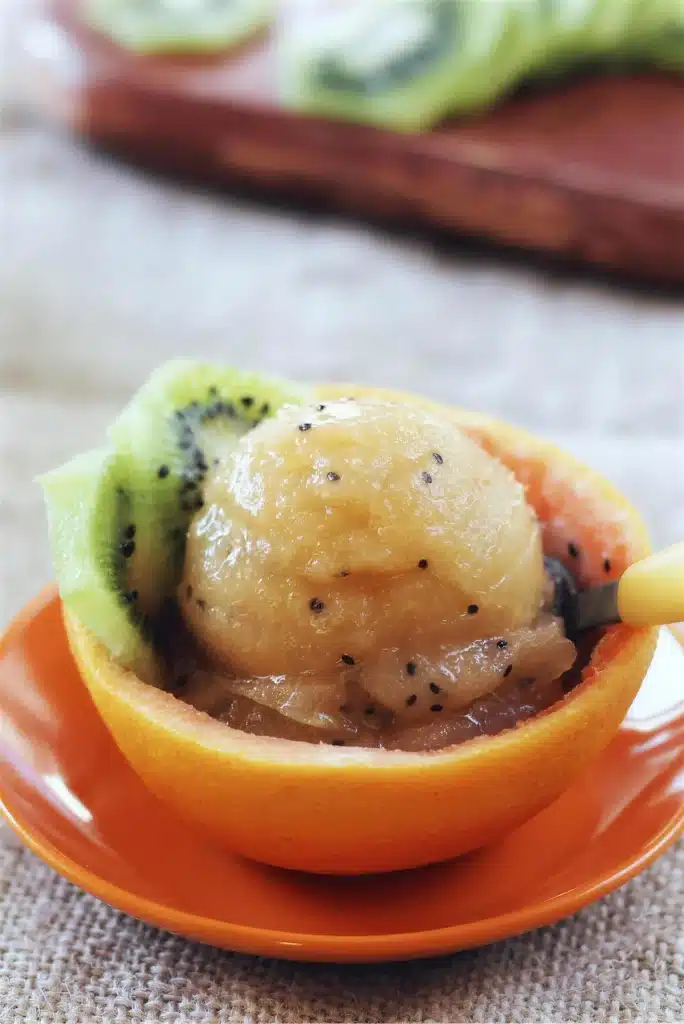
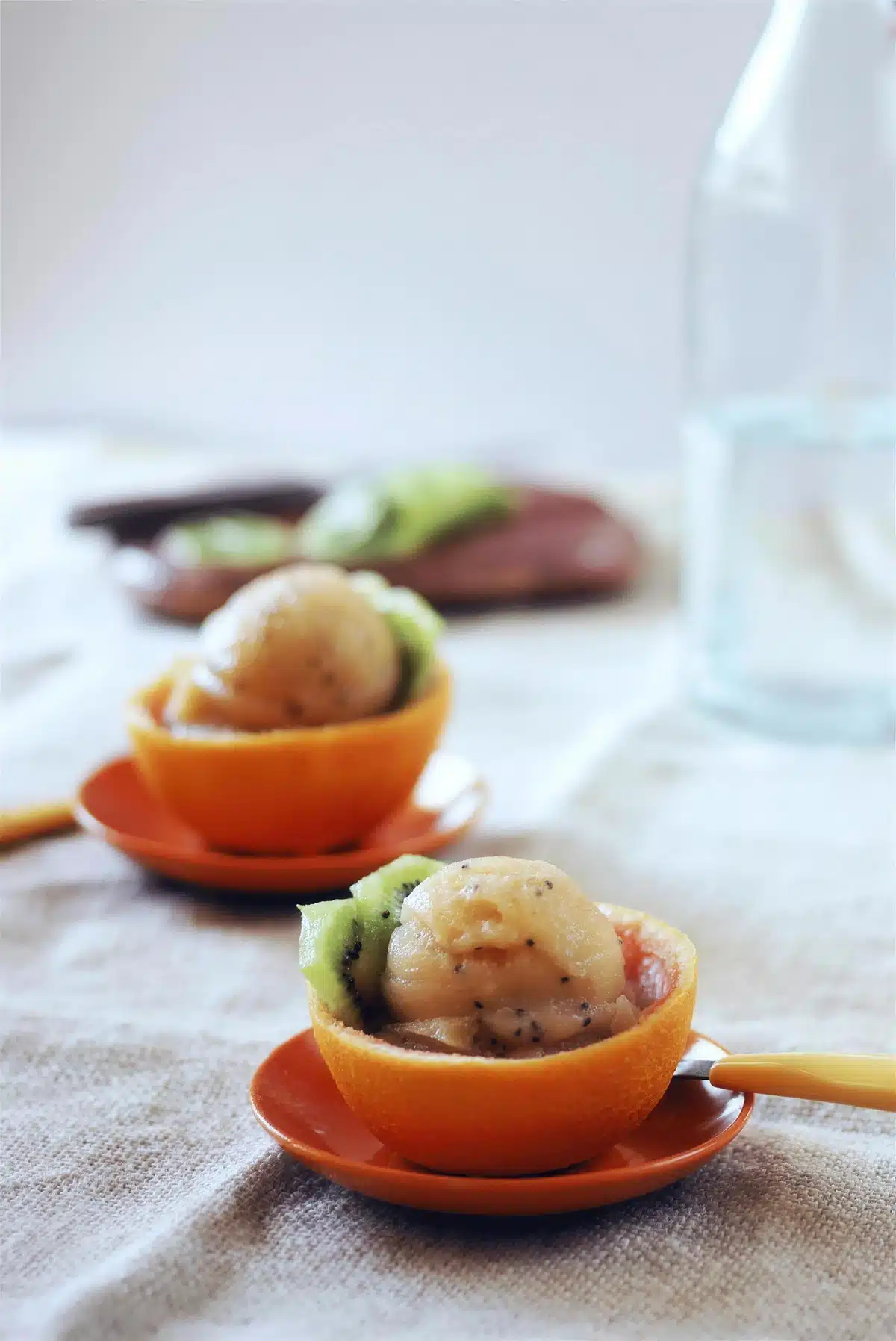
- Served in the hollowed grapefruit shells, it needs no other presentation

The whole recipe is a syrup, a puree and a decision about how long to run the blender.
- What Kiwi Sorbet Should Taste Like
- Ingredient Notes
- Why This One Is Pale Rather Than Green
- How To Make Kiwi Sorbet
- Do Not Blend the Seeds
- Getting the Sugar Right
- Making Kiwi Sorbet Without an Ice Cream Maker
- How To Tell When It Is Churned Enough
- Make It Ahead and Serving
- Storing Kiwi Sorbet
- Variations and Substitutions
- What to Serve with Kiwi Sorbet
- Kiwi Sorbet FAQ
What Kiwi Sorbet Should Taste Like
Kiwi on its own makes a disappointing frozen dessert, which is worth saying plainly.
It is about 83 percent water and low in both sugar and acid compared to the fruit that sorbets are usually built from.
Frozen alone it goes icy, because there is not enough dissolved solid in it to interrupt the ice crystals.
Its flavor is delicate and green, closer to melon than to citrus, and it disappears completely under too much sugar.
Grapefruit fixes all three problems. It brings acid, it brings sugar, and its slight bitterness gives the whole thing a spine.
The result is tart rather than sweet, and it is the sort of thing you serve after a heavy dinner instead of a cake.
Save this recipe
Enter your email and I’ll send this recipe straight to your inbox.
Ingredient Notes
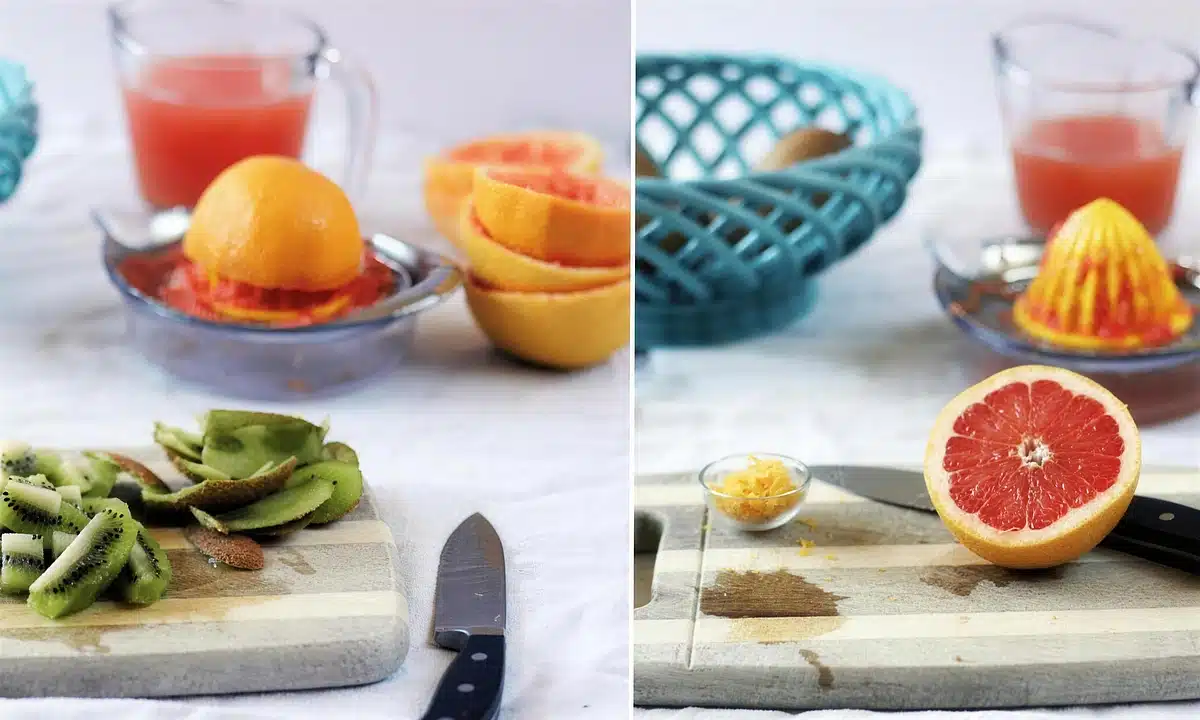
A kiwi sorbet this simple runs to six items and one of them is optional. Exact amounts are in the recipe card below.
- Kiwi: three, about nine ounces once peeled. Ripe ones give to gentle pressure like a ripe peach. Rock-hard kiwi tastes of nothing and will not sweeten in the freezer.
- Grapefruit juice: two cups, freshly squeezed from about three fruit and strained. Ruby and Star Ruby are sweeter than the pale kinds. The UC Riverside citrus collection notes that the pink and red varieties all descend from Marsh, a seedless chance seedling found in Florida around 1860, which is why they behave so similarly in the kitchen.
- Granulated sugar: half a cup, dissolved in water first so there is no grit in the finished batch.
- Honey: a quarter cup. Honey is partly fructose, which resists freezing solid better than plain sugar does, so it improves the texture as well as the flavor.
- Vodka: two tablespoons, and it is the difference between a scoop and a block. Alcohol does not freeze at domestic freezer temperatures, so a small amount keeps the whole batch soft.
- Salt: a pinch. It reduces the perceived bitterness of grapefruit noticeably, which is the cheapest improvement in the recipe.
Why This One Is Pale Rather Than Green
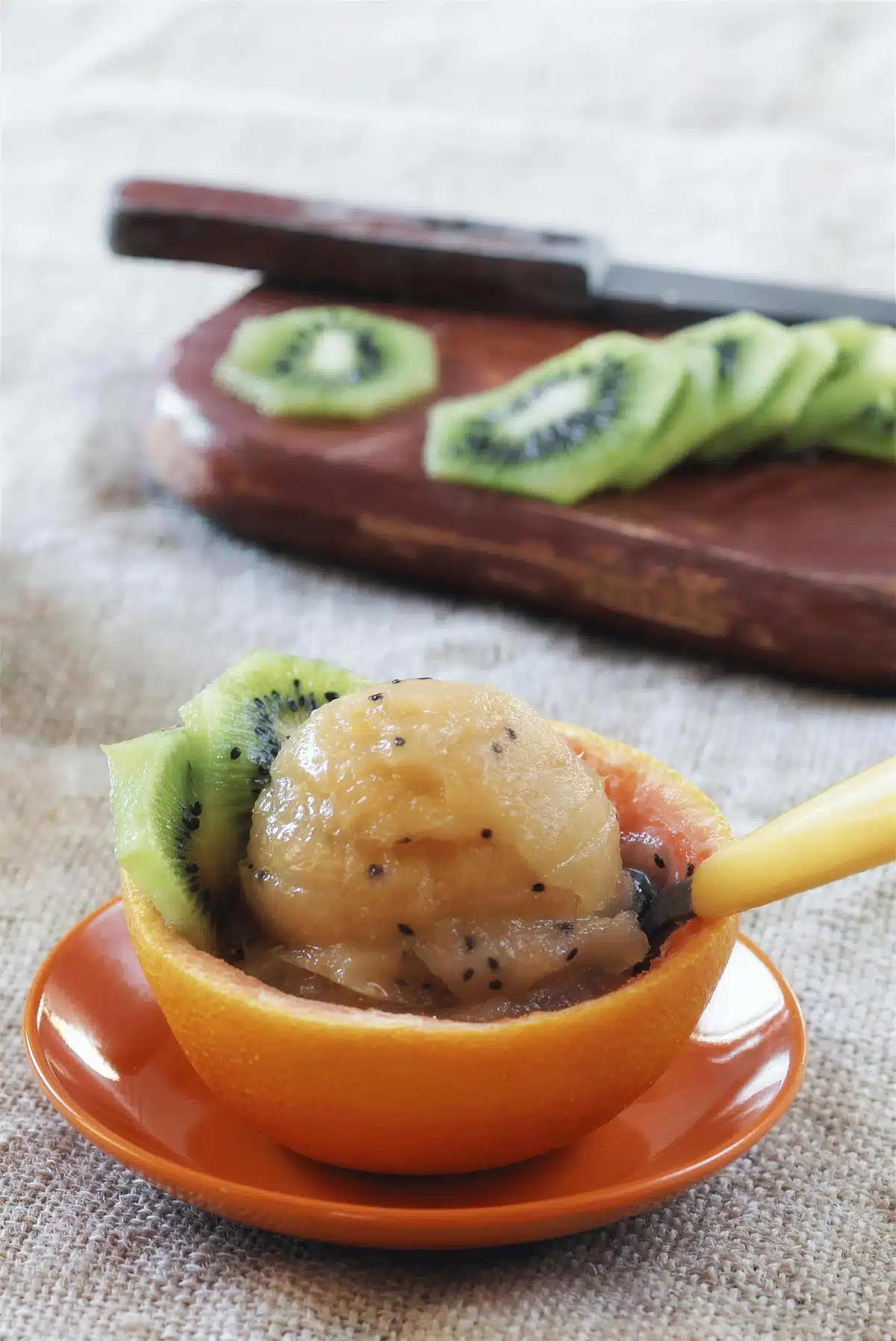
The photographs show something the color of pale honey, not the neon green you see on most kiwi sorbet recipes, and that is deliberate.
Two cups of grapefruit juice against nine ounces of kiwi means the citrus is the majority of the liquid, so the color follows the citrus.
Kiwi green is chlorophyll, and chlorophyll turns olive in acid. Blend kiwi into grapefruit juice and the green fades within minutes whatever you do.
The neon versions are usually all kiwi, often with lime, and they are a different and much sweeter dessert.
You can see the kiwi anyway. The black seeds stay suspended through the batch, which is the visual signature of a proper kiwi sorbet.
If you want it greener, flip the ratio to two cups of kiwi puree and one cup of juice, and expect to add a little more sugar.
How To Make Kiwi Sorbet
Everything here can be done the day before. Kiwi sorbet churns better from a base that has been properly cold overnight.
- First, warm the 1/2 cup of water with the 1/2 cup of sugar and the 1/4 cup of honey until the sugar has dissolved, about 3 minutes, then pour it into a large bowl and refrigerate it.
- Next, take 1 teaspoon of zest off one grapefruit, then juice enough fruit for 2 cups and pour it through a sieve to catch the pulp and membrane.
- Then peel the 3 kiwis, quarter them, and pulse them with a cup of the juice in short bursts until they are broken down but the seeds are still whole. Five or six pulses, no more.
- After that, stir the fruit, the remaining juice, the zest, the 2 tablespoons of vodka and the pinch of salt into the cold syrup, and chill the whole base for 2 hours until it is thoroughly cold.
- Finally, churn it in an ice cream maker for 20 to 25 minutes, until it holds the trail of a spoon, then scrape it into a container and freeze for 3 hours before scooping.
Do Not Blend the Seeds
This is the one instruction people skip, and it is the one that ruins a kiwi sorbet.
Kiwi seeds are pleasant whole. They give a faint crunch and they are what makes a scoop recognizable as kiwi.
Cracked open they are bitter, in the same way that a blitzed passion fruit or a cracked cherry pit is bitter. Thirty seconds in a blender is enough to do it.
Use short pulses, five or six of about two seconds each, and stop while there are still small pieces of fruit visible.
A potato masher works too, and it cannot over-process anything.
Taste before you chill it. If it has already gone bitter, a tablespoon of honey will mask some of it, and nothing will fix it completely.
Getting the Sugar Right
Kiwi sorbet texture is almost entirely a sugar problem, and there is a narrow window.
Aim for roughly 25 to 30 percent sugar across the whole base, counting what the fruit brings as well as what you add. This recipe lands at about 28.
Too little sugar and it freezes into a brick, because sugar is what depresses the freezing point and keeps some of the water liquid.
Too much and it never sets, staying slushy no matter how long it sits in the freezer.
Honey counts toward the total and works a little harder than sugar, so a swap is not one for one.
The vodka is not sugar but does a similar job, and two tablespoons in this quantity is the most you can use before the base stops setting.
Making Kiwi Sorbet Without an Ice Cream Maker
The machine gives a finer texture and the fork method is genuinely fine.
Pour the chilled base into a shallow metal pan, which conducts cold far faster than glass or plastic.
Freeze for 45 minutes, then rake it thoroughly with a fork, breaking up everything that has set around the edges.
Repeat every 30 minutes for about three hours, five or six rakings in all. Each one breaks the crystals down before they can grow.
The result is closer to a granita, slightly flakier and just as good in a hollowed grapefruit shell.
A food processor shortcut: freeze the base solid in an ice cube tray, then blitz the cubes with a splash of juice. That one is worth blending hard, because the seeds are already trapped in ice.
How To Tell When It Is Churned Enough
Twenty minutes is a guide and the paddle tells you when the kiwi sorbet is ready.
It should hold the trail of a spoon and mound rather than pour, roughly the texture of a thick milkshake.
Straight from the machine it is soft. That is correct, not a failure, and three hours in the freezer firms it up.
If it is still liquid after 30 minutes, either the base was not cold enough or the machine bowl was not frozen hard for a full 24 hours.
Do not run it past 30 minutes hoping it will thicken. Over-churning warms the base through friction and makes the texture worse.
Scrape it out with a rubber spatula into a chilled container, and press a sheet of parchment onto the surface before the lid goes on.
Make It Ahead and Serving
Kiwi sorbet is a good dessert to have already sitting in the freezer.
The base keeps three days in the refrigerator before churning, and it improves overnight as the flavors settle.
Hollow the grapefruit shells in advance. Cut a thin slice off the base so they sit flat, scrape them clean, and keep them in the freezer.
Churn the day before serving and let it firm up properly overnight.
Take it out five minutes early. Even with the vodka in it, it scoops better after a short rest.
Scoop with a hot dry spoon, dipped in hot water and wiped between scoops, which gives the round shape in the photographs.
Storing Kiwi Sorbet
- In the freezer: kiwi sorbet is at its best for 1 week and perfectly good for 1 month. After that it starts collecting ice on the surface.
- Use a shallow container with a tight lid and press parchment onto the surface. Most freezer burn happens in the air gap.
- The unchurned base: 3 days refrigerated in a sealed jar, or freeze it in cubes for the food processor method.
- Refreezing after it melts gives a coarse, icy texture. Blitz it in a food processor instead and refreeze that.
- Keep it at the back of the freezer. The door swings through a wide temperature range and that is what grows ice crystals.
Variations and Substitutions
The base is a fruit puree and a syrup, so almost anything can be moved.
- Alcohol-free: leave the vodka out and add two more tablespoons of honey. It sets harder, so let it stand ten minutes before scooping.
- Lime instead of grapefruit for a much greener, sharper version. Use half a cup of lime juice and one and a half cups of water, and raise the sugar to three quarters of a cup.
- Blood orange in place of the grapefruit gives a pink batch and a rounder, less bitter flavor.
- Gin rather than vodka, which puts juniper behind the citrus and is very good.
- Basil or mint, a small handful steeped in the hot syrup for ten minutes and then strained out.
- Golden kiwi if you can find it: sweeter, tropical, no green at all, and the seeds are just as bitter when blended.
What to Serve with Kiwi Sorbet
Kiwi sorbet is tart and cold, so it wants something either plain or rich beside it.
- Thin, crisp cookies or a plate of shortbread, for something to bite against.
- A scoop beside strawberry cantaloupe sorbet, which is sweeter and makes a good pair in one bowl.
- Chocolate smoked salt ice cream for anyone at the table who thinks fruit is not a dessert.
- Prosecco poured straight over a scoop in a coupe, which is a sgroppino in everything but name.
- Peanut butter banana ice cream sandwiches if you are feeding children as well.
If you are churning more than one batch this summer, the notes on using an old Rival machine cover the bowl-freezing question properly.
Here is what readers ask most often.
Kiwi Sorbet FAQ
Frequently Asked Questions
Do I have to use an ice cream maker?
No. Pour the chilled base into a shallow metal pan, freeze it for 45 minutes, then rake it hard with a fork and repeat every 30 minutes for about three hours. The texture comes out flakier, closer to a granita, and it is genuinely good. The machine is a convenience rather than a requirement.
Can I leave out the vodka?
Yes, and the batch will freeze harder. Add two extra tablespoons of honey to make up some of the softening, and let it stand at room temperature for ten minutes before scooping. Nothing in this kiwi sorbet tastes of alcohol at two tablespoons; it is there purely for the freezing point.
Why is mine bitter?
Almost certainly the seeds. A blender run for even twenty seconds cracks them and releases a bitterness that nothing removes. Pulse in short bursts and stop while pieces of fruit are still visible. Grapefruit pith is the other suspect, so strain the juice and keep the zest to a teaspoon.
More Questions About Texture
Frequently Asked Questions
Why is it icy rather than smooth?
Three usual causes: the base was not cold enough going into the machine, the machine bowl was not frozen for a full day, or there is not quite enough sugar for your particular fruit. Grapefruits vary a lot in sweetness. Taste the base cold, before churning, and add a tablespoon of honey if it is very sharp.
Mine will not set at all. What now?
Too much sugar, too much alcohol, or both. Freeze it in an ice cube tray, then blitz the cubes in a food processor with nothing added and refreeze. If you doubled the vodka, there is no recovering it as a scoop, but it makes an excellent slush over ice.
More Questions About Fruit and Serving
Frequently Asked Questions
How do I know a kiwi is ripe?
Press it gently at the stem end. A ripe one gives, like a peach that is ready. Firm kiwi is starchy and sour and will not improve in the freezer, so leave them on the counter with a banana for a day or two and they will come round.
Can I use bottled grapefruit juice?
You can, and it is flatter and usually sweeter, so cut the sugar to a third of a cup and taste. Pasteurized juice loses the volatile aromas that make fresh citrus smell like the fruit, which matters more in something served cold, since cold already mutes flavor.
How many does it serve?
Eight, at about half a cup each, which is roughly three and a half cups in total. Served in hollowed grapefruit shells you will get six generous portions instead, and you will have the shells anyway from juicing the fruit.
A batch of kiwi sorbet costs three kiwis and three grapefruit and sits in the freezer for a month, which is a reasonable definition of a good summer dessert.
Kiwi Sorbet with Grapefruit and Honey
Save this recipe
Enter your email and I’ll send this recipe straight to your inbox.
Ingredients
For the Honey Syrup
- 1/2 cup water
- 1/2 cup granulated sugar
- 4 tablespoons honey 1/4 cup, mild rather than buckwheat
For the Sorbet
- 2 cups fresh grapefruit juice from about 3 grapefruits, strained
- 1 teaspoon grapefruit zest finely grated, no white pith
- 3 ripe kiwis about 9 ounces once peeled
- 2 tablespoons vodka optional, for a scoopable texture
- 1 pinch fine sea salt cuts the bitterness of the grapefruit
Equipment
- Small pot
- Blender
- Ice cream maker
- Large Bowl
Instructions
Make the Syrup
- Warm the water with the sugar and the honey in a small pan over medium heat, stirring, until the sugar has completely dissolved, about 3 minutes. Pour it into a large bowl and put it in the refrigerator to cool while you deal with the fruit.
Juice and Pulse the Fruit
- Zest 1 teaspoon from one grapefruit before you cut it, taking the colored layer only, then juice enough fruit for 2 cups and pour the juice through a sieve to catch the pulp and membrane.
- Peel the kiwis, quarter them, and pulse them with 1 cup of the juice in a blender or food processor in short bursts, five or six of about two seconds each. Stop while small pieces of fruit are still visible. Running the machine cracks the black seeds, which are bitter, and there is no fixing that afterward.
Chill and Churn
- Stir the kiwi mixture, the remaining juice, the zest, the vodka and the salt into the cold syrup. Taste it now: grapefruits vary a lot, and if it is very sharp add a tablespoon more honey. Chill the base for at least 2 hours, or overnight, until it is thoroughly cold.
- Churn in an ice cream maker for 20 to 25 minutes, until it mounds and holds the trail of a spoon. It will be soft coming out, which is correct. Scrape it into a chilled container, press parchment onto the surface and freeze for 3 hours before scooping.
Without an Ice Cream Maker
- Pour the chilled base into a shallow metal pan, freeze it for 45 minutes, then rake it thoroughly with a fork, breaking up everything set around the edges. Repeat every 30 minutes for about 3 hours, five or six rakings in all. The texture comes out flakier, closer to a granita.