
Grape salad is the dish that disappears first at every potluck, and almost nobody can tell you why. It is grapes, a sweetened cream cheese dressing, and a brown sugar and pecan crust scattered over the top. Nothing about that list sounds like a showstopper, yet the bowl comes home empty every single time.
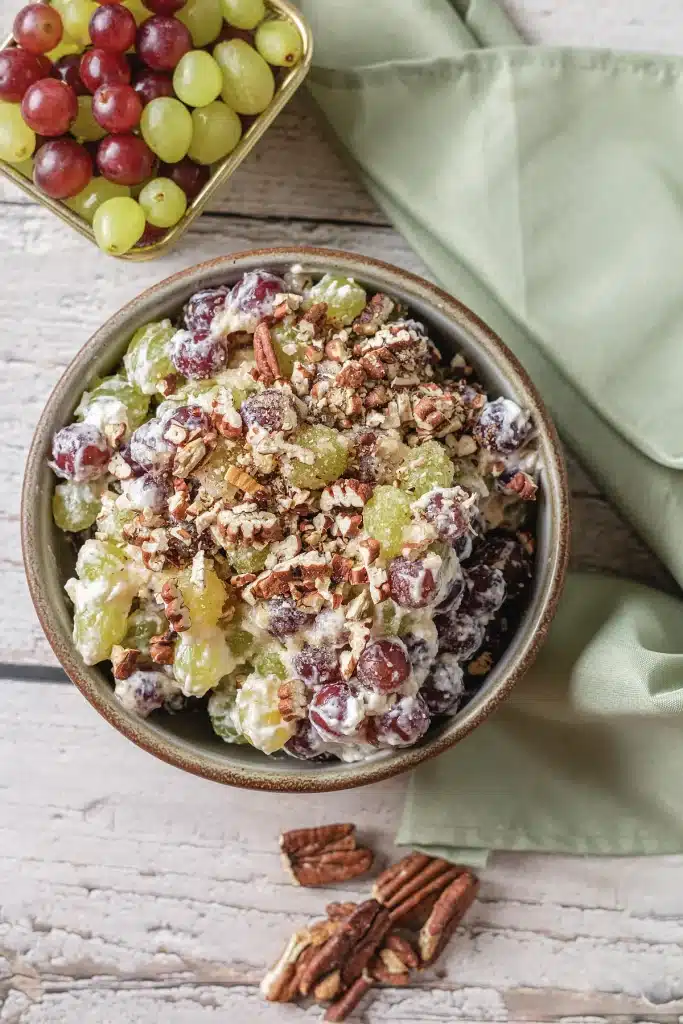
- Eight ingredients, no cooking, and one bowl to wash
- Sweet enough to pass as dessert and light enough to sit next to barbecue
- The brown sugar topping goes on at the table, so it stays crisp
- Doubles cleanly for a crowd without changing a single ratio
- Travels well, because it is better cold than at room temperature
The reason is texture. A cold grape splits under your teeth and releases juice, the dressing is thick and tangy the way cheesecake batter is tangy, and the brown sugar on top stays crunchy if you add it at the right moment. This version fixes the two things that go wrong with most recipes: a dressing that turns watery by hour two, and a topping that dissolves into wet sand before the salad reaches the table.

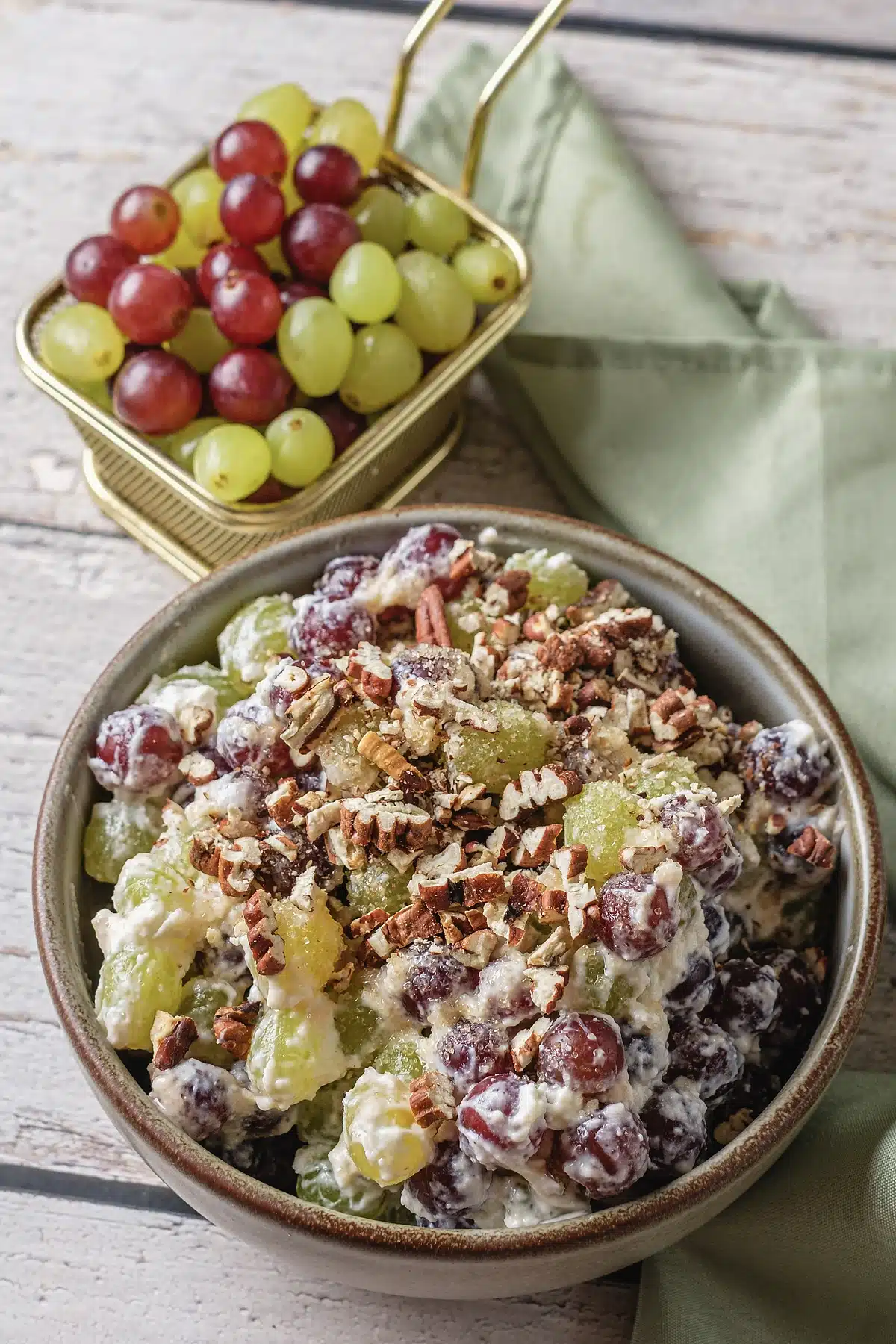
What Makes This Grape Salad Different
Most versions of this recipe are cream cheese, sour cream, sugar, grapes. That is the whole thing, and it works, but it also drifts. The sugar pulls water out of the grapes, the dressing thins as it sits, and by the second hour you have a bowl of fruit in sweet milk.
Two small choices fix that. The first is drying the grapes properly. Wash them, then spread them on a towel and let them sit until the skins are matte rather than shiny. Wet grapes are the single biggest cause of a runny grape salad, and it costs you ten minutes to prevent.
The second is beating the cream cheese completely smooth before anything else joins it. Cold cream cheese never fully incorporates; you get pale lumps that look like curdling. Room temperature cheese whipped for two full minutes gives you a dressing thick enough to cling to a grape instead of pooling under it.
The topping is the third piece, and it is the one people get wrong most often. Brown sugar and pecans belong on top at the last minute. Stir them in early and the sugar melts, the pecans soften, and you lose the crunch that makes this grape salad memorable.
Save this recipe
Enter your email and I’ll send this recipe straight to your inbox.
Ingredient Notes
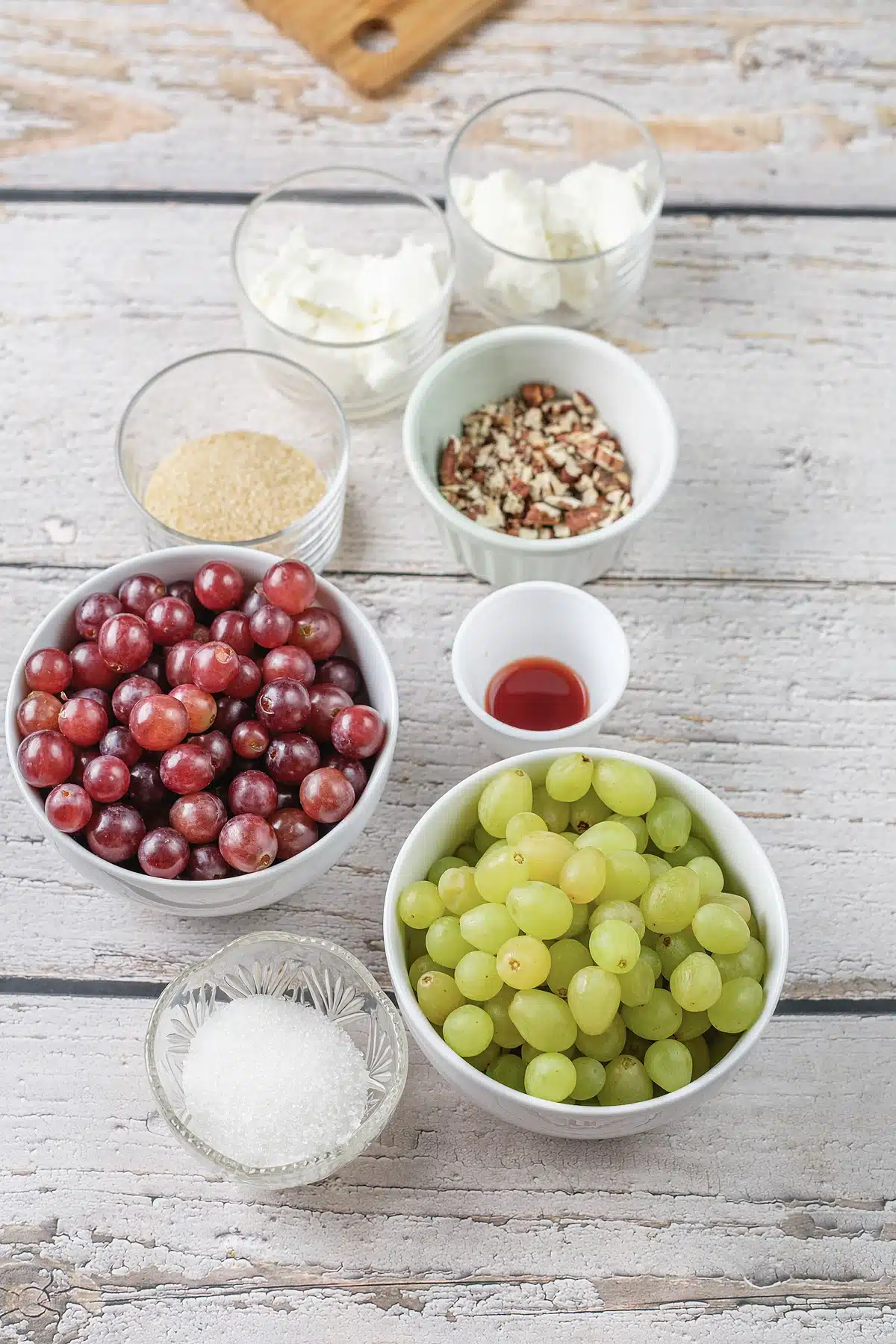
- Red and green seedless grapes. Two pounds of each, which sounds like a lot until you see how fast it goes. Use both colors, because the contrast is most of the visual appeal. Buy grapes that are firm and still attached to the stem; Illinois Extension has a good short read on choosing and storing grapes that is worth two minutes before you shop.
- Cream cheese. One full block, full fat, softened on the counter for an hour. The whipped tub style has air and stabilizers in it and gives you a looser dressing. Reduced fat works but tastes noticeably thinner.
- Sour cream. One cup, full fat again. This is what keeps the dressing tangy instead of sweet on sweet. Greek yogurt is a fair swap and brings a sharper edge with it.
- Granulated sugar. One third of a cup in the dressing. Taste your grapes first. Late season grapes are candy sweet and can take less, while early ones need the full amount.
- Vanilla extract. One teaspoon, and it matters more than you would guess. Without it the dressing tastes like plain sweetened dairy rather than something built on purpose.
- Light brown sugar. Half a cup, packed, for the topping only. Dark brown sugar has more molasses and reads almost smoky here, which fights the fruit.
- Pecans. Half a cup, chopped. Toasting them in a dry pan for three minutes doubles their flavor and is the cheapest upgrade in this recipe.
Should You Halve the Grapes?
This is the most argued question about grape salad, and the honest answer is that it depends on who is eating.
Whole grapes are the classic. They stay crisp, they hold their shape for days, and the burst of juice against the thick dressing is the entire point of the dish. Halving them changes the texture completely: more surface area means more dressing on every bite, but it also means more juice leaking into that dressing and a softer salad by the next morning.
The one case where halving is clearly right is a table with small children, because whole grapes are a genuine choking hazard for anyone under four. Cut them lengthwise, not across, and pat them dry again afterward. For an adult crowd, leave them whole and let the grapes do what they do best.
How To Make Grape Salad
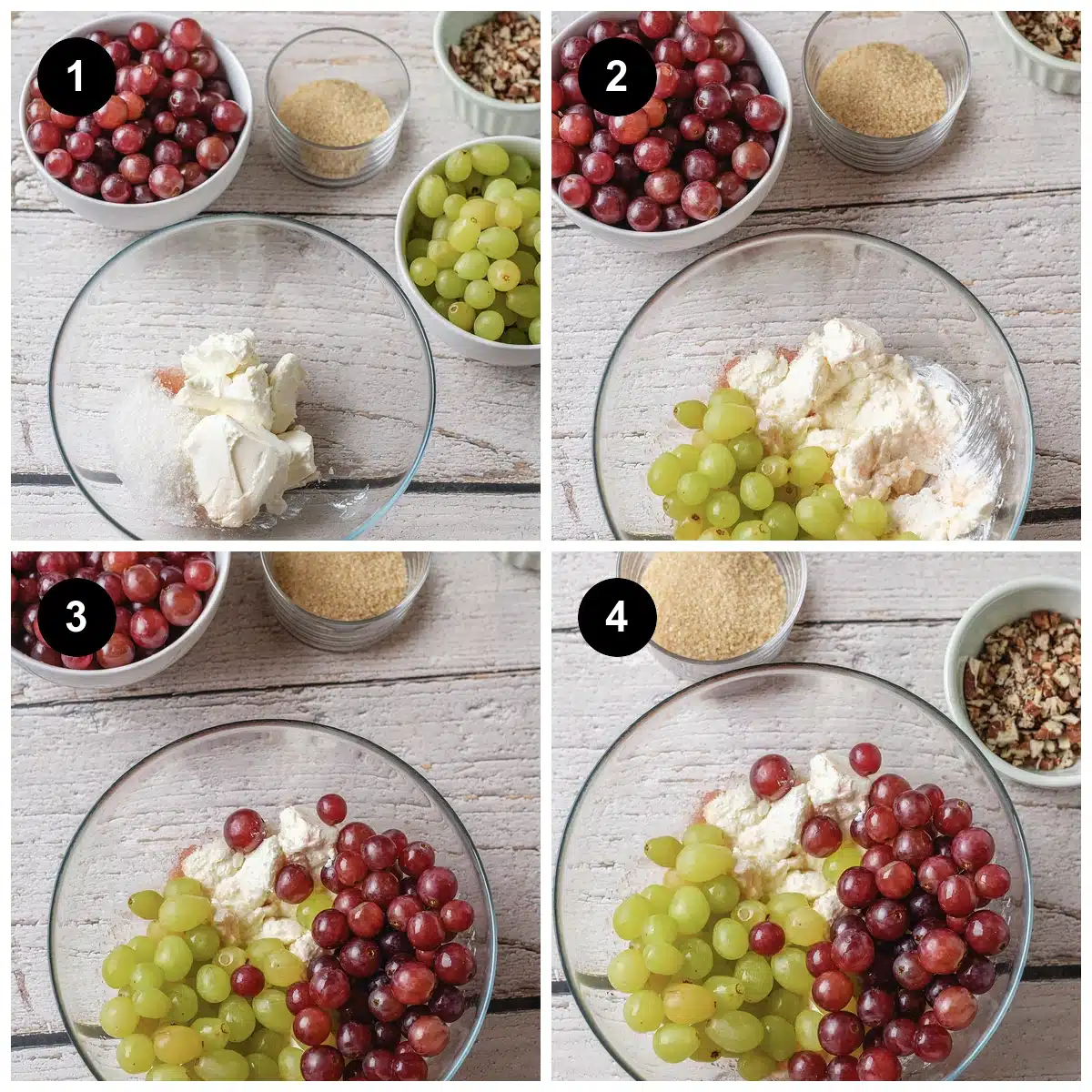
First, wash and dry the fruit. Pull the grapes off their stems, rinse them in a colander, then spread them in one layer on a clean kitchen towel. Leave them there while you make the dressing. They should look matte, not glossy, before they go anywhere near the bowl.
Next, beat the dressing. Put the softened cream cheese in a large bowl on its own and beat it for two minutes, scraping down the sides twice, until there is not a single lump left. Add the sour cream, the granulated sugar, and the vanilla, then beat for one more minute. The mixture should look like thick frosting and fall off the beater in a ribbon.
Then fold in the grapes. Use a spatula and a lifting motion rather than stirring in circles, and add the grapes in two batches so every one gets coated. Circular stirring bruises the skins, and bruised grapes weep.
Chill and Top It
After that, chill it. Transfer everything to your serving bowl, cover it, and refrigerate for at least an hour. This is not optional. The dressing firms up as it cools and the flavors settle into each other, and a grape salad served straight from the mixing bowl tastes flat.
Finally, top and serve. Just before the bowl goes on the table, scatter the brown sugar evenly across the surface, then the pecans over that. Do not stir them in. The topping is meant to be a crust you break through with the serving spoon.
How To Tell When the Dressing Is Right
Three checks, and all of them happen before the fruit goes in. The color should be uniform ivory with no white streaks; streaks mean the cream cheese was too cold. The texture should hold a soft peak for a second when you lift the beater. Flavor should land tangy first and sweet second, because the grapes are about to add a great deal of sugar of their own.
If it tastes sweet first, add another spoonful of sour cream. If it looks lumpy, keep beating rather than adding liquid; the lumps are cold fat and they will smooth out with another minute of work.
Make It Ahead
This is a genuinely good make-ahead dish, with one rule. Build the whole salad up to the topping, cover it, and refrigerate it for up to 24 hours. Keep the brown sugar and the pecans in a small container on the counter and add them at the last possible moment.
Assembled that way, the salad is better on day two than it is on day one. The dressing tightens, the grapes chill through, and the flavor of the vanilla comes forward. If you are cooking for a holiday table, this is the dish to get out of the way the night before.
Storing Grape Salad
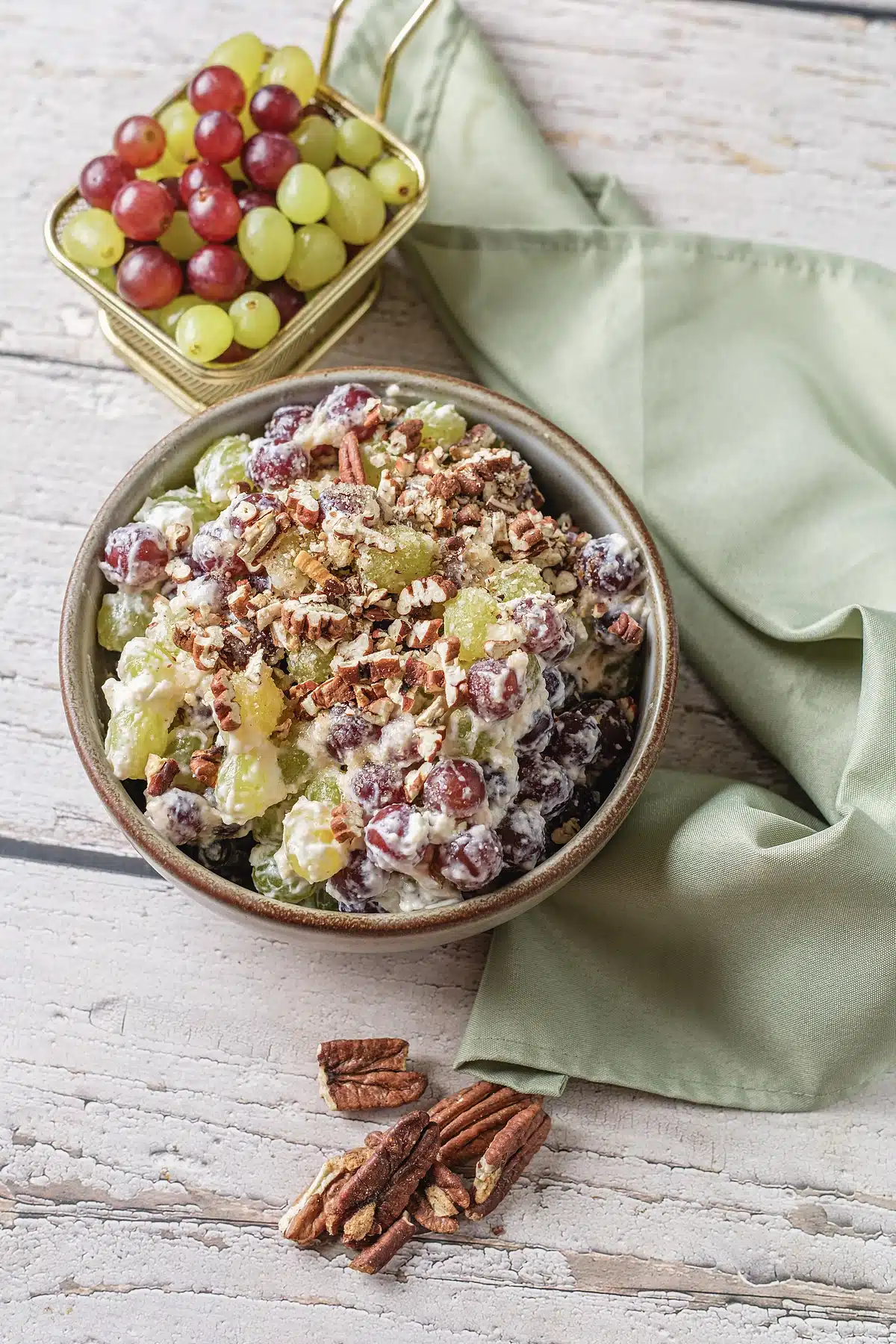
Covered tightly in the refrigerator, grape salad keeps for three days. After that the grapes begin to shrivel slightly and the dressing loosens, though it is still perfectly safe and perfectly edible. Give it a gentle fold before serving leftovers and add a fresh pinch of brown sugar and pecans.
Do not freeze it. Grapes turn to mush on thawing and the dairy separates, so you end up with something closer to a smoothie than a salad. If you have frozen grapes on hand, eat them straight from the bag; they are excellent that way and terrible in this dish.
One more storage note worth knowing: keep the bowl on a middle shelf rather than in the door. Temperature swings from the door opening are what start the weeping, and a grape salad that has been jostled and warmed repeatedly will separate faster than one that sat still and cold.
Scaling Grape Salad for a Crowd
The ratios in this recipe hold at any size, which is rare in a dressed salad. Double everything and you get roughly twenty servings out of a large mixing bowl. Triple it for a church supper and the only thing that changes is that you will want a stand mixer for the cream cheese, because beating three blocks smooth by hand is real work.
The one number that does not scale linearly is the topping. Brown sugar and pecans go on the surface, and surface area grows more slowly than volume, so a doubled grape salad in a wider bowl needs about one and a half times the topping rather than twice as much. Judge it by eye: you want an even layer that hides the fruit, not a drift.
For transport, mix the salad in the bowl you plan to serve from and carry the topping separately in a zip bag. Nothing about a grape salad survives being tipped from container to container at the other end.
Variations and Substitutions
Snickers style. Fold in chopped candy bars and diced apple just before serving for something closer to a Snickers salad. It is unapologetically a dessert at that point.
Lighter. Swap the sour cream for plain Greek yogurt and cut the sugar to a quarter cup. The dressing is tangier and thinner, and the grapes carry more of the sweetness.
Toasted coconut. A third of a cup of toasted coconut in place of half the pecans. It sounds odd and it works, especially with green grapes.
Nut free. Skip the pecans and use crushed graham crackers or toasted pepitas for the crunch. The brown sugar still does its job.
Citrus lift. Half a teaspoon of lemon zest in the dressing. This is the version to make when your grapes are very sweet and the whole bowl needs an edge.
What to Serve with Grape Salad
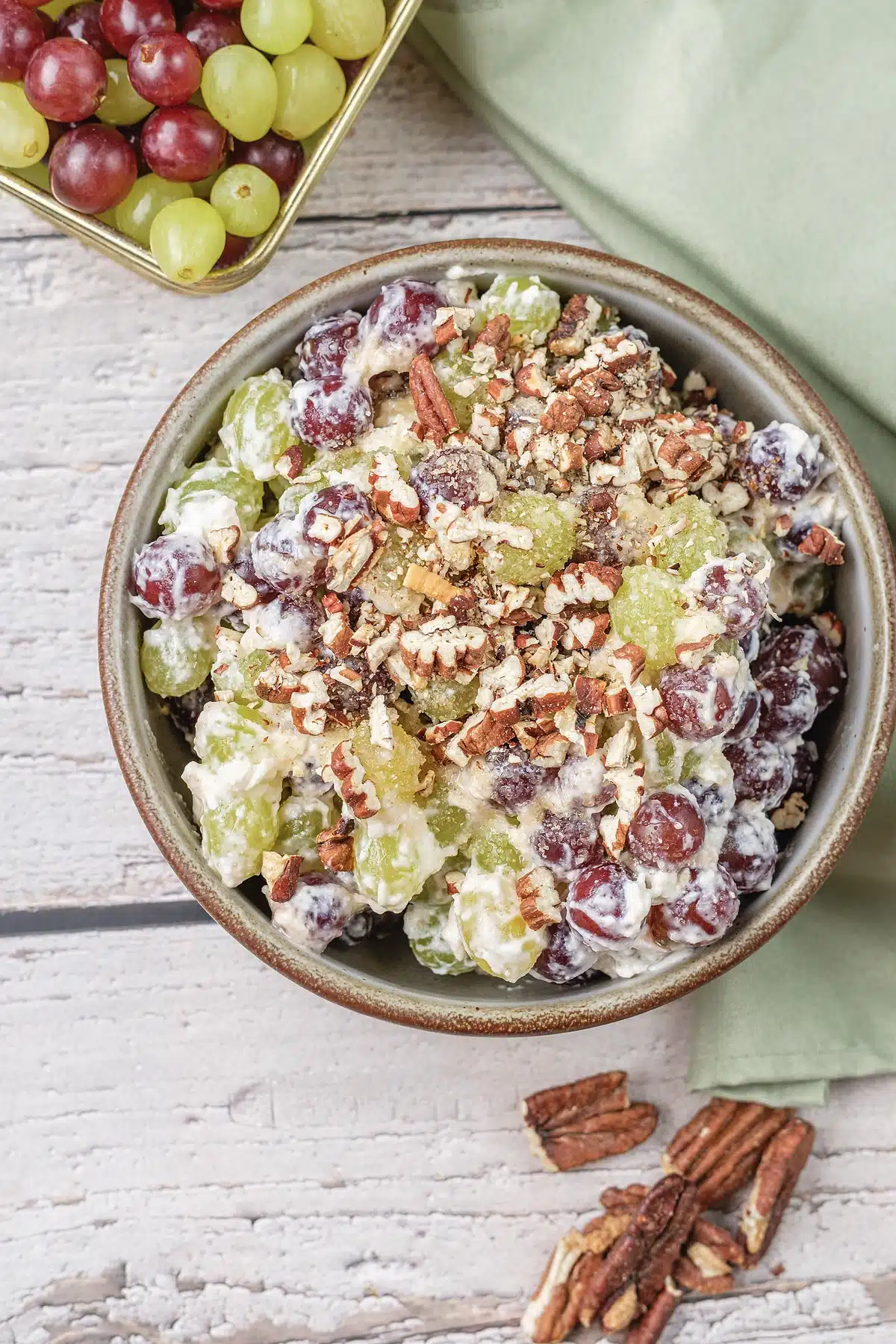
At a barbecue this sits next to pulled pork and baked beans and does the job that coleslaw usually does, which is to cool everything down. For brunch it goes beside a strata or a plate of bacon. At a holiday table it earns its place next to the ham, because the acidity in the dressing cuts through salt better than a sweet potato casserole does.
For a grazing table, a bowl of grape salad next to a cranberry pecan cheese ball covers both the sweet and the savory ends of the same flavor family, and both use the same block of cream cheese.
Portion it into small glasses or ramekins if you want it to read as a dessert rather than a side. Half a cup per person is generous, and the topping looks much better on a small surface than it does spread thin across a platter.
Grape Salad FAQ
Frequently Asked Questions
What are the ingredients in grape salad?
Seedless grapes, cream cheese, sour cream, granulated sugar and vanilla for the dressing, then light brown sugar and chopped pecans for the topping. That is eight items, and no cooking is involved.
What is the white stuff in grape salad?
It is a sweetened dressing of cream cheese and sour cream, whipped smooth. Some older recipes use whipped topping or marshmallow cream instead, which is sweeter and much softer.
What is the secret to a great grape salad?
Dry grapes and a topping added at the table. Everything else is straightforward, and those two habits are what separate a thick, glossy bowl from a watery one.
Should you cut grapes in half for grape salad?
Only for small children, where whole grapes are a choking risk. Otherwise leave them whole so they stay crisp and the dressing stays thick.
More Questions About Fruit Salads
Good to Know
Why did my salad turn watery?
Wet grapes, or the topping stirred in too early. Sugar draws water out of fruit, so brown sugar mixed through the bowl will thin the dressing within an hour.
Can I use only red grapes?
Yes, and it tastes the same. You lose the two tone look, which is a real part of why this bowl gets attention on a table, but nothing else changes.
Is this a side dish or a dessert?
Both, depending on the portion. In a big bowl with a spoon it is a side; in small glasses with extra pecans it is a dessert, and nobody at the table will argue either way.
If a cold bowl of fruit and cream is your idea of a good potluck contribution, the same logic runs through a classic Waldorf salad, which trades the grapes for apples and keeps the nuts.
Creamy Grape Salad
Save this recipe
Enter your email and I’ll send this recipe straight to your inbox.
Ingredients
Creamy Base
- 8 oz (226 g) cream cheese softened
- 1 cup (240 ml) sour cream
- 1/3 cup (67 g) granulated sugar
- 1 tsp (5 ml) vanilla extract
Grapes
- 2 lb (900 g) red seedless grapes washed and patted dry
- 2 lb (900 g) green seedless grapes washed and patted dry
Topping
- 1/2 cup (110 g) light brown sugar packed
- 1/2 cup (60 g) pecans chopped; toasted optional
Equipment
- Large mixing bowl
- Hand Mixer or Spoon
- Serving Bowl
Instructions
Whip the Dressing
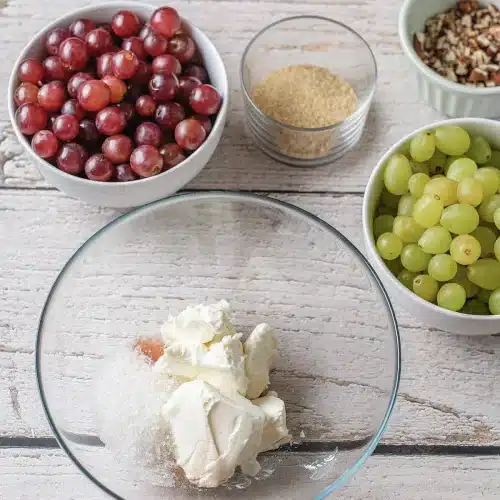
- Beat the softened cream cheese on its own in a large bowl for 2 minutes, scraping down the sides twice, until there is not a lump left in it.

- Add the sour cream, granulated sugar and vanilla extract. Beat for 1 more minute, until the mixture is glossy and falls off the beater in a ribbon.
Fold in the Grapes
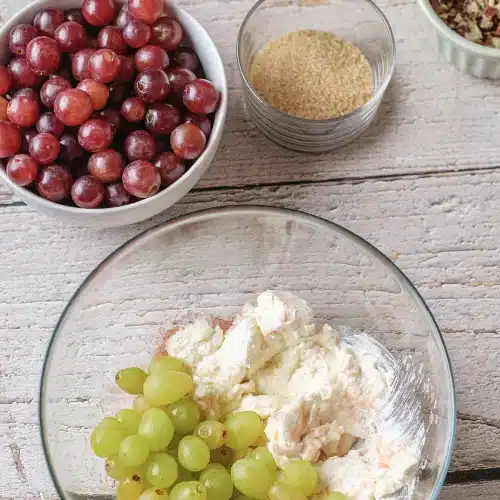
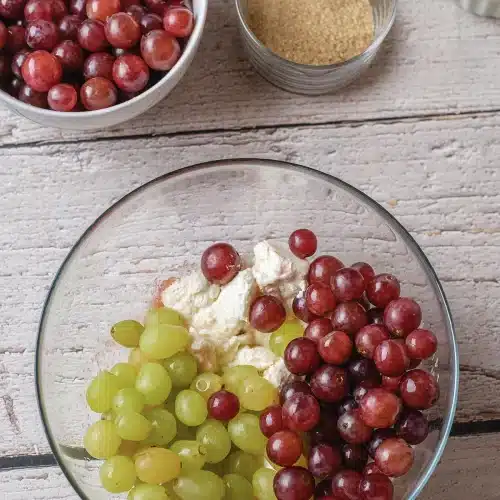
- Wash the grapes, spread them on a clean towel and dry them until the skins look matte rather than shiny. Add the green grapes to the bowl first.
- Add the red grapes and fold everything together with a spatula, lifting rather than stirring in circles, until every grape is coated.
Chill and Finish
- Transfer the salad to your serving bowl, cover it and refrigerate for at least 1 hour so the dressing firms up and the flavors settle.
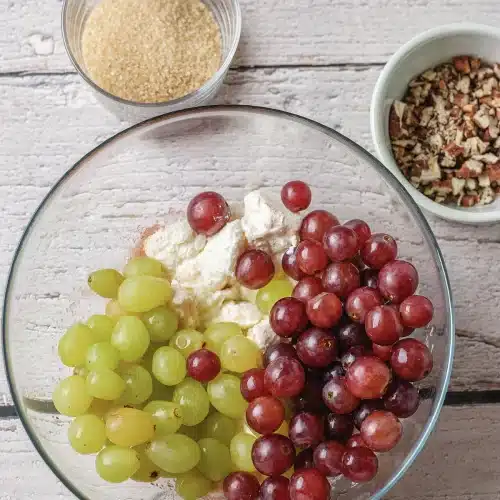
- Just before serving, scatter the light brown sugar evenly over the surface, then the chopped pecans. Do not stir the topping in.
Notes
Add the brown sugar and pecans only when the bowl goes to the table, so the topping stays crunchy.
Make-ahead: build the salad through the chilling step up to 24 hours in advance and keep the topping in a separate container.
Storage: refrigerate leftovers, covered, for up to 3 days. Do not freeze, because the grapes soften and the dairy separates.
Substitutions: plain Greek yogurt for the sour cream, walnuts or toasted pepitas for the pecans, or crushed graham crackers for a nut-free crunch.
For small children, halve the grapes lengthwise and pat them dry again before folding them in.
Nutrition values are an estimate.