
If you are standing over a pan of wontons right now, the fastest substitute for plum sauce is hoisin thinned with a little rice vinegar and a spoonful of apricot or plum jam, mixed one to one to one. It will not be identical, and nobody at your table will notice.
That is the answer. Everything below it exists because the right substitute for plum sauce depends entirely on what you are doing with the sauce. A glaze that gets brushed onto pork and roasted can take a much rougher stand-in than a dipping bowl set beside a plate of spring rolls, where the sauce is the only thing on the tongue. Below are eight options, what each one gets right, what each gets wrong, and the exact ratio to mix.

- A one-line answer at the top, for anyone cooking right now
- Every option carries a real ratio, not a vague suggestion to add sugar
- Sorted by what you are cooking: dipping, glazing, stir-frying or marinating
- A five-minute homemade version from jam, in a recipe card at the bottom
- Notes on which options are gluten-free and which are not
- The two common suggestions that genuinely do not work

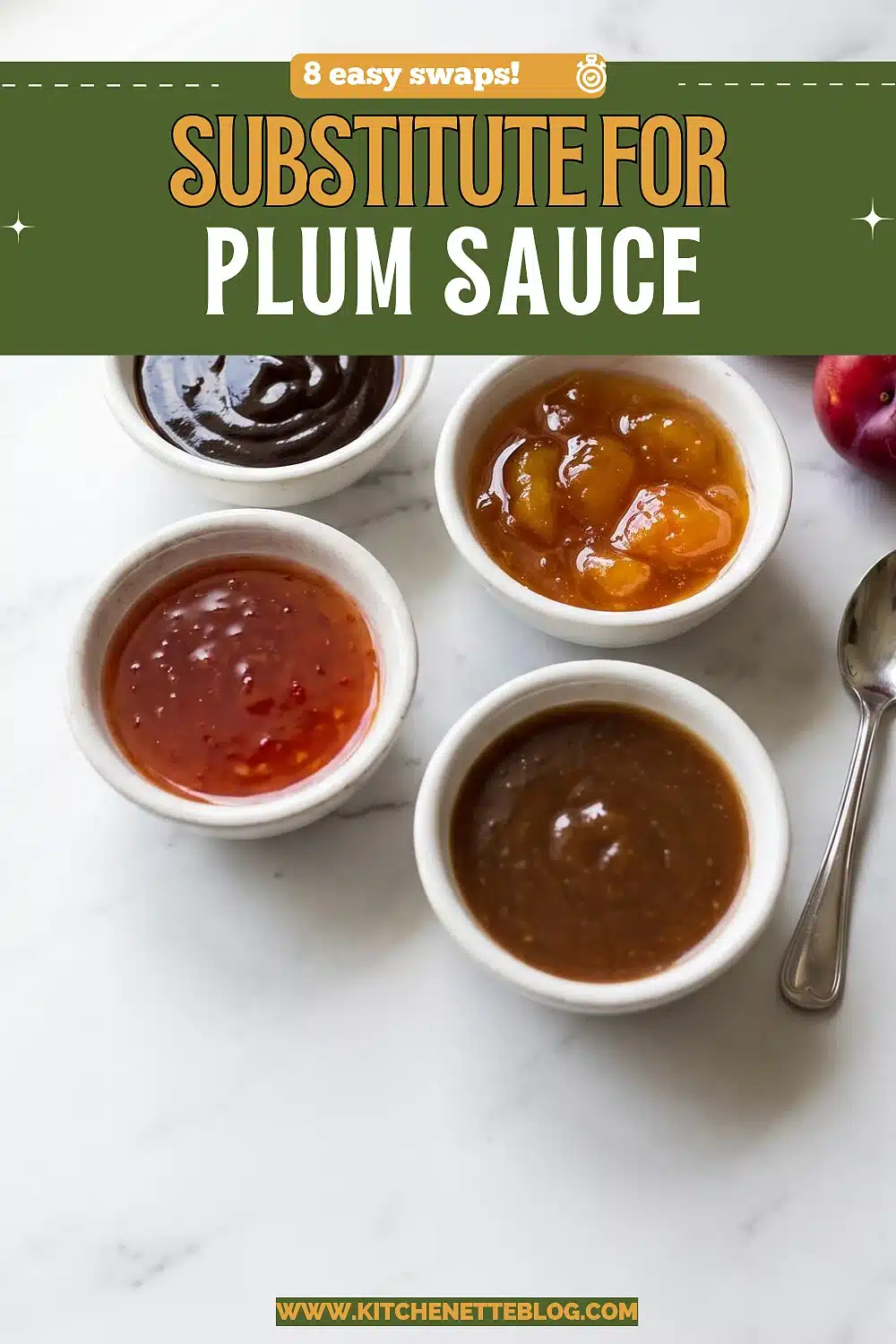
Plum sauce is doing three jobs at once, and any workable swap has to cover all three.
- The Fast Answer: The Best Substitute for Plum Sauce
- What Plum Sauce Actually Tastes Like
- Substitute for Plum Sauce: The Full Comparison
- Hoisin Sauce as a Substitute for Plum Sauce
- Duck Sauce, Sweet and Sour, and the American Confusion
- Apricot or Plum Jam: The Five-Minute Fix
- Choosing a Substitute for Plum Sauce by What You Are Cooking
- What Not to Use
- Storing Your Homemade Version
- Substitute for Plum Sauce FAQ
The Fast Answer: The Best Substitute for Plum Sauce
Rank every substitute for plum sauce by how close it lands and how likely you are to already own it.
| Option | Ratio | How close |
|---|---|---|
| Hoisin plus vinegar plus jam | 1 : 1 : 1 | Closest overall |
| Duck sauce, straight from the jar | 1 : 1 | Very close, sweeter |
| Apricot or plum jam plus rice vinegar | 3 : 1 | Close, needs salt |
| Hoisin sauce on its own | 1 : 1 | Good for glazing only |
| Sweet and sour sauce | 1 : 1 | Right sweetness, wrong aroma |
| Prunes simmered with soy and vinegar | see below | Close, ten minutes work |
| Cranberry sauce plus soy plus ginger | 4 : 1 : trace | Surprisingly workable |
| Teriyaki plus jam | 1 : 2 | Last resort, too salty |
If you have only one jar in the house and it is hoisin, use hoisin. If it is apricot jam, use the jam. Both are a better substitute for plum sauce than going without.
Save this recipe
Enter your email and I’ll send this recipe straight to your inbox.
What Plum Sauce Actually Tastes Like
You cannot judge a swap without knowing what you are matching. Chinese plum sauce, the thick amber stuff sold under names like Koon Chun and Lee Kum Kee, is built from four things.
Sweetness, from fruit rather than sugar alone. Salted or pickled plums are the base, sometimes with apricot or pineapple in commercial jars. The sweetness arrives with a fruit skin behind it, which is why straight sugar syrup never reads as plum sauce.
Sourness, from rice vinegar. Sharp and clean rather than the rounded sourness of lemon. This is the note most people forget when they build a substitute for plum sauce out of jam, and it is the reason a jam-only version tastes cloying.
Salt, usually from the cure on the plums. Not soy sauce salt, exactly, but enough that the sweetness has a floor under it.
Aromatics: ginger, garlic, chili and often star anise. This is the part that makes it taste Chinese rather than like fruit preserve. If your swap tastes close but somehow flat, it is almost always the aromatics that are missing.
Get sweet, sour, salt and aromatic in roughly that order of loudness and you have a passable substitute for plum sauce from almost any starting point.
Substitute for Plum Sauce: The Full Comparison
1. Hoisin, vinegar and jam. Equal parts hoisin sauce, rice vinegar and apricot or plum jam, whisked cold. Hoisin brings the fermented depth and the five spice notes, the jam brings fruit, the vinegar brings the missing sharpness. This is the best substitute for plum sauce you can make in thirty seconds.
2. Duck sauce. Use it one for one. In the United States the two names are used almost interchangeably, and the takeout packets are usually apricot rather than plum based. It is sweeter and thinner than the Chinese jar and a teaspoon of rice vinegar per quarter cup brings it back into line.
3. Apricot or plum jam plus vinegar. Three parts jam to one part rice vinegar, plus a pinch of salt and a grate of fresh ginger. Warm it for a minute so the jam loosens. This is the version I make most often because the ingredients live in every kitchen.
4. Hoisin on its own. Darker, saltier and considerably more savory. It works beautifully brushed onto ribs or duck, where the caramelizing does the sweetening for you, and it is too heavy as a dipping sauce without thinning.
Four More Options Worth Knowing
5. Sweet and sour sauce. The sugar and acid balance is right, the aromatics are not. Add a quarter teaspoon of five spice powder and a little grated ginger per half cup and it moves a long way toward plum sauce.
6. Prunes, soy and vinegar. Prunes are dried plums, so this is the most honest option on the list. Simmer eight prunes in half a cup of water for ten minutes, then blend with a tablespoon each of soy sauce and rice vinegar, a grated garlic clove and a pinch of chili. It is genuinely good.
7. Cranberry sauce, soy and ginger. Four parts jellied cranberry to one part soy, plus grated ginger. The sharpness is already there, which is more than most fruit preserves can say. Odd on paper and it works.
8. Teriyaki plus jam. One part teriyaki to two parts jam. Teriyaki is much saltier and carries mirin sweetness that reads as Japanese rather than Cantonese, so this is a genuine last resort.
Hoisin Sauce as a Substitute for Plum Sauce
Hoisin deserves its own section because it is the substitute for plum sauce most people reach for, and the one most often used wrongly.
Hoisin is built on fermented soybean paste, with sugar, vinegar, garlic, chili and five spice. Plum sauce is built on fruit. They overlap on aromatics and diverge completely on base. That means hoisin is saltier, darker, thicker and far more savory, and it will dominate anything delicate.
Where it works without help: brushed on pork, duck or ribs before roasting, stirred into a stir-fry sauce, or used in a marinade. Anywhere heat and other ingredients will absorb it.
Where it needs help: in a dipping bowl. Thin it with rice vinegar and sweeten it with jam or honey, one part each to one part hoisin, and it becomes a proper substitute for plum sauce rather than simply a different sauce.
One thing worth knowing: most commercial hoisin contains wheat, and most plum sauce does not. If you are cooking for someone avoiding gluten, the jam and vinegar route is the safer swap.
Duck Sauce, Sweet and Sour, and the American Confusion
Three sauces, three different things, endlessly muddled on menus.
Duck sauce is the American cousin. The packets that come with egg rolls are usually apricot based, thinned with water and corn syrup, and they contain little or no plum. It is the closest thing on any supermarket shelf and it is genuinely fine.
Sweet and sour sauce is a different family altogether: sugar, vinegar and often ketchup or pineapple juice, thickened with cornstarch and frequently dyed red. The balance of sweet against sour is similar. The fruit depth and the star anise are not.
Plum sauce proper is thicker than both, browner than both, and tastes of preserved fruit rather than syrup.
The practical upshot: if a recipe asks for plum sauce and you reach for duck sauce, do nothing else. If you reach for sweet and sour, add five spice and ginger.
Apricot or Plum Jam: The Five-Minute Fix
This is the substitute for plum sauce I actually use, and the one in the recipe card below.
Jam gives you fruit sweetness and body in one move, which is most of the work done. What it lacks is acid, salt and aroma, and all three are a spoon away. Rice vinegar for the sharpness, soy sauce for the salt and a little color, then ginger, garlic, five spice and chili flakes for the rest.
Apricot jam is closer than you would guess, because commercial plum sauce often contains apricot anyway. Plum jam is the obvious choice if you have it. Damson, greengage and even fig all work. Avoid anything with added citrus peel.
If you have fresh plums rather than jam, cook them down first. The National Center for Home Food Preservation notes that you should select firm, ripe fruit soft enough to yield to slight pressure, which is exactly the ripeness that breaks down fastest in a pan. Halve and stone about six, simmer with a splash of water until collapsed, then treat the result as jam.
How To Make a Quick Substitute for Plum Sauce
Exact amounts are in the recipe card at the bottom of the page.
- First, warm the jam with a tablespoon of water in a small pan over low heat, just until it loosens and pours.
- Next, whisk in the rice vinegar and soy sauce off the heat, so nothing reduces and turns sticky.
- Then stir in the grated ginger, grated garlic, five spice and chili flakes, and let it sit for five minutes.
- Finally, taste it against whatever you are serving. Add vinegar if it is cloying, soy if it tastes thin, and a pinch of sugar only if the jam was unusually tart.
Choosing a Substitute for Plum Sauce by What You Are Cooking
The same swap can be excellent in one dish and wrong in the next.
- Dipping, for spring rolls, wontons or egg rolls: duck sauce, or the jam and vinegar mix. Nothing salty, because the sauce is tasted on its own.
- Glazing, for ribs, duck or pork: hoisin straight, or hoisin loosened with jam. The oven caramelizes it and covers a multitude of sins. Try it on smoky pork spare ribs in place of the usual barbecue mop.
- Stir-frying: hoisin plus a spoon of jam, thinned with stock. Depth matters more than fruit once it meets a hot wok, as in a Hunan chicken stir fry.
- Marinating: anything with soy in it already. The salt is doing structural work here, so hoisin or teriyaki beat jam. This is what I brush onto teriyaki chicken skewers.
- Finishing a noodle bowl: the prune version, which stays glossy and does not turn to syrup on hot noodles.
- Cold, on a cheese or charcuterie board: plum or damson jam on its own, with no adjustment at all.
For something in a similar register but built from scratch, my General Tso sauce uses the same sweet, sour and aromatic logic.
What Not to Use
Two suggestions come up constantly online as a substitute for plum sauce, and both produce something you will throw away.
Ketchup and brown sugar. The tomato is unmistakable and no amount of five spice hides it. It reads as a bad barbecue sauce, not as a substitute for plum sauce, and the vinegar in ketchup is the wrong kind of sharp.
Plain honey or maple syrup. Sweetness without fruit or acid, which leaves you with a sticky coating and nothing else. If honey is genuinely all you have, add rice vinegar and soy in equal measure and treat it as a base rather than an answer.
Worth a mention: oyster sauce and black bean sauce are not swaps either. Both are savory to the point of having no sweetness to build on.
Storing Your Homemade Version
- Refrigerator: up to 3 weeks in a clean sealed jar. The vinegar and the sugar in the jam are doing the preserving.
- Freezer: up to 6 months. Freeze it in an ice cube tray and bag the cubes, so you can thaw one portion at a time.
- Thickening: it firms considerably when cold. Let it come to room temperature or stir in a teaspoon of warm water before serving.
- Doubling: the recipe scales cleanly, and a double batch is barely more work than a single one.
- When to throw it out: any mold on the surface, any fizz, or a smell that has turned alcoholic. Sugar ferments quietly.
Here is what readers ask most often.
Substitute for Plum Sauce FAQ
Frequently Asked Questions
Are plum sauce and hoisin the same?
No. They share their aromatics, which is why they smell alike in the jar, but they are built on completely different bases. Plum sauce starts with fruit, usually salted plums with apricot or pineapple alongside, so it is sweet and tart. Hoisin starts with fermented soybean paste, so it is salty, dark and savory with sweetness added afterward. Hoisin works as a substitute for plum sauce in cooked dishes and glazes, where its saltiness gets absorbed, but it needs thinning with vinegar and sweetening with jam before it belongs in a dipping bowl.
What is plum sauce called in the US?
Duck sauce, most of the time. The little packets that arrive with egg rolls are labeled duck sauce and contain no duck, and are usually built on apricot rather than plum. On supermarket shelves you will also see it as Chinese plum sauce or, on Cantonese jars, as sour plum sauce or su mei jiang. They are close enough to swap one for one, with the caveat that the American version tends to be sweeter and thinner than the Chinese one.
Is plum sauce the same as sweet and sour sauce?
No, although the confusion is understandable because both balance sugar against vinegar. Sweet and sour sauce is usually built from sugar, vinegar, ketchup or pineapple juice and cornstarch, and is often colored red. Plum sauce is thicker, browner and tastes of preserved fruit, with star anise and ginger behind it. Sweet and sour makes a serviceable substitute for plum sauce if you stir in a quarter teaspoon of five spice powder and some grated ginger per half cup.
More Questions About Plum Sauce and Its Stand-Ins
Good to Know
What to use if you don’t have plum extract?
Worth separating out, because plum extract and plum sauce are different products. Extract is a concentrated flavoring used in baking and, as maesil syrup, in Korean cooking. For sweetness with plum character, thin plum or damson jam with a little water. For the sour, funky note in Korean recipes, umeboshi paste or ume plum vinegar is far closer.
Is plum sauce gluten-free?
Usually, but check the label. Traditional plum sauce is fruit, sugar, vinegar and spice, none of which contain gluten. Hoisin almost always contains wheat, and so does most soy sauce, so the obvious swap is the one that fails here. Build your substitute for plum sauce from jam, rice vinegar, tamari and fresh aromatics and it stays gluten-free throughout.
Can I use plum jam straight from the jar?
On a board or beside cold meat, yes. In place of a cooking sauce, no, because it is missing everything except sweetness. A tablespoon of rice vinegar and a teaspoon of soy per third of a cup of jam takes twenty seconds and makes the difference.
What is plum sauce used for?
Mostly as a dip for fried things, which is where most jars end up: spring rolls, wontons, egg rolls and crab rangoon. It is also brushed onto roast duck and pork as a glaze, stirred into stir-fry sauces, and used as the sweet element in a marinade.
Keep a jar of hoisin and a jar of apricot jam in the cupboard and you are never actually out. For another sauce that rewards ten minutes of whisking, try my General Tso sauce.
Five-Minute Plum Sauce Substitute
Save this recipe
Enter your email and I’ll send this recipe straight to your inbox.
Ingredients
The Base
- 1/3 cup apricot or plum jam not a jelly, and nothing with citrus peel
- 1 tablespoon water
- 2 teaspoons rice vinegar plus more to taste
- 2 splashes soy sauce about 2 teaspoons, or tamari to keep it gluten-free
The Aromatics
- 1 teaspoon fresh ginger finely grated
- 1 clove garlic finely grated
- 1/4 teaspoon Chinese five spice powder
- 1/4 teaspoon red pepper flakes or a pinch of ground chili
- 1 pinch fine salt only if the jam was unsweetened
Instructions
Warm and Whisk
- First, warm the jam with the water in a small pan over low heat for about 2 minutes, just until it loosens enough to pour. Do not let it bubble or it will reduce and turn sticky.
- Next, take the pan off the heat and whisk in the rice vinegar and the soy sauce. Adding the acid off the heat keeps it sharp rather than cooking it away.
Balance and Rest
- Then stir in the grated ginger, grated garlic, five spice and red pepper flakes, and leave it to sit for 5 minutes so the raw aromatics soften into the fruit.
- Finally, taste it with a piece of whatever you are serving in your hand. Add vinegar if it is cloying, soy if it tastes thin, and salt only if the jam was unsweetened. Pour it into a clean jar once it is cool.