
The first thing worth knowing about yogurt covered pretzels is that the ones in the snack aisle contain almost no yogurt. The coating is a confectionery coating built on sugar and palm kernel oil, with a little dried yogurt powder somewhere down the list for the name.
That is not a scandal, it is just food manufacturing, and it explains why homemade yogurt covered pretzels behave so differently. Real yogurt brings water, water refuses to set hard at room temperature, and so the honest home version lives in the freezer. Once you accept that, they are a fifteen minute job and better than the bag.
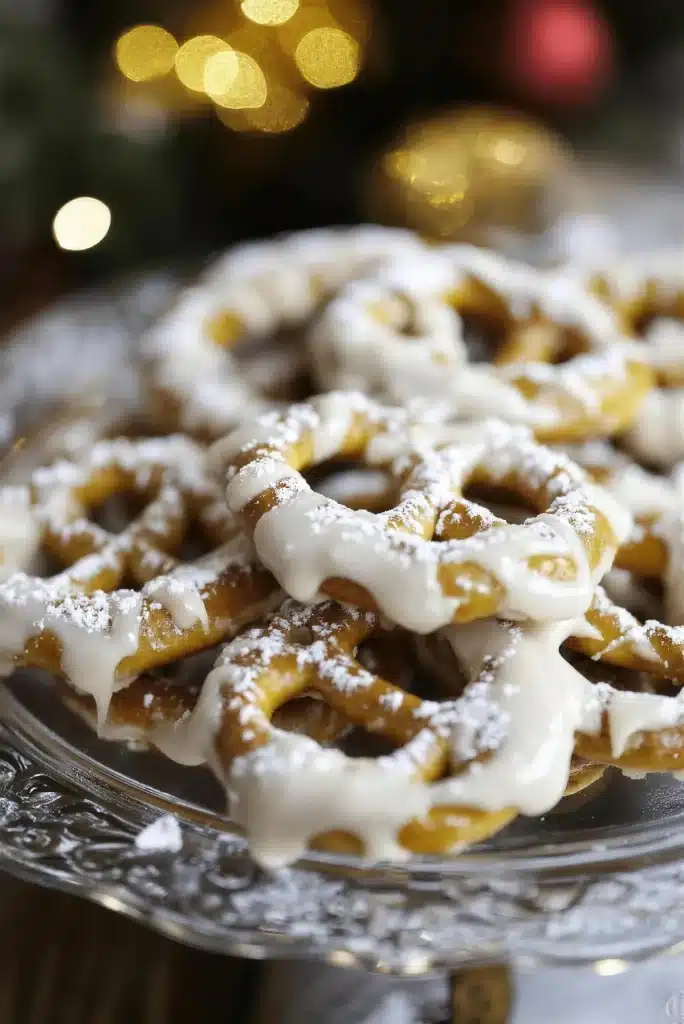
- Three ingredients, no thermometer, and nothing to melt or temper
- Actual Greek yogurt, so there is real tang instead of flat sweetness
- Fifteen minutes of work and the freezer does the rest
- You control the sugar, which the snack aisle version does not let you do
- They freeze for three months, so a holiday tin can be built weeks early
- A room-temperature version is included for gift boxes and mailed tins


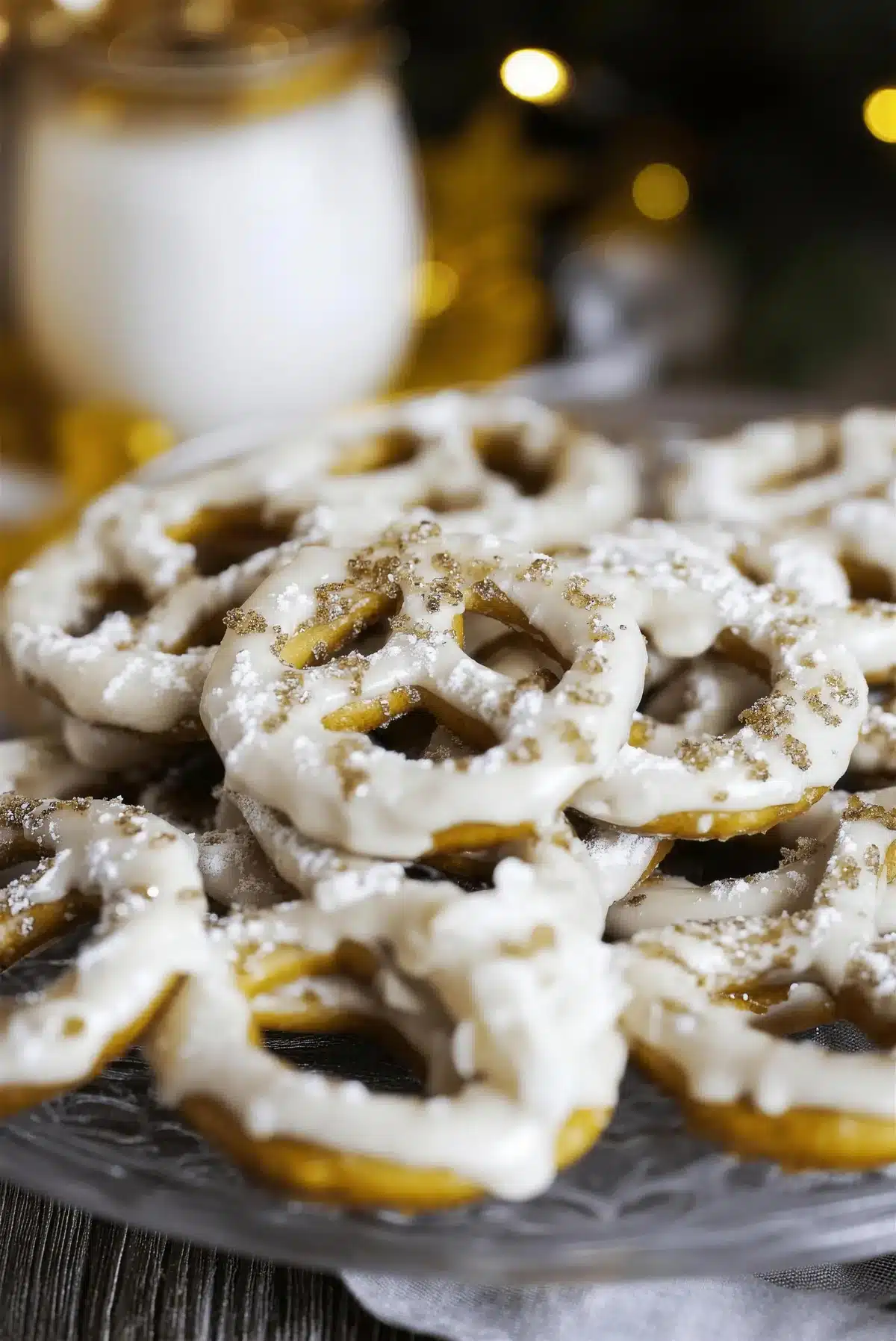
Two things decide how yogurt covered pretzels turn out: how thick the yogurt is before it meets the sugar, and how cold the tray is when the pretzels land on it.
- What the Coating on Store-Bought Pretzels Is
- Ingredient Notes
- Frozen or Set Hard: Two Ways to Make Yogurt Covered Pretzels
- How To Make Yogurt Covered Pretzels
- How To Tell When the Coating Is Set
- Make It Ahead
- Storing Yogurt Covered Pretzels
- Variations and Substitutions
- What to Serve with Yogurt Covered Pretzels
- Yogurt Covered Pretzels FAQ
What the Coating on Store-Bought Pretzels Is
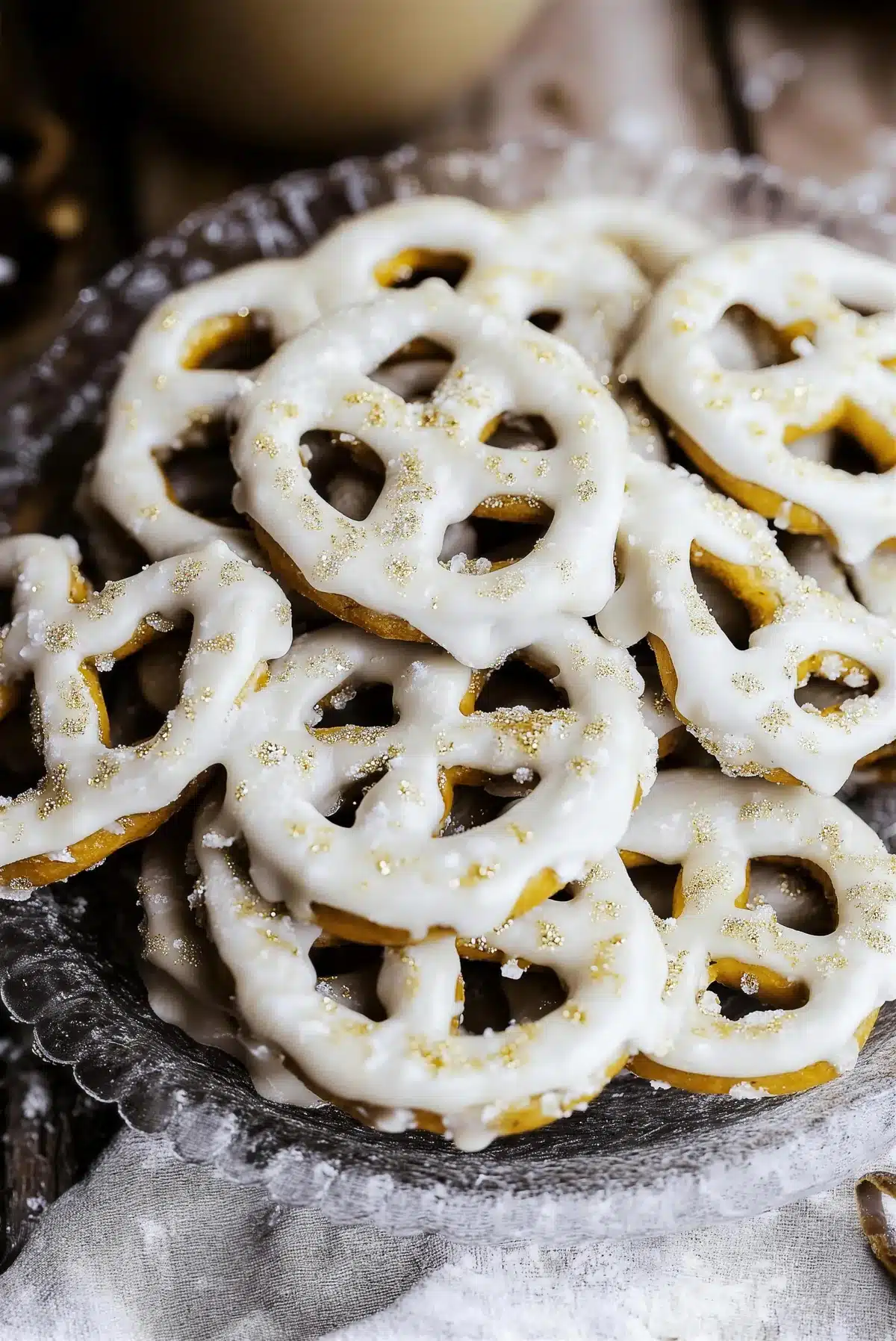
Turn a bag of Sun-Maid or Albanese around and read the coating line. The order runs sugar, hydrogenated palm kernel oil, nonfat dry milk, dry nonfat yogurt, whey, soy lecithin and vanilla, often finished with confectioner’s glaze so they do not stick together.
Sugar first, fat second, and the yogurt itself is a dried powder present in small amounts for flavor and for the label. That combination is what lets a factory pretzel sit on a warm shelf for nine months without softening or sweating.
Yogurt itself is a genuinely useful food. Illinois Extension notes that yogurt is fermented by live bacterial cultures that support digestive health, and that Greek yogurt carries roughly double the protein of regular yogurt because the whey has been strained away. None of that survives being dried, heated and blended into palm kernel fat.
So homemade yogurt covered pretzels are not a copy of the bag. They are a different and better-tasting thing that happens to look identical, and the one trade is that they have to stay cold.
Save this recipe
Enter your email and I’ll send this recipe straight to your inbox.
Ingredient Notes
Yogurt covered pretzels need three ingredients, plus whatever you scatter over the top. Exact amounts are in the recipe card below.
- Greek yogurt: whole milk, plain, and thick enough to hold a spoon upright. Low-fat works and tastes thinner. Regular unstrained yogurt does not work at all, because the extra water makes a glaze that slides straight off.
- Powdered sugar: two and a half cups, sifted if the box has been open a while. This is doing two jobs, sweetening and thickening, which is why the quantity looks alarming next to one cup of yogurt.
- Mini pretzel twists: eight ounces, which is most of a standard bag. Twists hold more coating in their loops than sticks or snaps do, and the salt is the entire point of the contrast.
- Vanilla: a teaspoon. The commercial coating is vanilla-flavored and a plain sugar glaze tastes noticeably blank without it.
- Salt: a pinch in the glaze, even though the pretzels are salted. It sharpens the tang rather than making anything taste salty.
- Chocolate and sprinkles: optional. A quarter cup of melted chocolate drizzled over half the tray and sanding sugar on the other half gives one batch two looks.
Use a fork or a dipping tool rather than your fingers. Warm hands melt the glaze at the exact moment you need it to hold.
Frozen or Set Hard: Two Ways to Make Yogurt Covered Pretzels
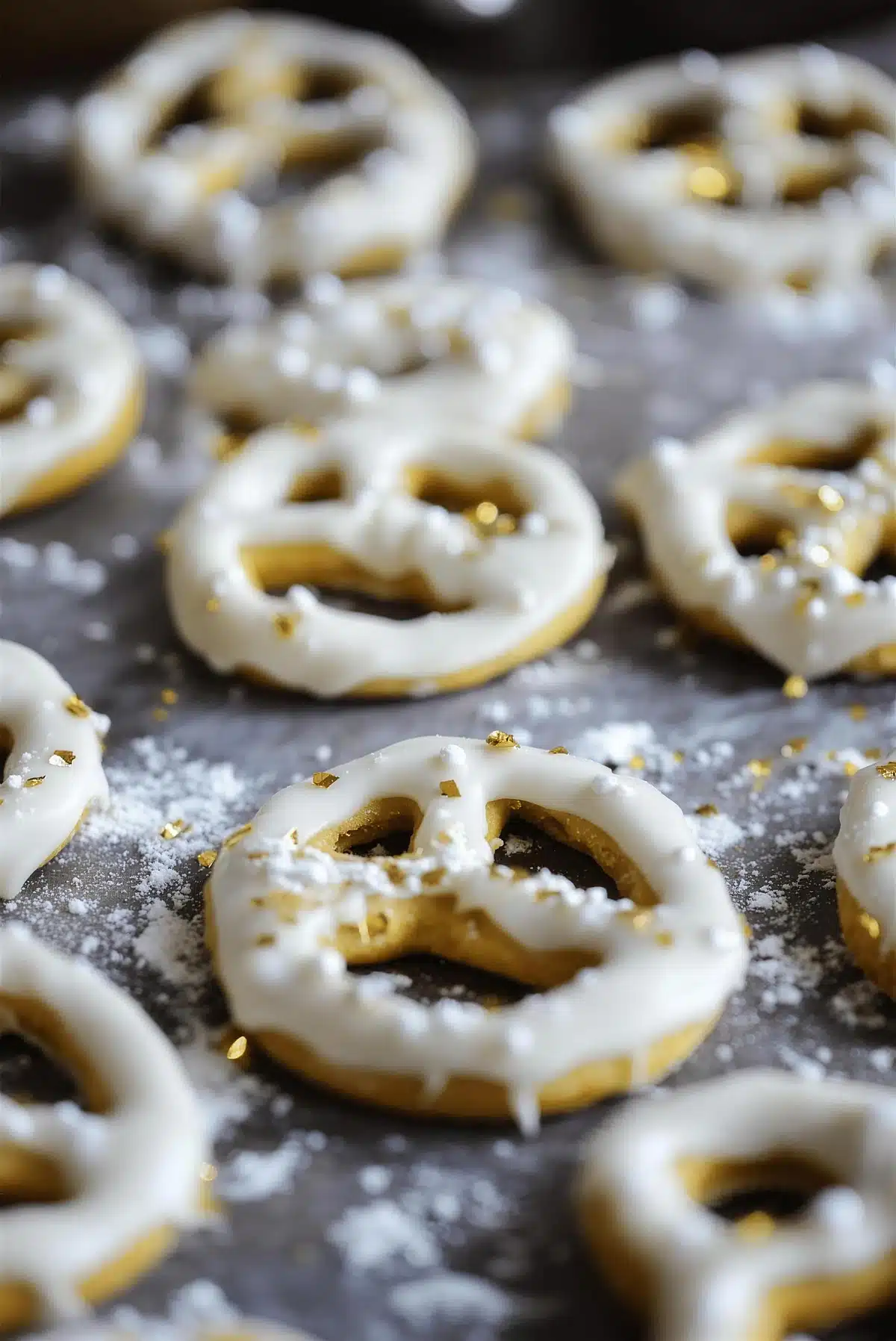
Both are legitimate. They are simply built for different jobs, and choosing the wrong one is why people end up with a sticky plate.
The yogurt version, which is this recipe. Greek yogurt, powdered sugar, vanilla. Real tang, real cultures, fifteen minutes of work. It sets firm in the freezer and stays firm for about ten minutes on a table before it starts to soften and weep. Serve it straight from the freezer and nobody ever notices.
The set-hard version. Melt twelve ounces of white confectionery wafers, stir in two tablespoons of powdered yogurt or buttermilk powder, and dip the same way. This one behaves exactly like the bag: hard shell, stable at room temperature, fine in a gift tin or a lunchbox for a week.
What does not work is stirring wet Greek yogurt into melted white chocolate. Water seizes chocolate on contact and you get a grainy paste in about four seconds. If you want tang in a hard shell, the yogurt has to arrive as a powder.
Both make yogurt covered pretzels that look the same in a bowl. Decide by where they are going: freezer to table, or wrapped and mailed.
How To Make Yogurt Covered Pretzels
Line the tray and clear freezer shelf space before you mix anything, because yogurt covered pretzels have to be dipped fast once the sugar goes in.
- First, line a sheet pan with parchment or wax paper and put it in the freezer to chill while you work.
- Next, whisk the Greek yogurt, powdered sugar, vanilla and salt until completely smooth. It should ribbon off the whisk and sink back in about 3 seconds.
- Then drop a pretzel in, turn it once with a fork, lift it out and tap the fork on the rim of the bowl six or seven times to shed the excess.
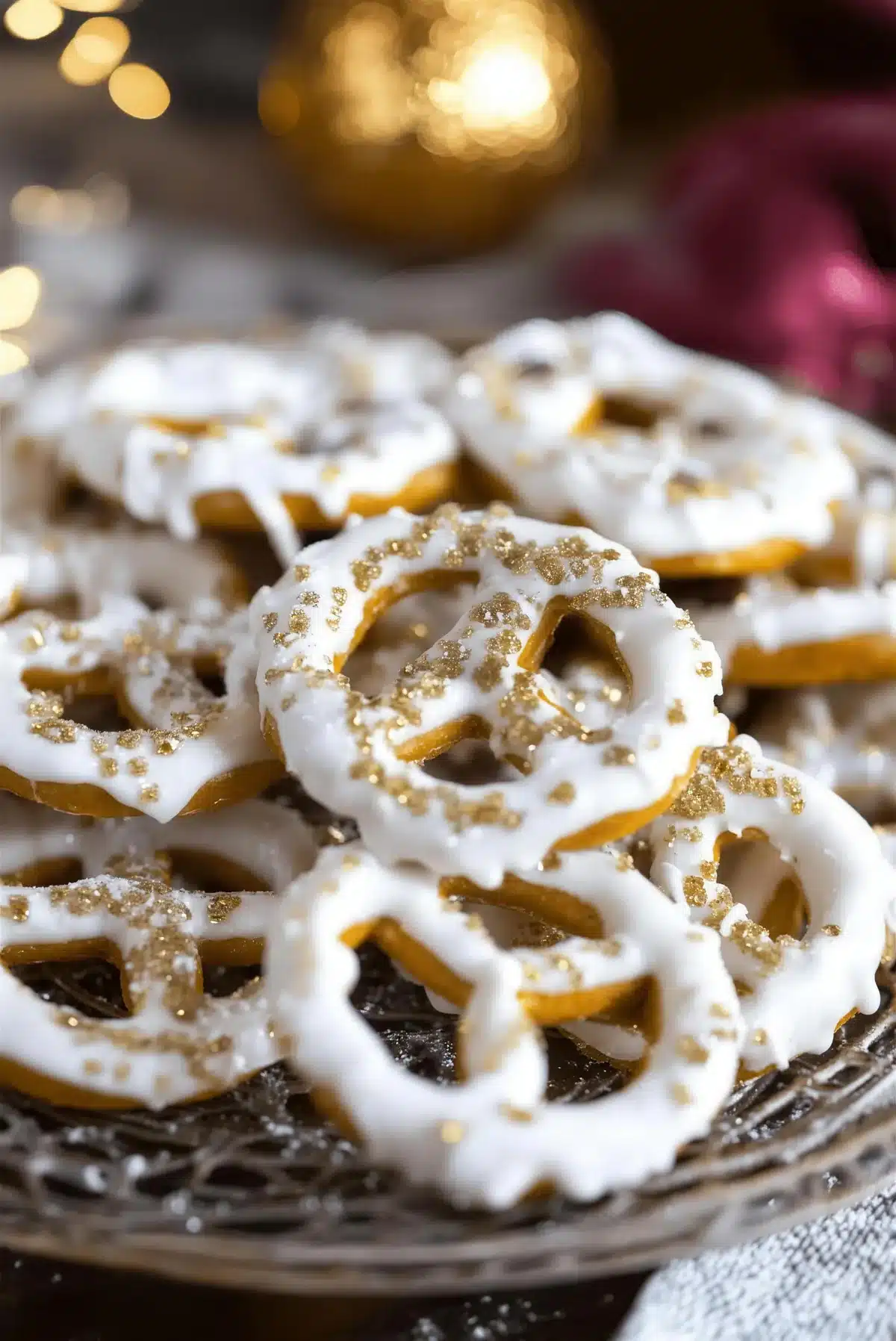
- After that, set each one on the cold tray with a little space around it, and scatter sprinkles on while the surface is still wet.
- Finally, freeze the tray flat for at least 2 hours, then drizzle melted chocolate over half of them and return the tray to the freezer for ten minutes to fix it.
Dipping Without Coating Your Fingers
Drop the pretzel in and never pick it up with your hands. A regular dinner fork works: slide the tines under the pretzel, lift it flat, and let it sit on the fork while you tap.
A chocolate dipping fork is better and costs almost nothing, because the thin tines hold less glaze and release cleanly.
If a pretzel slides off the fork onto the tray upside down, leave it. Trying to flip a wet one smears the coating and it will look worse than the accident did.
Work in batches of eight or ten. The glaze thickens as it sits, and a stiff bowl is what gives you those thick, uneven shells that never quite smooth out.
How To Tell When the Coating Is Set
Press the top of one of the yogurt covered pretzels with a fingertip after ninety minutes. A set pretzel feels firm and slightly waxy and leaves nothing on your finger. An unset one dimples.
Two hours is the safe number for a full tray. A single layer of minis can be done in ninety minutes, and a crowded tray takes closer to three hours because the pieces insulate each other.
They will never go crisp and glassy the way a chocolate shell does. Frozen yogurt glaze sets firm but stays slightly yielding, which is correct and not a fault in your batch.
The real test is the ten minute test. Take one out, leave it on the counter, and watch. Beads of moisture after about ten minutes confirm that yogurt covered pretzels are freezer-to-table food, which is exactly what they are.
Make It Ahead
Yogurt covered pretzels are one of the easiest holiday jobs to move forward, and there is no penalty for doing it early.
Make the whole batch up to three months ahead and leave it in the freezer in a sealed container. The coating does not crack, dull or absorb odors the way chocolate does.
The glaze itself can be mixed a day ahead and refrigerated, though it stiffens considerably in the cold. Let it sit out for twenty minutes and whisk in a teaspoon of milk to bring it back to a ribbon.
Do not dip more than a day before serving if you plan to keep them refrigerated rather than frozen. In the refrigerator the coating slowly softens and begins to pull moisture out of the pretzel, and by day two the crunch underneath is gone.
Storing Yogurt Covered Pretzels
- Freezer: up to 3 months in a sealed container with parchment between the layers. This is the only long-term option for the yogurt version.
- Refrigerator: up to 2 days, and the pretzel softens noticeably by the end of it.
- Room temperature: about ten minutes on a plate. Put out a small bowl and refill it rather than setting the whole batch out at once.
- The set-hard version: two weeks in an airtight tin at room temperature, away from any heat source, which is what makes it the one to mail.
- Never a warm car. Both versions turn into a solid welded block, and the yogurt one is a genuine food safety problem after a couple of hours.
Variations and Substitutions
In yogurt covered pretzels the yogurt, the sugar and the pretzel are structural. Everything else is decoration.
- Strawberry: a tablespoon of freeze-dried strawberry powder in the glaze, which colors it pink and tastes like the Sun-Maid mixed bags.
- Peanut butter: two tablespoons of powdered peanut butter whisked in, adding flavor without the loose oil that seizes the glaze.
- Dark chocolate drizzle: half the tray drizzled, half left plain, so one batch reads as two things on a platter.
- Peppermint: a quarter teaspoon of peppermint extract and crushed candy cane over the top for a December tin.
- Gluten-free: gluten-free pretzel twists behave identically, though they are more brittle, so dip them with a lighter hand.
- Other dippers: the same glaze coats yogurt covered raisins, banana coins, dried apricots and animal crackers.
What to Serve with Yogurt Covered Pretzels
Yogurt covered pretzels are sweet, salty and cold, so put them next to things that are none of those.
- On a cookie platter beside something soft and warm-spiced, such as churro cookies.
- In a movie-night bowl with popcorn and salted almonds, where the cold coating is the whole trick.
- As part of a holiday tin with funfetti shortbread bites, using the set-hard version so nothing has to be shipped frozen.
- Alongside white chocolate raspberry cookies, which share the palette and not the texture.
- Crushed over vanilla ice cream, which is the best possible use for the broken ones at the bottom of the container.
Here is what readers ask most often.
Yogurt Covered Pretzels FAQ
Frequently Asked Questions
What is the coating on yogurt pretzels?
On the commercial ones it is a confectionery coating rather than yogurt. The ingredient list typically opens with sugar and hydrogenated palm kernel oil, followed by nonfat dry milk, dried nonfat yogurt, whey, soy lecithin and vanilla, and it is often sealed with confectioner’s glaze. The palm kernel fat is what makes the shell snap and stay stable on a warm shelf. Homemade yogurt covered pretzels use real yogurt instead, which tastes better and behaves differently, since real yogurt contains water and water will not set hard at room temperature.
Are yogurt-covered pretzels a healthy snack?
They are a candy, and they are worth treating as one. Sugar is the first ingredient in the store-bought coating, and a one ounce serving runs around 130 calories with roughly 12 grams of sugar, which is not meaningfully different from a similar weight of chocolate. The homemade version has the same problem in a nicer form, though you control the sugar and get real cultured yogurt instead of powder. What they are not is a health food dressed up in a white coat.
Can you use Greek yogurt for yogurt covered pretzels?
Yes, and it is the only kind I would use. Greek yogurt has been strained, so it has far less water than regular yogurt, and less water means a glaze that clings instead of running off. It also carries about twice the protein and considerably more tang, which stands up to two and a half cups of powdered sugar. Whole milk Greek yogurt coats best. The one thing Greek yogurt cannot do is go into melted white chocolate, because any moisture seizes it instantly.
More Questions About Coating and Storage
Good to Know
How do you make yogurt dipped pretzels?
Whisk one cup of thick Greek yogurt with two and a half cups of powdered sugar, a teaspoon of vanilla and a pinch of salt until smooth. Dip mini pretzel twists one at a time with a fork, tap off the excess against the rim of the bowl, and lay them on a chilled parchment-lined tray. Add sprinkles while the surface is wet, then freeze flat for two hours. Keep them frozen until you serve them.
Why is my glaze running off?
Almost always because the yogurt was too thin. Regular unstrained yogurt has far too much water, and even Greek yogurt varies between brands. Strain it through a coffee filter for an hour, or simply whisk in more powdered sugar a quarter cup at a time until a ribbon drawn across the surface holds for about three seconds.
Do they have to stay frozen?
The yogurt version does. It holds up on a plate for roughly ten minutes before the surface begins to bead, so serve small amounts from the freezer and refill. If you need something that survives a gift box, make the set-hard version with white confectionery wafers and powdered yogurt instead.
Make one tray and you will stop buying the bag, if only because you finally know what was in it. For the same glaze on something smaller, try my homemade yogurt covered raisins.

Yogurt Covered Pretzels
Save this recipe
Enter your email and I’ll send this recipe straight to your inbox.
Ingredients
For the Yogurt Coating
- 1 cup plain whole milk Greek yogurt thick enough to hold a spoon upright
- 2 1/2 cups powdered sugar sifted, plus more if the glaze is loose
- 1 teaspoon vanilla extract
- 1 pinch fine sea salt
To Dip and Decorate
- 8 ounces mini pretzel twists about 3 cups, unbroken
- 1/4 cup chocolate chips optional, melted for drizzling
- 2 tablespoons sanding sugar or sprinkles optional
Equipment
- Mixing bowl
- Baking sheet
- Wax paper
- Ziplock bag (for drizzle)
Instructions
Mix the Coating
- First, line a sheet pan with parchment or wax paper and slide it into the freezer to chill while you work. A cold tray sets the first side almost on contact.
- Next, whisk the Greek yogurt, powdered sugar, vanilla and salt together until completely smooth. Drag a ribbon of glaze across the surface with the whisk. It should hold its shape for about 3 seconds before sinking back, and if it disappears at once, add more powdered sugar a quarter cup at a time.
Dip the Pretzels
- Then drop a pretzel into the bowl, turn it once with a fork, and lift it out flat on the tines. Tap the fork against the rim six or seven times to shed the excess rather than scraping it, which strips the coating out of the loops.
- After that, set each one on the chilled tray with a little space around it and scatter sanding sugar over while the surface is still wet. Work in batches of eight or ten, because the glaze stiffens as it stands.
Freeze and Finish
- Finally, freeze the tray flat for at least 2 hours. A pretzel is set when the top feels firm and slightly waxy and leaves nothing on your fingertip.
- Drizzle melted chocolate over half of them, return the tray to the freezer for 10 minutes to fix it, then transfer everything to a sealed container. Serve straight from the freezer.