
This is roasted chicken and vegetables with one deliberate change: a spoonful of bacon jam goes under the skin of each thigh before it ever meets the oven. It sits directly against the meat, seasons it from the inside while the skin above crisps, and everything it renders drips onto the potatoes and sprouts underneath.
Almost every version of roasted chicken and vegetables asks you to season the outside and hope. Bacon jam under the skin is the opposite bet. It is salty, sweet and already fatty, so it does the work of a marinade, a basting fat and a pan sauce at once, and the vegetables end up cooked in it rather than merely next to it.

- The jam goes under the skin, so it seasons the meat instead of glazing the outside
- One pan, and the vegetables cook in what renders out of the chicken
- Bone-in thighs, which are far more forgiving than breast
- The potatoes get a head start so nothing is raw and nothing is scorched
- A recipe for the bacon jam itself, which the old version of this post asked for and never gave you
- Lemon and parsley at the end to cut all that richness


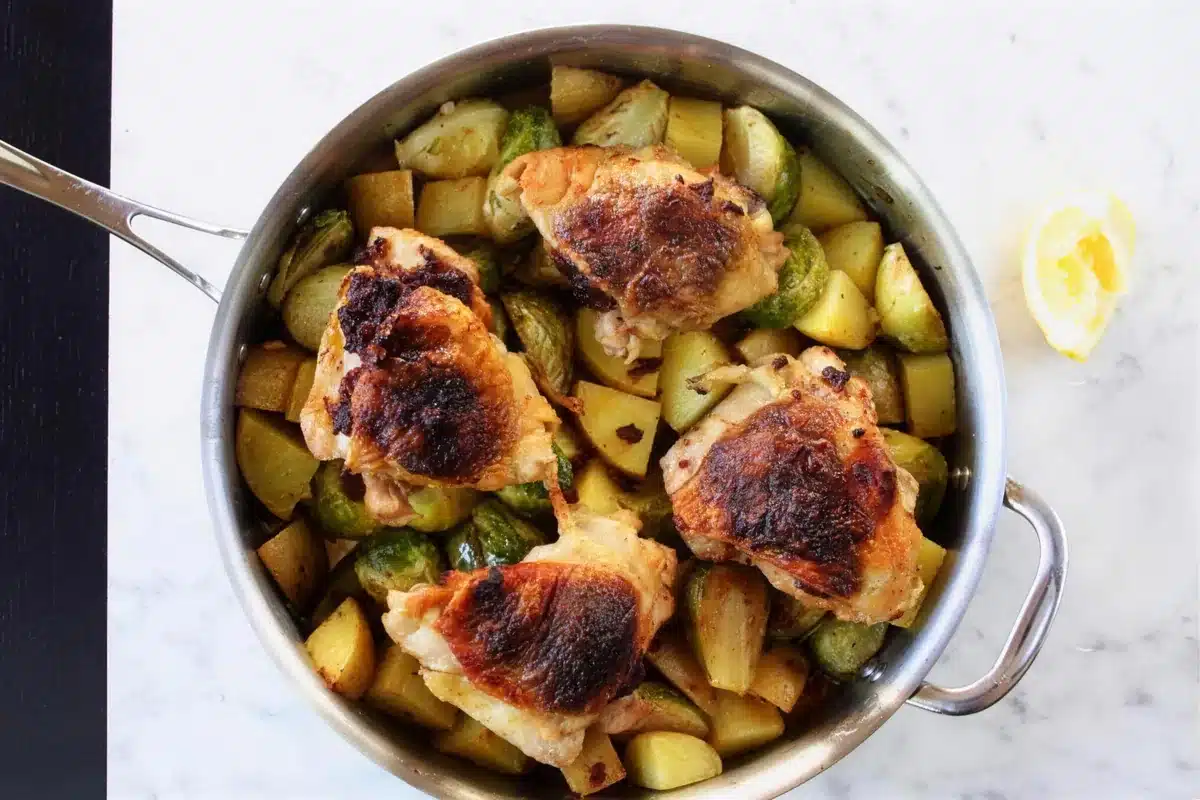
Everything below is written for a heavy roasting pan and four bone-in thighs.
- Why Bacon Jam Under the Skin Works
- The Cut of Chicken Matters More Than the Vegetables
- Ingredient Notes
- Making the Bacon Jam
- How To Make Roasted Chicken and Vegetables
- Getting the Timing Right on One Pan
- How To Tell When Roasted Chicken and Vegetables Are Done
- Make It Ahead
- Storing Roasted Chicken and Vegetables
- Variations and Substitutions
- What to Serve with Roasted Chicken and Vegetables
- Roasted Chicken and Vegetables FAQ
Why Bacon Jam Under the Skin Works
Three things happen at once in a tray of roasted chicken and vegetables when the jam is tucked underneath rather than brushed on top.
It seasons the meat, not the skin. Skin is a barrier. Anything spread on the outside flavors the outside and then burns, which is why sweet glazes are usually brushed on in the last ten minutes. Under the skin the jam is in direct contact with the muscle for the whole roast, and the salt in it acts on the meat the way a dry brine would.
It bastes from within. Bacon jam is roughly a third fat. As it warms it liquefies, runs down between skin and flesh, and keeps the thigh moist in an oven hot enough to crisp the skin above it.
It seasons the pan. What escapes past the edges of the skin lands on the potatoes and sprouts. That is the whole reason this roasted chicken and vegetables needs so little oil: the pan gets its fat from above.
And the skin still crisps. The sugar stays sheltered under a layer of skin instead of sitting exposed at 425F, so it never gets the chance to burn.
Save this recipe
Enter your email and I’ll send this recipe straight to your inbox.
The Cut of Chicken Matters More Than the Vegetables
Swap the sprouts for cauliflower and you still have roasted chicken and vegetables. Swap the thighs for breast and you have a different, worse dish.
Bone-in, skin-on thighs are the point. There has to be skin to lift, and the bone slows the heat reaching the center so the meat stays juicy across a forty minute roast.
Dark meat wants to go past the safety minimum. The National Chicken Council puts the safe internal temperature for poultry at 165F, and that is where breast should stop. Thigh meat is full of connective tissue that only softens above about 170F, so pull these at 175F and they are both safe and noticeably better.
Boneless skinless thighs will work. You lose the skin pocket, so spread the jam on top instead and cut the roast to about 30 minutes.
Do not use breast. By the time the vegetables are done the breast is chalky, and there is no skin worth lifting.
Ingredient Notes
A short list for roasted chicken and vegetables, and the amounts the old version left blank are filled in on the recipe card.
- Bacon jam: half a cup, which is two tablespoons per thigh. Shop-bought is fine and the card includes a recipe that makes about a cup and a quarter if you would rather. The previous version of this post called for up to a full cup on four thighs, which is enough to make the pan sticky and the dish cloying.
- Bone-in, skin-on chicken thighs: about 2 pounds for four. Pat them dry; wet skin steams rather than crisps.
- Yukon gold potatoes: cut into even 1 1/4-inch chunks. Yukons hold their shape and go creamy inside where a russet falls apart.
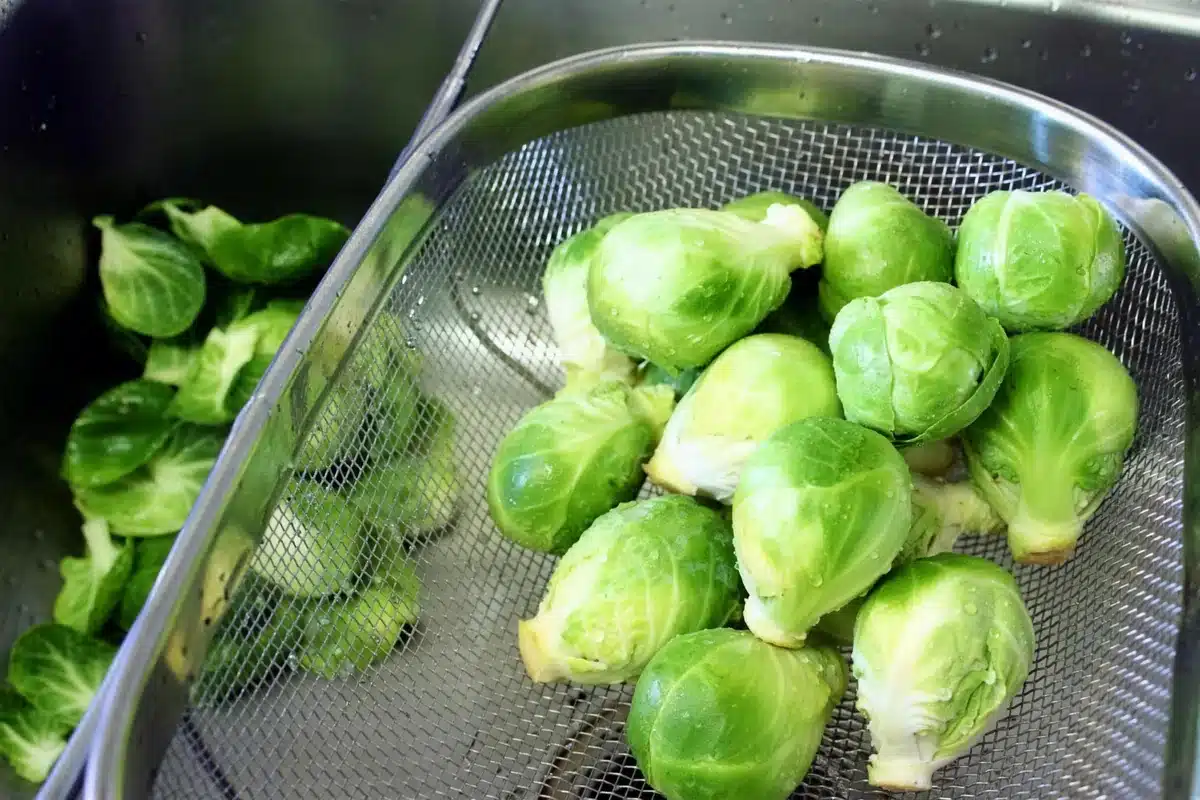
- Brussels sprouts: trimmed and halved, not quartered. Quartered sprouts under a dripping thigh go from caramelized to bitter in about ten minutes.
- Vegetable oil: two tablespoons, split between the potatoes and the sprouts. Any more and the rendering fat has nowhere to go.
- Kosher salt and black pepper: measured on the card. Both the chicken and the vegetables need their own seasoning, and the jam is not salty enough to cover for both.
- Lemon and flat-leaf parsley: to finish. They were used in the old method and listed nowhere, which is how a dish this rich ended up with nothing sharp in it.
A roasting pan wide enough for a single layer, and a thermometer. Roasted chicken and vegetables needs no other equipment.
Making the Bacon Jam
It is worth making once, because the shop-bought jars vary wildly in sweetness and this roasted chicken and vegetables leans on it heavily.
Render the bacon properly first. Chopped thick-cut bacon over medium heat, 12 to 15 minutes, until the pieces are crisp at the edges. Lift them out and pour off all but about two tablespoons of the fat.
Take the onions further than feels necessary. Twenty to twenty-five minutes of gentle cooking, stirring often, until they are genuinely deep gold. This is where the sweetness comes from; the sugar only supports it.
Then the sugar, coffee, vinegar and pepper go in with the bacon and it simmers down until a spoon dragged across the pan leaves a track, 10 to 15 minutes.
Pulse it briefly if you want it spreadable. Long strands of bacon are hard to tuck under skin. A few pulses in a food processor is enough; a puree loses the texture entirely.
It keeps two weeks refrigerated and is worth doubling, since it is as good on a sandwich as it is in roasted chicken and vegetables.
How To Make Roasted Chicken and Vegetables
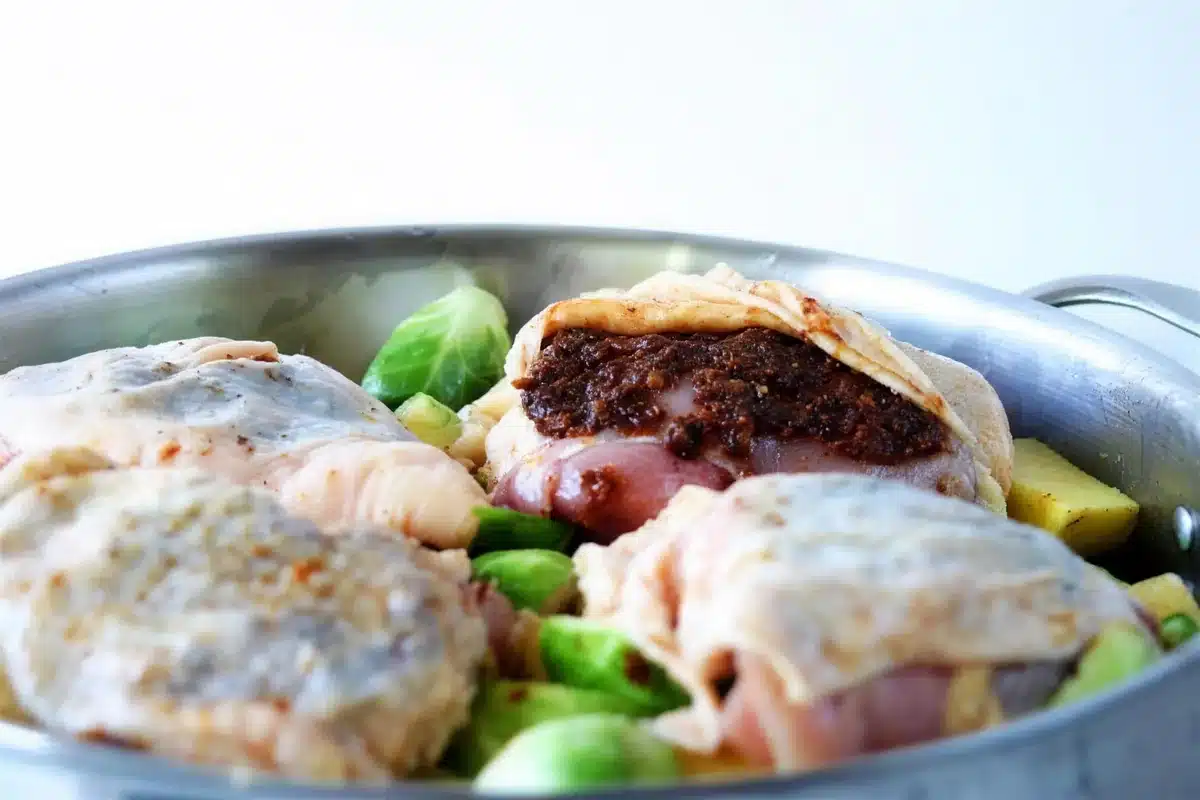
Roasted chicken and vegetables is mostly waiting. The only fiddly part is separating the skin, and it takes about thirty seconds a thigh.
- First, heat the oven to 425F and toss the potato chunks with half the oil, half a teaspoon of salt and a little pepper in a pan wide enough to hold everything in one layer. Roast them alone for 15 minutes.
- Next, season the thighs on both sides with the rest of the salt and pepper while the potatoes get their head start.
- Then slide your fingers under the skin at one end of each thigh to loosen it, leaving it attached along the other edges, and spread 1 tablespoon of bacon jam into the pocket. Spread a second tablespoon over the underside.
- After that, toss the halved sprouts with the remaining oil, stir them into the part-roasted potatoes, and set the thighs skin side up on top. Roast 35 to 40 minutes, stirring the vegetables once, until a thigh reads 175F.
- Finally, rest the chicken 5 minutes under loose foil while the vegetables sit in the switched-off oven, then scatter over the parsley and serve with lemon wedges.
Getting the Timing Right on One Pan
The single real difficulty in any tray of roasted chicken and vegetables is that the components do not want the same amount of time.
Potatoes are the slowest, so they go in alone. Fifteen minutes at 425F before anything else joins them is the difference between creamy and crunchy centers.
Sprouts are the fastest and they sit under a dripping thigh. Halved and added with the chicken, they get their 35 to 40 minutes and come out browned rather than blackened.
Crowding is the other failure. Vegetables piled two deep steam in the rendered fat instead of caramelizing against the base of the pan. Use a bigger pan or roast less.
Stir once, at the halfway mark. The pieces at the edge of the pan are always ahead of the ones in the middle.
Do not cover it at any point. The skin needs dry heat, and a foil lid turns this into a braise.
How To Tell When Roasted Chicken and Vegetables Are Done
Four checks on a pan of roasted chicken and vegetables, and only one of them involves the clock.
The thigh reads 175F at the thickest part, away from the bone. Juices running clear is not a test; color is not a test either.
The skin is tight and deep brown rather than pale and slack. Slack skin means the pan was crowded or the oven was not hot enough.
A potato chunk gives to a knife tip with no resistance at the center. Firm centers mean they went in with the sprouts instead of ahead of them.
The sprout leaves at the edges are dark and crisp and the cut faces are golden. Uniformly soft sprouts have steamed.
Make It Ahead
Very little of this roasted chicken and vegetables can be done in advance, and it is worth knowing which parts.
The bacon jam: up to two weeks. This is the only component that genuinely improves with a few days in the refrigerator.
Tuck the jam under the skin a day ahead and keep the thighs uncovered on a rack in the refrigerator. The salt acts as a dry brine and the skin dries out, which is better on both counts.
Cut the potatoes the night before and keep them submerged in cold water. Drain and dry them thoroughly or they will steam.
Trim the sprouts a day ahead and keep them in a bag in the refrigerator.
Do not part-roast anything. Reheated potatoes go grainy and the second stint in the oven overcooks the chicken.
Storing Roasted Chicken and Vegetables
- Refrigerate leftover roasted chicken and vegetables in an airtight container for up to 3 days. Keep the lemon wedges separate.
- Reheat at 375F for 12 to 15 minutes so the skin crisps again. A microwave makes the skin soft and rubbery.
- Freeze for up to 2 months, though the potatoes come back slightly grainy. The chicken freezes perfectly.
- Strip leftover chicken off the bone and it is very good cold in a sandwich with a little more bacon jam.
- Never leave it in the pan overnight. The rendered fat sets around the vegetables and they turn greasy on reheating.
Variations and Substitutions
The technique behind this roasted chicken and vegetables carries over to almost any dense root vegetable and any thick savory jam.
- No bacon jam: onion jam or fig jam with a tablespoon of bacon fat stirred in gets you most of the way there.
- Different vegetables: cauliflower, carrots, parsnips or celery root, all cut to the same 1 1/4-inch chunks.
- Sweet potatoes: skip their head start entirely and add them with the sprouts.
- Whole chicken: spatchcock it, spread the jam under the skin of both breasts and thighs, and roast about an hour.
- Aromatics: whole unpeeled garlic cloves and thyme sprigs thrown in with the potatoes.
- Spicier: a pinch of chile flakes in the bacon jam, which cuts the sweetness better than more vinegar does.
For another one-pan chicken dinner built the same way, my Greek sheet-pan chicken uses lemon and oregano where this one uses bacon.
What to Serve with Roasted Chicken and Vegetables
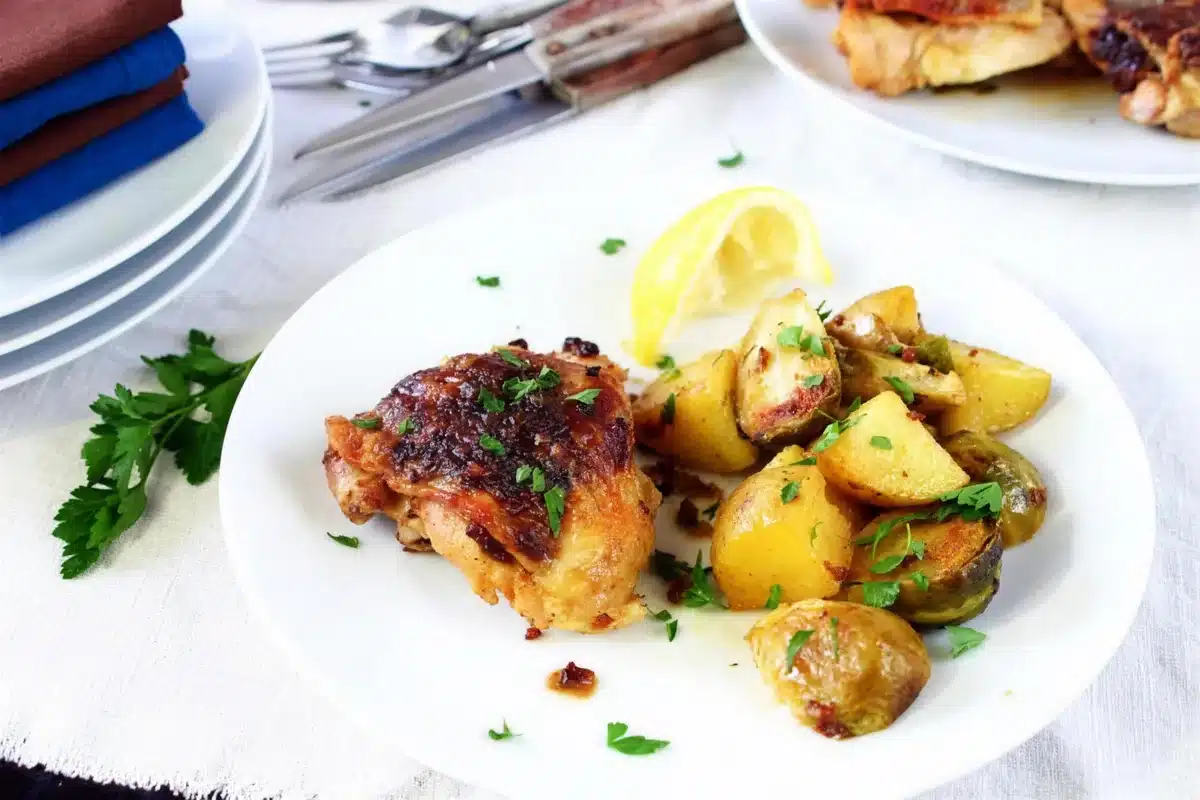
A plate of roasted chicken and vegetables is already rich and complete, so anything else should be sharp.
- My celery salad with parmesan, which is cold, crunchy and lemony against all that fat.
- Crusty bread, purely for the juices left in the pan.
- Quick pickled onions or a dish of cornichons.
- A beet and lentil salad if you want a second vegetable with some acidity in it.
- A glass of pinot noir or a dry cider.
- Extra lemon at the table, because people always want more than you cut.
Here is what readers ask most often.
Roasted Chicken and Vegetables FAQ
Frequently Asked Questions
Can I use boneless skinless thighs?
You can, and you lose both of the things that make this work: there is no skin pocket for the jam and no bone slowing the heat. Spread the jam over the top instead, add the thighs to the pan when the potatoes have had 25 minutes rather than 15, and roast about 30 minutes to 175F. The vegetables need the longer head start because the chicken now needs less time than they do.
Where do I find bacon jam, and can I skip it?
Larger supermarkets stock it near the condiments or in the deli section, and it is easy to order online. It is also straightforward to make, and the recipe card includes a version that yields about a cup and a quarter. Skipping it entirely leaves you with plain roasted chicken and vegetables, which is fine but is not this dish; onion jam with a spoonful of bacon fat is the nearest honest substitute.
Why did my brussels sprouts turn bitter?
They were cut too small, or they were under the chicken for the full roast. Halved sprouts added at the same time as the thighs get about 35 minutes, which browns them. Quartered sprouts, or sprouts that went in with the potatoes, get closer to 55 minutes under dripping fat and cross over into scorched. The bitterness is the cut edges burning, not the sprouts themselves.
More Questions About Thighs and Bacon Jam
Good to Know
Should chicken thighs really go to 175F?
Yes. 165F is the safe minimum for all poultry and the right stopping point for breast meat, but thigh is dark meat threaded with connective tissue that does not begin to soften until about 170F. Ten degrees past the minimum costs you nothing in moisture on a bone-in thigh and gives you meat that pulls away from the bone cleanly instead of clinging to it.
Can I make this on a sheet pan instead?
A rimmed sheet pan works and browns slightly better, because the shallow sides let more steam escape. The catch is that a lot of fat renders out of four thighs and a sheet pan holds it in a thin layer that spits. Use the largest rimmed pan you own, and if the vegetables are sitting in fat at the halfway stir, spoon some off.
How do I keep the jam from leaking out?
Loosen the skin at the wide end only and leave it attached everywhere else, then push the jam toward the middle rather than the edge you opened. A little always escapes and that is fine; it lands on the vegetables. What you want to avoid is tearing the skin across the top, because then the jam sits exposed at 425F and burns.
Season the meat from underneath and the rest of the roasted chicken and vegetables follows. For another chicken dinner that gets its depth from one strong ingredient rather than a long list, try my chicken and lentil stew with leeks.

Bacon Jam Roasted Chicken and Vegetables
Save this recipe
Enter your email and I’ll send this recipe straight to your inbox.
Ingredients
Bacon Jam (makes about 1 1/4 cups)
- 12 ounces thick-cut bacon chopped
- 2 medium yellow onions halved and sliced thin
- 3 cloves garlic sliced
- 1/3 cup packed dark brown sugar
- 1/2 cup brewed coffee
- 3 tablespoons cider vinegar
- 1/2 teaspoon black pepper
The Chicken and Vegetables
- 1 1/2 pounds yukon gold potatoes cut into 1 1/4-inch chunks
- 2 tablespoons vegetable oil divided
- 1 1/4 teaspoons kosher salt divided
- 1/2 teaspoon black pepper divided
- 1 1/2 pounds brussels sprouts trimmed and halved, not quartered
- 4 bone-in, skin-on chicken thighs about 2 pounds
- 1/2 cup bacon jam from the group above, or store-bought
To Finish
- 2 tablespoons chopped flat-leaf parsley
- 1 lemon cut into wedges
Instructions
Make the Bacon Jam
- Cook the chopped bacon in a wide skillet over medium heat until the fat has rendered and the pieces are crisp at the edges, 12 to 15 minutes. Lift the bacon out with a slotted spoon and pour off all but about 2 tablespoons of the fat.
- Add the onions and garlic and cook gently, stirring often, until soft, sweet and deep gold, 20 to 25 minutes. Return the bacon with the brown sugar, coffee, vinegar and pepper and simmer until a spoon dragged across the pan leaves a track, 10 to 15 minutes. Cool, then pulse briefly in a food processor so it is smooth enough to spread. Skip this group entirely if you are using a store-bought jam.
Give the Potatoes a Head Start
- Heat the oven to 425F. Toss the potato chunks with 1 tablespoon of the oil, 1/2 teaspoon of the salt and 1/4 teaspoon of the pepper in a roasting pan wide enough to hold everything in a single layer, and roast for 15 minutes on their own.
- While they roast, season the thighs on both sides with the remaining 3/4 teaspoon salt and 1/4 teaspoon pepper.
Fill the Skin
- Slide a finger under the skin at the wide end of each thigh to loosen it, leaving it attached along the other edges, and push 1 tablespoon of bacon jam into the pocket toward the middle. Spread a second tablespoon over the underside of each thigh.
Roast and Rest
- Toss the halved sprouts with the remaining 1 tablespoon of oil, stir them through the part-roasted potatoes, and set the thighs skin side up on top. Roast 35 to 40 minutes, stirring the vegetables once at the halfway mark, until the thickest part of a thigh reads 175F away from the bone and the skin is tight and deep brown.
- Rest the chicken 5 minutes on a plate under loose foil while the vegetables sit in the switched-off oven. Scatter the parsley over everything and serve with the lemon wedges.