
Nobody buys yogurt covered raisins expecting a health food, but almost everybody buys them assuming there is yogurt involved. Read the back of a Sun-Maid box and the coating begins with sugar, then hydrogenated palm kernel oil, and the dried yogurt turns up fourth or fifth.
Making yogurt covered raisins at home changes what is in the coating without pretending they stop being candy. What you get is a soft, tangy shell made from strained yogurt cheese, butter and powdered sugar, wrapped around raisins you chose yourself. They live in the refrigerator rather than a warm cupboard, and that is the whole trade.
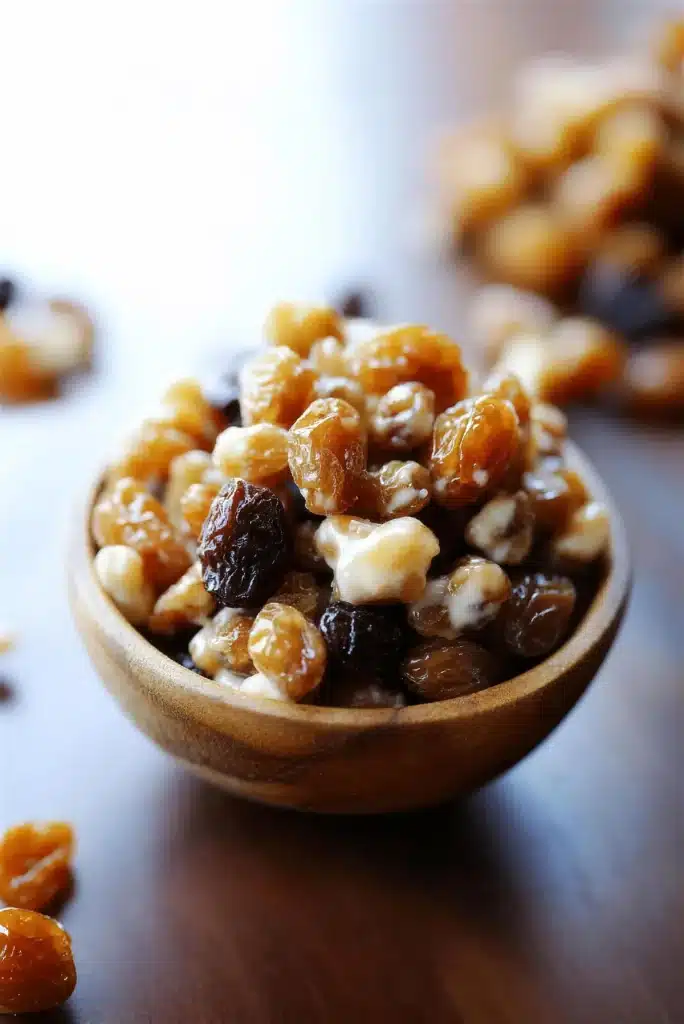
- Five ingredients, none of them hydrogenated
- Real strained yogurt, so there is actual tang behind the sweetness
- Twenty minutes of work and the refrigerator does the rest
- Half the coating weight of the boxed version, so they taste of fruit
- Golden raisins, dark raisins or a mix, which no supermarket box lets you choose
- They keep two weeks cold, and the lumpy ones taste exactly the same

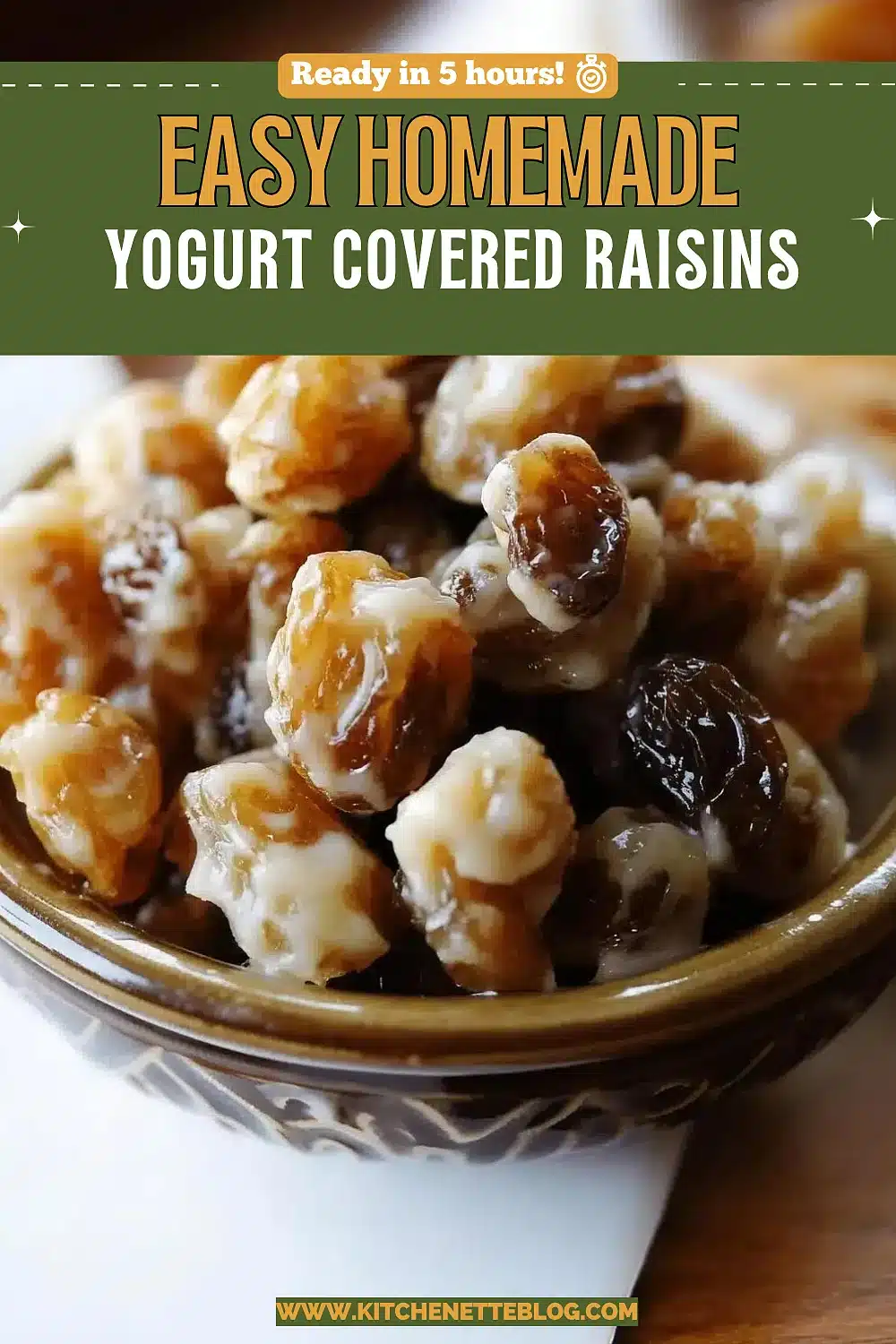
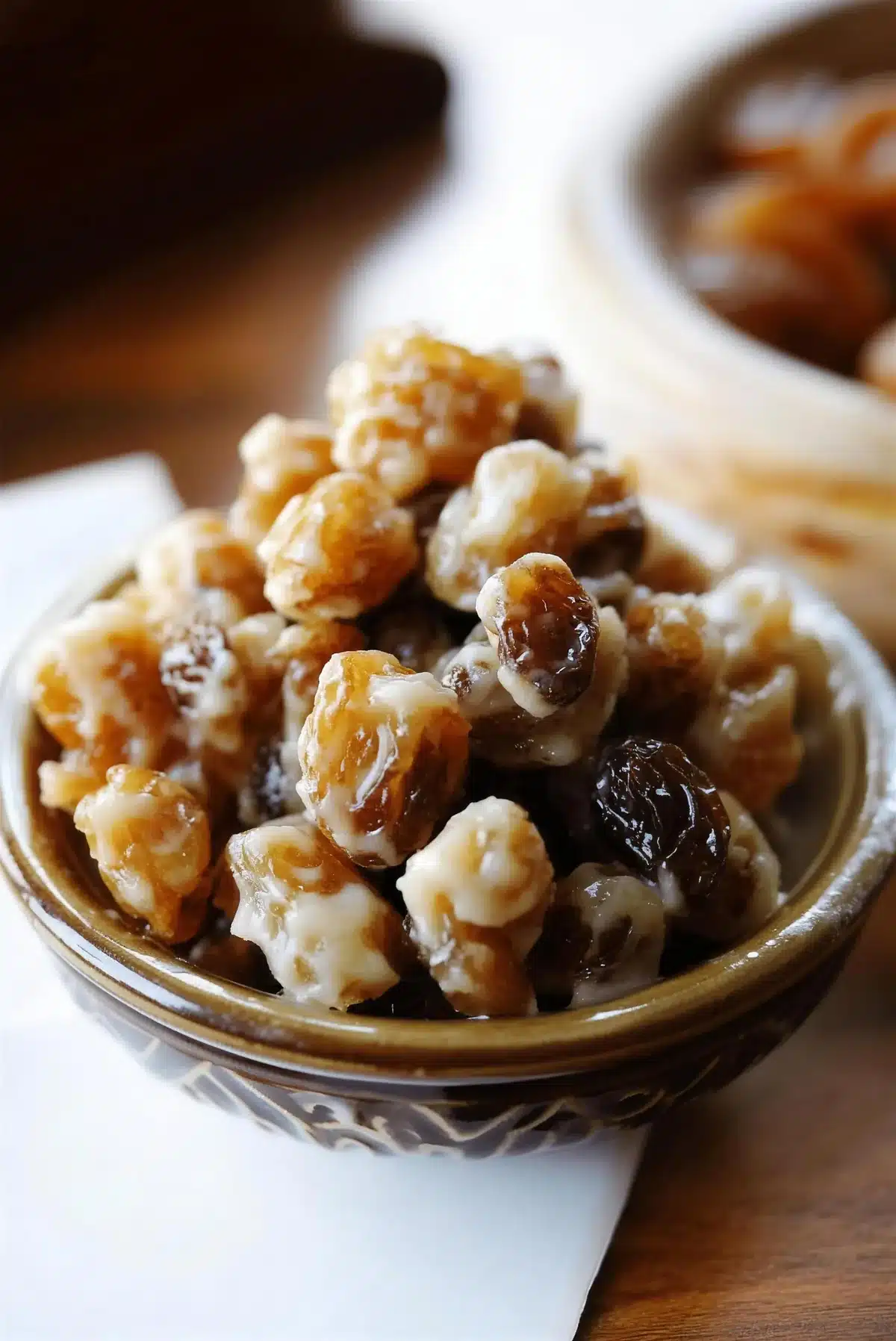
Two things decide whether yogurt covered raisins work: how dry the fruit is when the coating meets it, and how much sugar goes into a fixed amount of yogurt cheese.
- What Store-Bought Yogurt Raisins Are Made Of
- Are They Actually a Healthy Snack
- Ingredient Notes
- How To Make Yogurt Covered Raisins
- How To Tell When Yogurt Covered Raisins Are Set
- Make It Ahead
- Storing Yogurt Covered Raisins
- Variations and Substitutions
- What to Serve with Yogurt Covered Raisins
- Yogurt Covered Raisins FAQ
What Store-Bought Yogurt Raisins Are Made Of
The word yogurt on the front of the box is doing a lot of work. Turn it around and the coating reads, in order, sugar, hydrogenated palm kernel oil, nonfat dry milk, dried nonfat yogurt, whey, soy lecithin and vanilla, usually finished with confectioner’s glaze and a little tapioca dextrin so the pieces do not stick together.
That is a confectionery coating, not yogurt. The palm kernel fat is what makes the shell snap and survive a warm shelf for months, and the dried yogurt is there in small quantities for flavor and for the name on the front.
None of that is dangerous. It is just worth knowing before deciding whether the boxed version is a better snack than a plain handful of fruit.
The coating on homemade yogurt covered raisins cannot do the same job. Yogurt cheese carries water, and water and butter make a soft fondant rather than a hard shell, which is why these need cold storage and the boxed ones do not.
Save this recipe
Enter your email and I’ll send this recipe straight to your inbox.
Are They Actually a Healthy Snack
With yogurt covered raisins the honest answer is that the fruit inside is genuinely good and the coating is candy, and the ratio decides everything.
Illinois Extension is clear about the fruit itself: raisins are a good source of fiber, iron and potassium and are packaged without added sugars, but because the water has been driven out of the grape the natural sugars are concentrated, and a quarter cup carries about 29 grams of sugar on its own. That same quarter cup counts as half a serving of fruit.
Add a coating and you roughly double the sugar. A one ounce serving of the boxed kind lands near 130 calories and 20 grams of sugar, which puts it in the same territory as chocolate raisins.
The homemade version helps in two ways. The coating is about half the weight of the finished piece rather than most of it, and there is no hydrogenated fat in it at all. It is still a treat, and calling it anything else would be a stretch.
Ingredient Notes
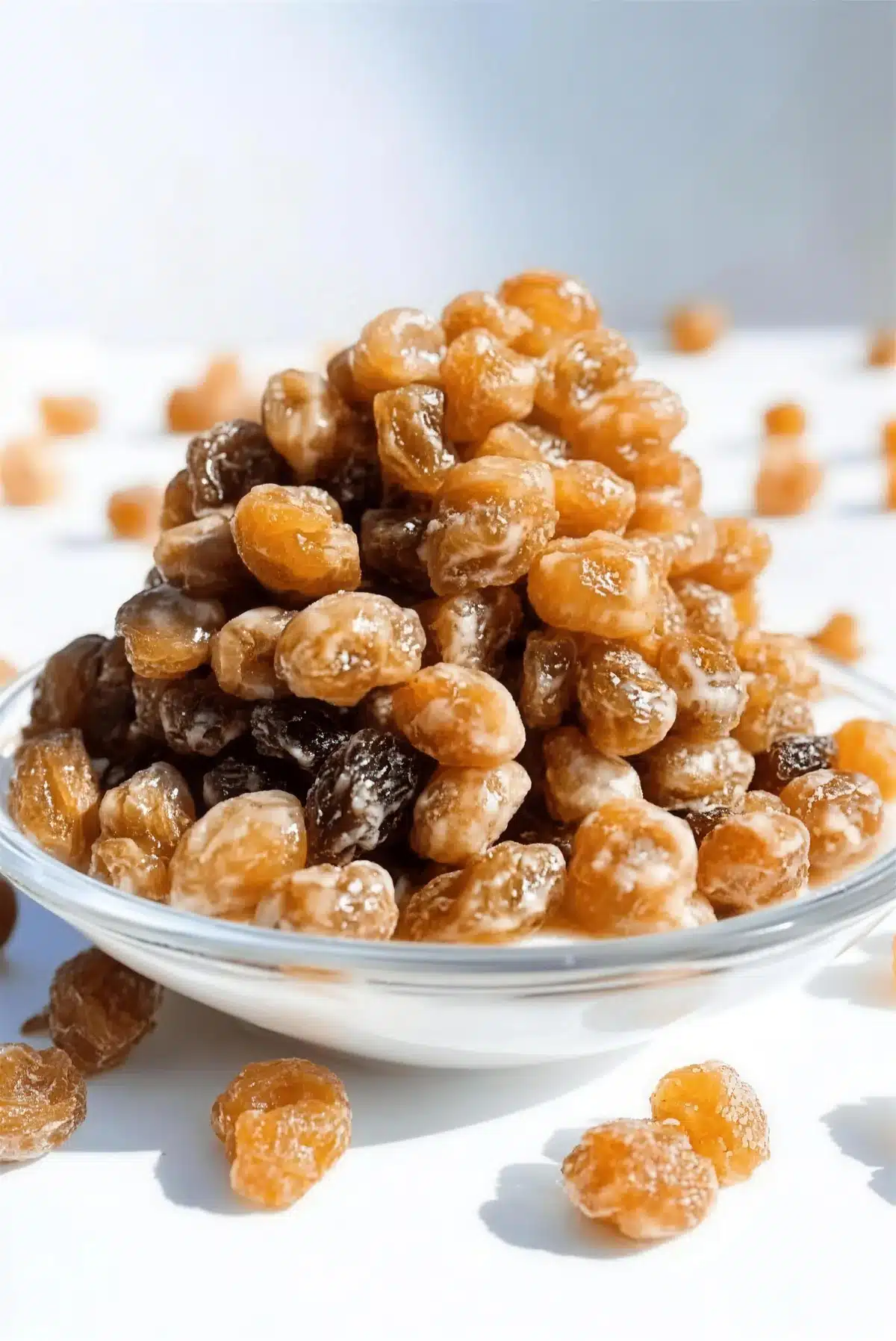
Yogurt covered raisins take five ingredients, and the important one is not the yogurt. Exact amounts are in the recipe card below.
- Raisins: two and a half cups, which is about fifteen ounces. Golden raisins are sweeter and look better under a pale coating, dark raisins taste more of grape, and a mix of both is what I actually make.
- Yogurt cheese: four ounces, sold as labneh, or made by straining a cup and a half of plain Greek yogurt in a lined sieve overnight. Plain cream cheese works and loses the tang, which is the only reason anyone would want yogurt in here.
- Butter: three tablespoons, softened. This is what makes the coating set firm and smooth rather than chalky, and cutting it makes the shell crack.
- Powdered sugar: two cups, sifted. The old version of this recipe called for six, which is why it warned you the mixture might be too dry. Two is the amount that actually coats.
- Vanilla: a teaspoon and a half. The commercial coating is vanilla flavored, so leaving it out makes the homemade one taste oddly plain.
- Salt: a quarter teaspoon of fine salt, which sharpens the tang rather than making anything taste salty.
Sift the sugar even if the box is new. Lumps in powdered sugar never dissolve into a fat-based coating and show up as white specks in every piece.
How To Make Yogurt Covered Raisins
The raisins have to be soft on the inside and dry on the outside before anything else happens. Yogurt covered raisins fail at this step more often than at any other.
- First, steam the raisins over boiling water for 5 minutes to plump them, then spread them on a towel and leave them until the surface is completely dry to the touch.
- Next, warm the butter and yogurt cheese together over low heat, whisking, until smooth and pourable. Take it off the heat before it starts to bubble.
- Then stir in the sifted powdered sugar in three additions, along with the vanilla and salt, until the mixture is thick and glossy and falls from the spoon in a ribbon.
- After that, tip the dry raisins in and fold until every one is coated, then chill the bowl for 10 minutes so the coating firms enough to hold its shape.
- Finally, spread them on parchment, separate any clusters with two forks, and leave them at cool room temperature for about 4 hours until the surface is dry and no longer tacky.
Separating Them Before They Set
Yogurt covered raisins want to clump, and once the coating firms the clumps are permanent. The window is about ten minutes.
Use two forks rather than fingers. Lift a cluster, tap it against the side of the bowl, and let the pieces fall onto the parchment separately.
Work across the tray rather than piling them in a corner. A single layer with a little space around each one dries in a third of the time a heap does.
If they do set in clusters, leave them. Three stuck together is one large piece and nobody has ever complained about it.
How To Tell When Yogurt Covered Raisins Are Set
Roll one between finger and thumb. Set yogurt covered raisins are matte, dry and slightly firm, with nothing transferring to your skin.
Four hours at cool room temperature is the usual number. A warm kitchen can take six, and the refrigerator does it in about ninety minutes although the surface stays a little softer.
Homemade yogurt covered raisins will never snap the way a boxed one does. A butter and yogurt cheese shell sets firm but stays yielding, which is correct, and the only way to get a true snap is to use a confectionery coating instead.
If they are still tacky the next morning, the raisins were damp. That batch is still perfectly good stirred into oatmeal or yogurt, and it is worth trying again with properly dried fruit.
Make It Ahead
Yogurt covered raisins are better on day two than on the day you make them, which is unusual for anything coated.
The coating keeps drawing a little moisture out of the raisin overnight, which firms the shell and softens the fruit underneath at the same time. Make them a day before you need them if you can.
The yogurt cheese can be strained up to three days ahead and kept refrigerated, which removes the only part of the job that takes real time.
Do not make the coating and leave it sitting. It stiffens as it cools and has to be rewarmed gently, and rewarming a butter and sugar mixture twice tends to make it grainy.
Storing Yogurt Covered Raisins
- Refrigerator: up to 2 weeks in a sealed container. This is the default, because a dairy coating is not shelf stable the way palm kernel fat is.
- Room temperature: a few hours on a plate is fine, and a lunchbox on a warm day is not.
- Freezer: up to 3 months. Freeze them spread on a tray first, then bag them, or you will get one solid lump.
- Thawing: straight from the freezer is best. Thawing in a sealed bag traps condensation and the coating goes sticky again.
- Layering: parchment between the layers in the container. They are only just set, and weight welds the bottom layer together.
Variations and Substitutions
In yogurt covered raisins the dried fruit, the fat and the sugar are structural. Everything else is adjustable.
- Real tang: a pinch of citric acid, sold as sour salt, which does what the boxed version fakes with cultured milk powder.
- Strawberry: a tablespoon of freeze-dried strawberry powder in the coating, which turns it pink without adding any liquid.
- Cranberries or blueberries: dried cranberries take this coating beautifully and look far better than raisins do.
- Set-hard version: twelve ounces of white confectionery wafers melted with two tablespoons of powdered yogurt, which behaves exactly like the boxed kind and needs no refrigeration.
- Dairy-free: a thick coconut yogurt strained overnight, plus a vegan butter block rather than a spread.
- Cocoa: two tablespoons of cocoa powder sifted in with the sugar, which is the supermarket chocolate yogurt version.
What to Serve with Yogurt Covered Raisins
Yogurt covered raisins are small, sweet and cold, so they belong in a mix rather than in a bowl on their own.
- In a homemade trail mix with almonds, pretzel sticks and dark chocolate chips, added last so the coating stays intact.
- On a snack tray next to yogurt covered pretzels, which use almost the same idea at twice the size.
- Scattered over plain yogurt or oatmeal, where a tacky batch that never quite set is genuinely at its best.
- Beside oatmeal raisin cookies for a table that leans entirely into one ingredient.
- On a party tray with cannoli bites, since both want to come out of the refrigerator at the last minute.
Here is what readers ask most often.
Yogurt Covered Raisins FAQ
Frequently Asked Questions
How do you make yogurt coated raisins?
Steam two and a half cups of raisins for five minutes to plump them, then dry them thoroughly on a towel. Warm four ounces of strained yogurt cheese with three tablespoons of butter until smooth, take it off the heat, and stir in two cups of sifted powdered sugar with vanilla and salt. Fold the dry raisins through, chill the bowl for ten minutes, then spread them on parchment and separate the clusters with two forks. Leave them at cool room temperature for about four hours to set, then keep them refrigerated.
Are yogurt-covered raisins healthy?
They are a candy built around a genuinely good fruit. Illinois Extension notes that raisins bring fiber, iron and potassium and carry no added sugar, though drying concentrates the natural sugars enough that a quarter cup holds about 29 grams. The coating then roughly doubles that, and the commercial one starts with sugar and hydrogenated palm kernel oil. Homemade yogurt covered raisins improve the coating rather than the arithmetic, so treat a small handful as a treat and eat plain raisins when you want the fruit.
Can diabetics eat yogurt raisins?
This is a question for the person managing your care rather than a recipe page, and the honest general point is that they are a concentrated source of sugar in a very small volume. A one ounce serving carries roughly the carbohydrate of a slice of bread, and it goes down in about four bites. If they are going to be eaten, portioning them out in advance rather than eating from an open container is the practical part anybody can act on.
More Questions About Coating and Cultures
Good to Know
Why is my coating still sticky?
The raisins were damp when they went in. Steaming leaves a film of water on the surface, and water thins a butter and sugar coating enough that it never fully sets. Spread the steamed fruit out and dry it completely first, or skip the steaming and use soft raisins straight from the bag. A cool, dry room also matters more than most people expect.
Are there live cultures in the coating?
Some, and fewer than you would hope. The yogurt cheese is warmed only gently here, so more survives than in any factory coating, but heat and sugar are both hard on live bacteria. Eat yogurt for the cultures and make these because they taste good.
Can I use regular yogurt instead of yogurt cheese?
Not without straining it. Plain unstrained yogurt is mostly water, and it will loosen the coating into a glaze that runs off the fruit and pools on the parchment. Line a sieve with a coffee filter, leave a cup and a half of Greek yogurt in the refrigerator overnight, and you will have roughly the four ounces of thick cheese this needs.
Make one tray of yogurt covered raisins and the box in the snack aisle stops looking like the easy option. For the same idea on something with a crunch underneath, try my churro cookies.
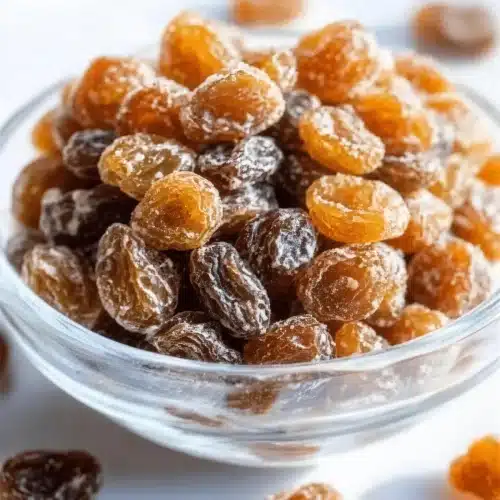
Yogurt Covered Raisins
Save this recipe
Enter your email and I’ll send this recipe straight to your inbox.
Ingredients
The Fruit
- 2 1/2 cups raisins about 15 ounces, golden, dark or a mix
For the Yogurt Coating
- 4 ounces yogurt cheese labneh, or 1 1/2 cups Greek yogurt strained overnight
- 3 tablespoons unsalted butter softened
- 2 cups powdered sugar sifted
- 1 1/2 teaspoons vanilla extract
- 1/4 teaspoon fine sea salt
Equipment
- Large saucepan
- Steamer strainer
- Medium saucepan
- Whisk
- Mixing bowl
- Wax paper
- Flat plate
Instructions
Plump and Dry the Raisins
- First, set the raisins in a steamer basket over boiling water, cover, and steam for 5 minutes until they swell and soften.
- Spread them on a clean towel in a single layer and leave them for about 20 minutes, until the surface is completely dry to the touch. Damp fruit is the single most common reason a batch never sets.
Make the Coating
- Next, warm the butter and yogurt cheese together in a small saucepan over low heat, whisking, until smooth and pourable. Take the pan off the heat before it starts to bubble.
- Then stir in the sifted powdered sugar in three additions, with the vanilla and the salt, until the mixture is thick, glossy and falls from the spoon in a ribbon.
Coat and Separate
- After that, tip the dried raisins into the warm coating and fold until every piece is covered. Chill the bowl for 10 minutes so the coating firms enough to hold its shape.
- Spread the mixture onto a parchment-lined tray and separate the clusters with two forks while the coating is still soft. You have about 10 minutes before the clumps become permanent.
Set and Store
- Finally, leave the tray at cool room temperature for about 4 hours, until a piece rolled between finger and thumb feels matte, dry and slightly firm and leaves nothing on your skin.
- Transfer them to a sealed container with parchment between the layers and keep them refrigerated. A dairy coating is not shelf stable the way the boxed kind is.