
Good almond biscotti should snap, not resist. The difference between a cookie you dunk because you want to and one you dunk because you have to comes down to three things: how much fat is in the dough, how long the logs cool before you slice them, and whether you turn the slices over for the second bake.
This recipe was rebuilt from the ground up in 2026. The version that used to sit on this page was an oil-based dough with dried cranberries in it, and neither of those things matched the photographs, which show plain almond biscotti with whole nuts and no fruit at all. What follows is a butter dough, a little richer and a little shorter, with toasted almonds in two sizes so every slice has both whole nuts and small pieces. It is not anyone else’s recipe, and it is not Ina Garten’s, which is a different cookie entirely. There is more on that in the questions below.
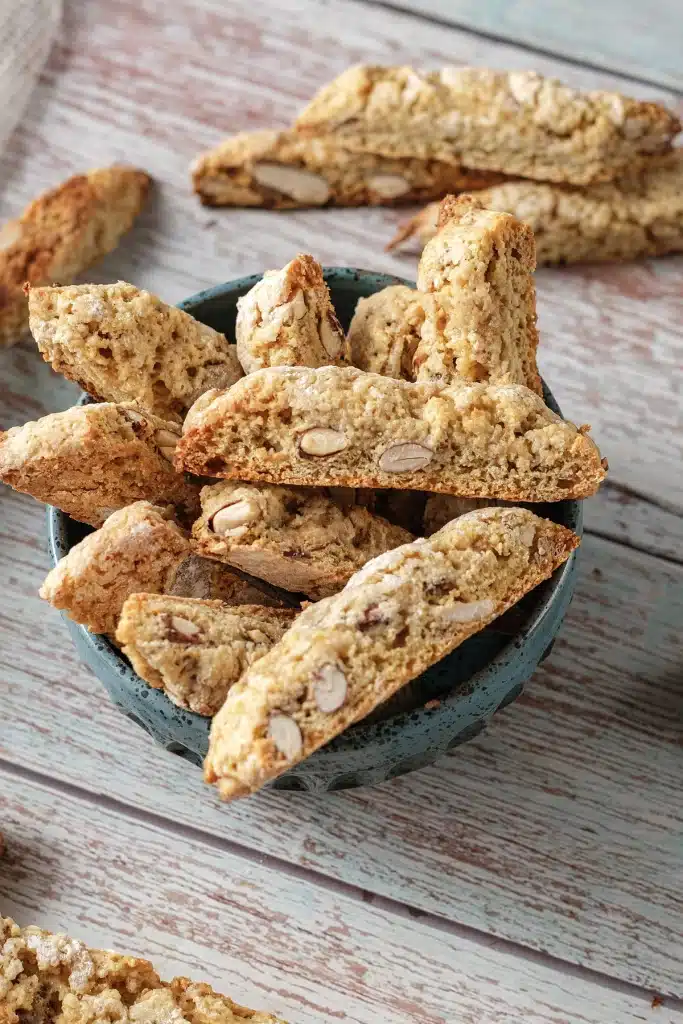
- Crisp rather than tooth-breaking, because butter shortens the crumb
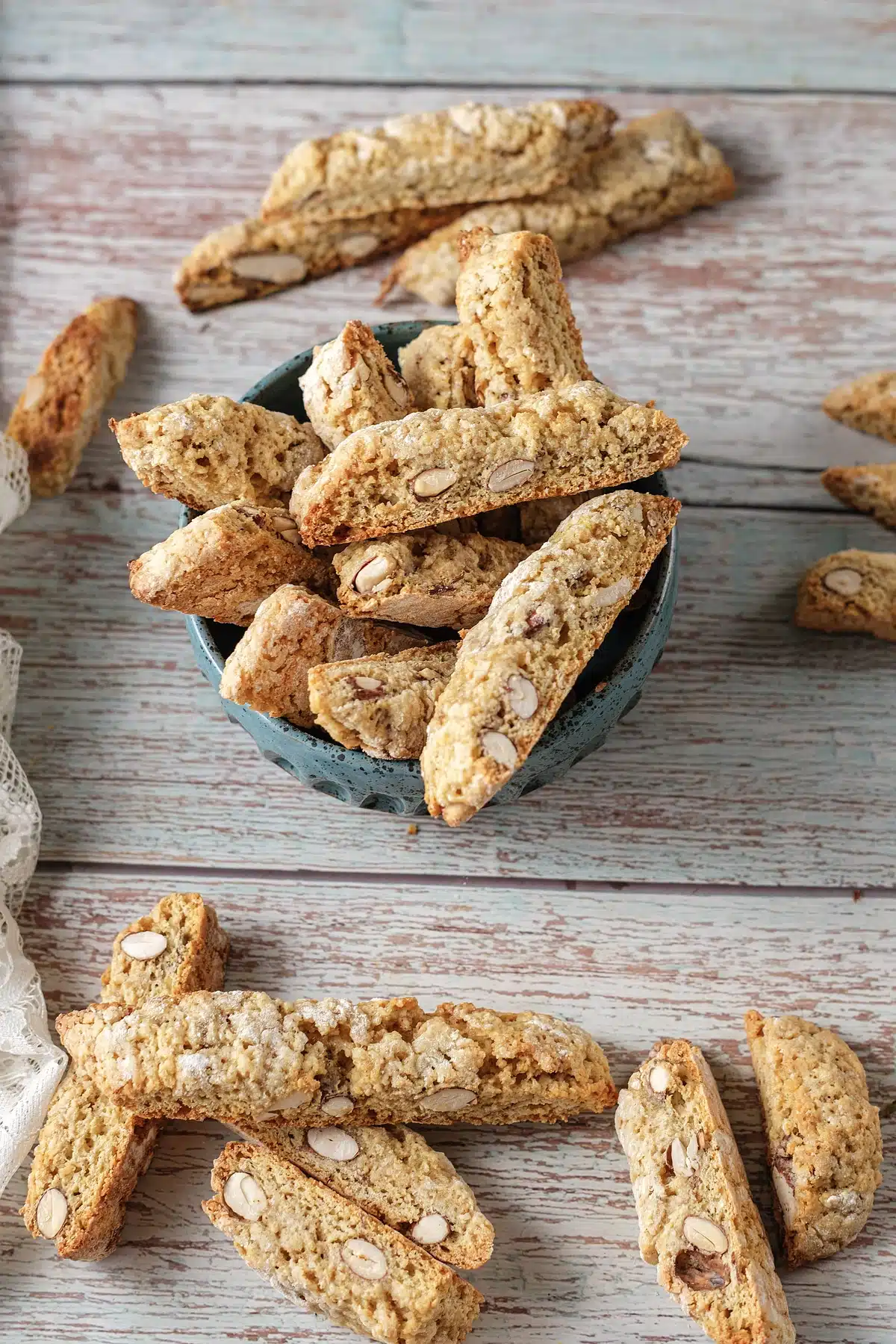
- Toasted almonds in two sizes, so you get whole nuts and small pieces in every slice
- Lemon zest and freshly grated nutmeg instead of vanilla doing all the work
- Two logs make about thirty-four cookies, which is a month of coffee
- They keep three weeks in a tin and freeze for three months
- No mixer needed, because the butter is melted rather than creamed

Everything below assumes you want them crisp all the way through and dry enough to keep.
What Makes Almond Biscotti Crisp Instead of Hard
Almond biscotti has a reputation for being punishing, and that reputation is earned by three specific mistakes.
Not enough fat. Traditional cantucci contain no butter at all, which is why they are rock hard and were designed to be dipped in vin santo. Six tablespoons of butter in this quantity of flour shortens the crumb enough that the cookie fractures cleanly instead of fighting back.
Slicing too early or too late. A hot log tears and crumbles under the knife. A completely cold log shatters. Twenty minutes out of the oven, when the log is warm to the hand but no longer hot, is the window.
Not turning the slices. Baked cut-side down and left alone, one face dries and the other stays soft, and the cookie goes stale from the inside. Turning them halfway through the second bake dries both faces evenly, and that is what makes almond biscotti keep for weeks.
Get those three right and the rest of it is arithmetic.
Save this recipe
Enter your email and I’ll send this recipe straight to your inbox.
Ingredient Notes
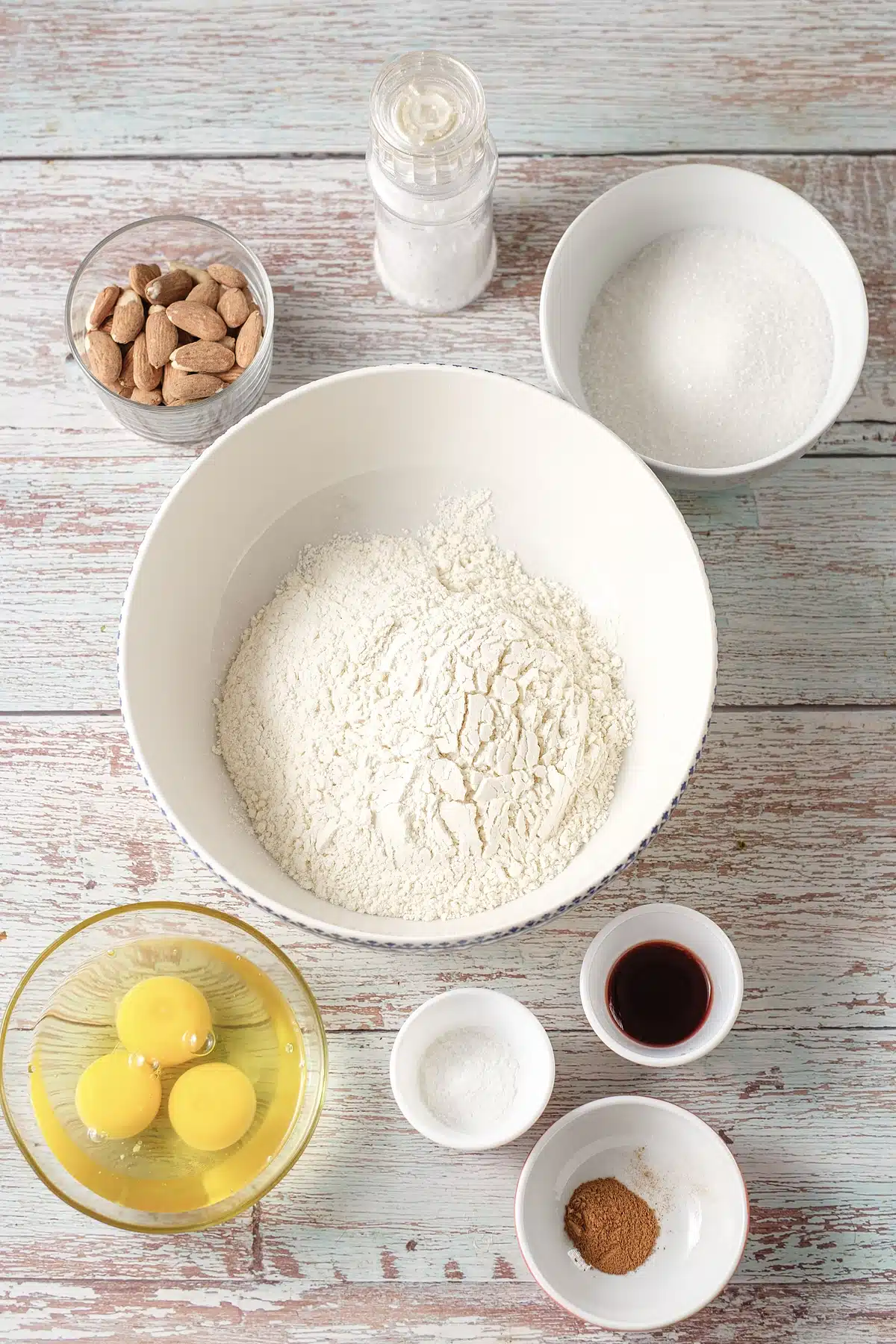
Almond biscotti is a short list of ordinary things. Exact amounts are in the recipe card below.
- Almonds: one cup of whole raw almonds, toasted. Half stay whole and half get roughly chopped. Toasting is not optional: raw almonds in a baked cookie taste of almost nothing. The Almond Board of California puts an ounce of almonds at 6 grams of protein and 4 grams of fiber, which is why a couple of these with coffee holds you longer than a cookie has any right to.
- Butter: six tablespoons, melted and cooled. Melting rather than creaming means no mixer and a denser, snappier crumb.
- Eggs: two whole plus one yolk in the dough. The extra yolk adds fat and color without adding water, which is exactly what a dough you want to dry out needs.
- Baking powder: 1 1/2 teaspoons for 2 1/4 cups of flour, which is deliberately less than a cake ratio. Too much and the logs puff, then collapse, and the slices come out cakey.
- Lemon zest: a full tablespoon, from two lemons. It is the loudest flavor in the cookie and it should be.
- Nutmeg: a quarter teaspoon, grated fresh. Pre-ground nutmeg has usually lost the volatile oils that make it worth including.
- Turbinado sugar: two tablespoons over the egg wash, for a crackly top. Regular granulated sugar dissolves and does nothing.
Two sheet pans, a bowl and a serrated knife are the equipment.
Butter or Oil in the Dough
Most almond biscotti recipes online use vegetable oil, and it is worth knowing what that choice costs you.
Oil makes a leaner, harder cookie. Liquid fat coats the flour more thoroughly than solid fat does, which sounds like it should tenderize but in a low-moisture dough it mostly produces a dense, uniform crumb with a hard fracture.
Butter brings water and milk solids. The water turns to steam and opens the crumb slightly; the milk solids brown during two separate bakes and taste of something.
Melted butter is the compromise. Creamed butter whips air into the dough and gives you a soft, cake-like slice. Melted butter behaves halfway between oil and creamed butter, which is exactly where a biscotti wants to sit.
Cool the butter before it meets the eggs. Hot butter scrambles yolks, and you will see the flecks in the finished slice.
If you want the traditional version, leave the butter out entirely and add two tablespoons of water. That is genuine cantucci, and it needs a glass of something sweet to go with it.
How To Make Almond Biscotti
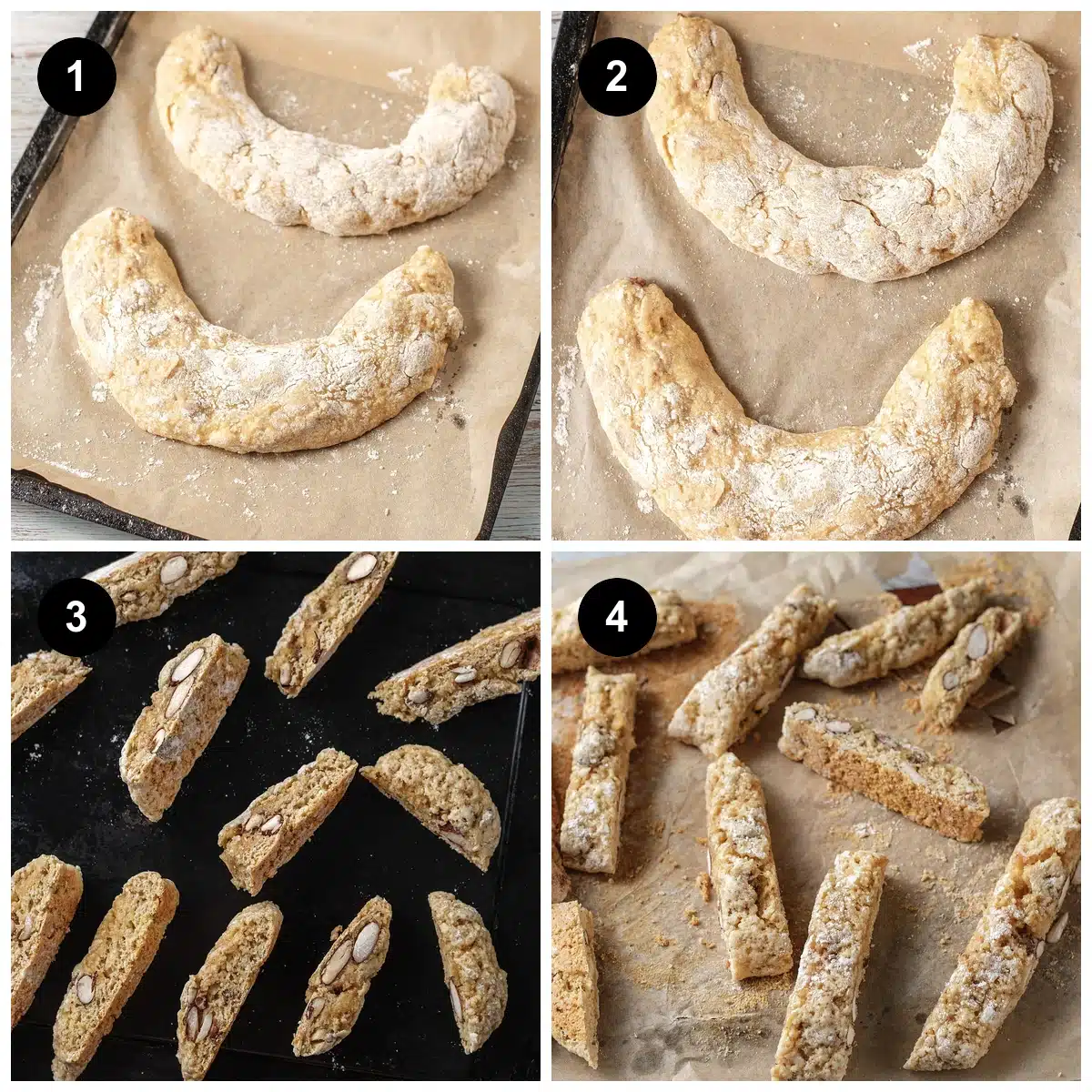
Almond biscotti is baked twice with a rest in between, and the rest is not a formality.
- First, toast the almonds at 350F for 8 to 10 minutes, cool them, then chop half of them coarse and leave the rest whole.
- Next, whisk the melted butter with the sugar, eggs, yolk, lemon zest, almond extract and vanilla, then stir in the flour, baking powder, salt and nutmeg until a stiff dough forms, and fold in the almonds.
- Then shape two logs about 11-inch long and 2 1/2-inch wide on a lined sheet, flatten them to roughly 3/4-inch, brush with egg white and scatter over the turbinado sugar.
- After that, bake at 350F for 28 to 32 minutes, until firm and golden and just cracked along the top, then cool on the sheet for 20 minutes.
- Finally, slice on a slight diagonal at 1/2-inch with a serrated knife, lay the slices cut-side down and bake at 325F for 12 minutes a side, turning them over once.
Slicing the Logs Without Shattering Them
More almond biscotti is lost at the knife than in the oven, and the fixes are all mechanical.
Use a long serrated knife. A chef’s knife compresses the log and pushes the whole almonds sideways, which is what cracks the slice apart.
Saw, do not press. Long strokes with almost no downward pressure. Let the teeth do it.
Cut on a slight diagonal. A shallow angle gives you longer slices with more surface area to dry out, and it looks like biscotti rather than like sliced bread.
Half an inch, not a quarter. Thin slices dry into shards. Half an inch is thick enough to survive being turned over.
Move the log to a board first. Slicing on the hot sheet pan means the slices slide and the knife skids.
Make It Ahead
Almond biscotti is one of the few cookies that is genuinely better after a few days, so it is the right thing to bake in advance.
The dough: one day. Shape the logs, wrap them and refrigerate. Bring them back to room temperature for twenty minutes before baking or the outside sets before the middle rises.
Half-baked logs: three days. Do the first bake, cool them completely, wrap them and finish the second bake on the day you want them. This is the trick worth knowing for a party.
Finished cookies: three weeks. A tin at room temperature, never a plastic bag, which traps the small amount of moisture left in them.
Frozen: three months. Freeze the finished cookies flat in a bag. Ten minutes in a 300F oven brings them back completely.
What does not work is refrigerating the finished cookies. They go soft in about two days, and the only way back is a spell in a low oven.
Storing Almond Biscotti
- Airtight tin, room temperature: 3 weeks, and they are arguably at their best in week two.
- Never the refrigerator. Cold, humid air is exactly what a dried cookie does not want.
- Frozen: 3 months, then 10 minutes at 300F straight from the freezer.
- If they soften, spread them on a sheet and give them 10 minutes at 300F. They crisp up as they cool, not in the oven.
- Do not store them with soft cookies. Moisture moves from the soft one to the crisp one and you end up with two mediocre cookies.
Variations and Substitutions
The flour, the two bakes and the turn are structural. The flavorings all move.
- Swap the nut: hazelnuts with orange zest, pistachios with cardamom, or pecans with a little brown sugar in place of a quarter of the white.
- Add dried fruit: two-thirds of a cup of dried cranberries or sour cherries, chopped, folded in with the nuts. Chop them, because whole ones tear the slice.
- Chocolate: dip one long edge in tempered dark chocolate once they are completely cold.
- Anise: two teaspoons of crushed anise seed instead of the nutmeg, which takes it toward the Tuscan original.
- Less sweet: drop the sugar to 3/4 cup. The texture holds; you lose some of the crackle on top.
- Espresso: a tablespoon of instant espresso powder in the dry ingredients, which suits them since they are going into coffee anyway.
What to Serve with Almond Biscotti
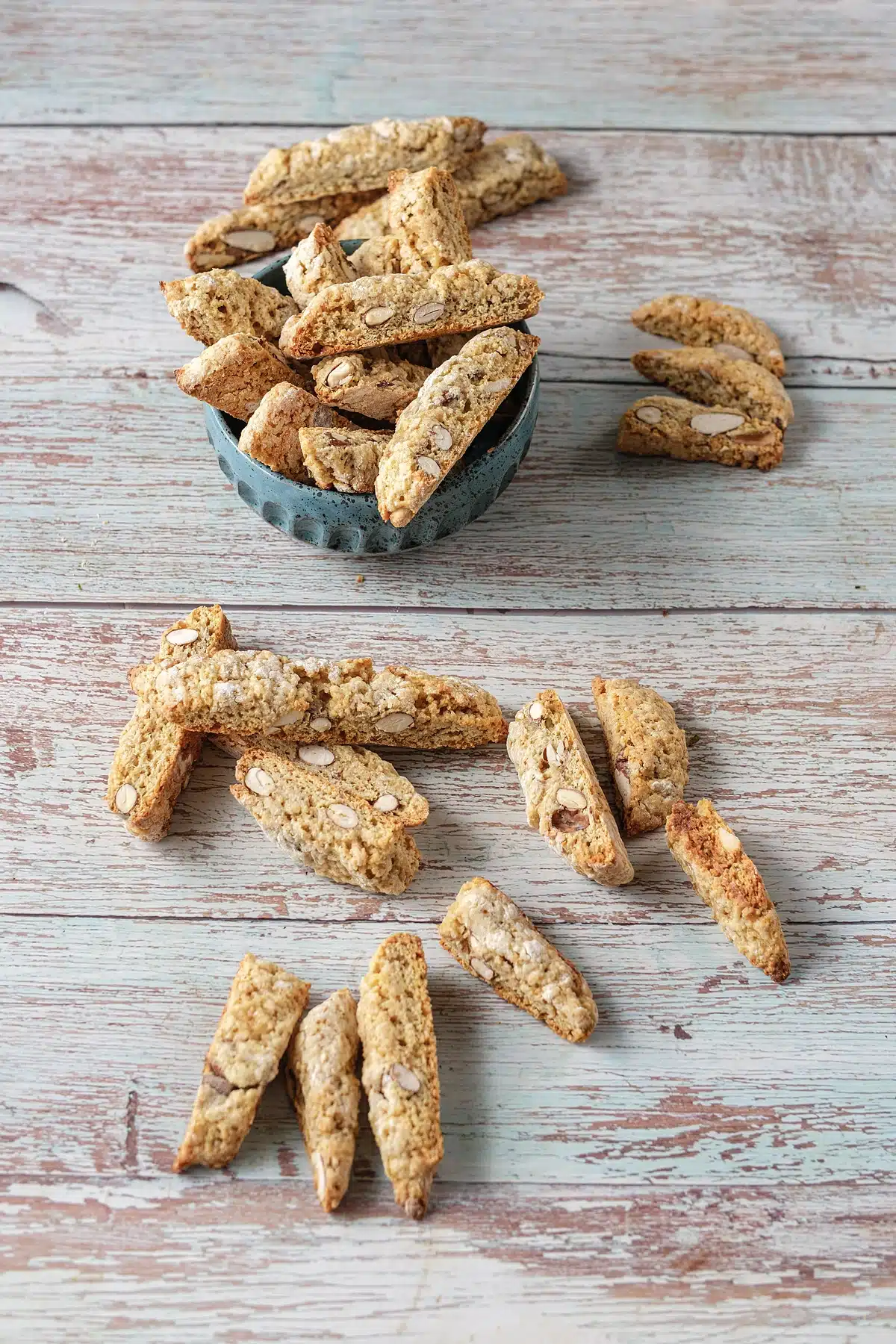
Almond biscotti is dry by design, so it wants something to go into.
- Espresso, which is the point, and a cappuccino if you are not Italian about it.
- Vin santo, the traditional partner, or any sweet dessert wine.
- Alongside something soft on a cookie plate, such as my salted toffee cookies with pretzels and peanuts, so there is a texture contrast.
- Crumbled over ice cream, where they behave like a nut praline.
- With an almond cake if you are running an entirely almond dessert table.
- Or on a breakfast pastry board with chocolate almond croissants.
Here is what readers ask most often.
Almond Biscotti FAQ
Frequently Asked Questions
Is this Ina Garten’s Barefoot Contessa biscotti recipe?
No, and it never was. This page carried that title for years, which was a mistake we have corrected. Ina Garten’s biscotti is a Cherry Pistachio Biscotti built on creamed butter, light brown sugar, almond flour, cinnamon, pistachios and dried cherries. It is a different cookie in almost every respect. What is on this page now is our own almond biscotti, developed here and matching the photographs, and the old recipe has been retired.
Why did my biscotti crumble when I sliced it?
Almost always the rest. Twenty minutes out of the oven is the window: the log should be warm to the hand and no longer hot. Slice it straight away and it tears; leave it until completely cold and it shatters along the almonds. Use a long serrated knife, saw with long strokes and almost no downward pressure, and move the log onto a board first so it cannot slide.
How do I know when almond biscotti is done?
By feel rather than by color. After the second bake the slices should be firm and sound hollow when tapped, but they will still bend very slightly. They crisp as they cool, which is the same trick meringues and shortbread play, so a batch that seems slightly soft coming out of the oven is usually right. If they are still yielding an hour later, give them another eight minutes at 325F.
More Questions About Biscotti and Baking
Good to Know
How many does this make?
About thirty-four, from two 11-inch logs sliced at half an inch. The old version of this recipe claimed twelve servings from the same two logs, which was simply wrong. The dough halves cleanly if that is more cookies than you want, though they keep three weeks in a tin and freeze for three months, so most people bake the full batch.
Can I make them without a mixer?
Yes, and you should. The butter is melted rather than creamed, so the whole dough comes together in one bowl with a whisk and then a wooden spoon. A stand mixer actively works against you here by whipping air into a dough that is supposed to be dense. This is the main reason to prefer melted butter over the creamed method in almond biscotti.
Why toast the almonds first if they get baked twice anyway?
Because the nuts are insulated inside the dough and never get hot enough or dry enough to develop flavor. Eight to ten minutes at 350F before they go in is what produces the toasted almond smell people associate with these cookies. Chopping half of them afterwards spreads that flavor through the crumb rather than leaving it locked in a few whole nuts.
Almond biscotti rewards patience twice, once for the rest between bakes and once for the week in the tin, and very little else about it is difficult. For a softer cookie to sit next to it on the plate, try my vegan oatmeal chocolate chip cookies.
Almond Biscotti with Lemon Zest and Nutmeg
Save this recipe
Enter your email and I’ll send this recipe straight to your inbox.
Ingredients
The Dough
- 2 1/4 cups all-purpose flour about 280 grams, spooned and leveled
- 1 cup granulated sugar
- 1 1/2 teaspoons baking powder
- 3/4 teaspoon fine sea salt
- 1/4 teaspoon nutmeg freshly grated
- 6 tablespoons unsalted butter melted and cooled to lukewarm
- 2 large eggs at room temperature
- 1 large egg yolk
- 1 tablespoon lemon zest finely grated, from about 2 lemons
- 1 teaspoon pure almond extract
- 1 teaspoon pure vanilla extract
- 1 cup whole raw almonds about 140 grams, toasted, half left whole and half chopped coarse
The Egg Wash
- 1 large egg white
- 1 teaspoon water
- 2 tablespoons turbinado sugar for scattering over the logs
Equipment
- Mixing bowls
- Measuring cups
- Measuring spoons
- Whisk
- Spatula
- Baking sheet
- Parchment paper
- Sharp knife
Instructions
Toast the Almonds
- Heat the oven to 350F. Spread the almonds on a sheet pan and toast for 8 to 10 minutes, until they smell nutty and the skins have darkened a shade. Cool them completely, then chop half of them coarse and leave the rest whole. Line two sheet pans with parchment.
Mix and Shape the Logs
- Whisk the melted butter with the sugar until it looks like wet sand, then whisk in the eggs, the extra yolk, the lemon zest and both extracts. The butter must be lukewarm rather than hot or it will scramble the yolks.
- Stir the flour, baking powder, salt and nutmeg together, add them to the bowl and mix with a wooden spoon until a stiff, slightly sticky dough forms. Fold in the whole and chopped almonds. Do not use a mixer, which whips air into a dough that should stay dense.
- Divide the dough in two and shape each half on a lined sheet into a log about 11-inch long and 2 1/2-inch wide, then flatten the tops to roughly 3/4-inch with damp hands. Leave plenty of room between them because they spread. Brush with the egg white beaten with the water and scatter over the turbinado sugar.


The First Bake and the Rest
- Bake at 350F for 28 to 32 minutes, until the logs are firm, golden and cracked along the top. A skewer into the middle should come out with a few moist crumbs rather than wet dough.
- Cool on the sheet for exactly 20 minutes, then slide each log onto a board. This rest is the single most important step: at 20 minutes the log is warm to the hand and cuts cleanly, while a hot log tears and a cold one shatters.

Slice and Bake Again
- Turn the oven down to 325F. Using a long serrated knife and long sawing strokes with almost no downward pressure, cut each log on a slight diagonal into slices a generous 1/2-inch thick. Lay them cut-side down on the sheets.
- Bake for 12 minutes, turn every slice over, and bake for a further 12 minutes. They should be pale gold, firm, and sound hollow when tapped. Cool completely on a rack, where they finish crisping, then store airtight at room temperature.

