
Every method for cooking toaster oven eggs comes down to the same trade: you give up the moment-to-moment control a skillet gives you, and in exchange nothing needs stirring and nothing sticks to a pan you then have to scrub.
The catch is that a toaster oven is a small metal box with the elements two or three inches from the food, so the numbers that work in a full-size oven do not transfer. Everything below is the temperature and the time for a countertop machine specifically, method by method, with the one adjustment each of them needs.

- Five methods with real times, not one recipe and a shrug
- The temperature drop that stops a small oven turning eggs rubbery
- Hard boiled eggs with no pot, no water and no watching
- A doneness temperature that is about food safety rather than preference
- Everything scales to one person, which is what most egg cooking actually is
- Nothing here needs a special dish beyond a small pan and a ramekin

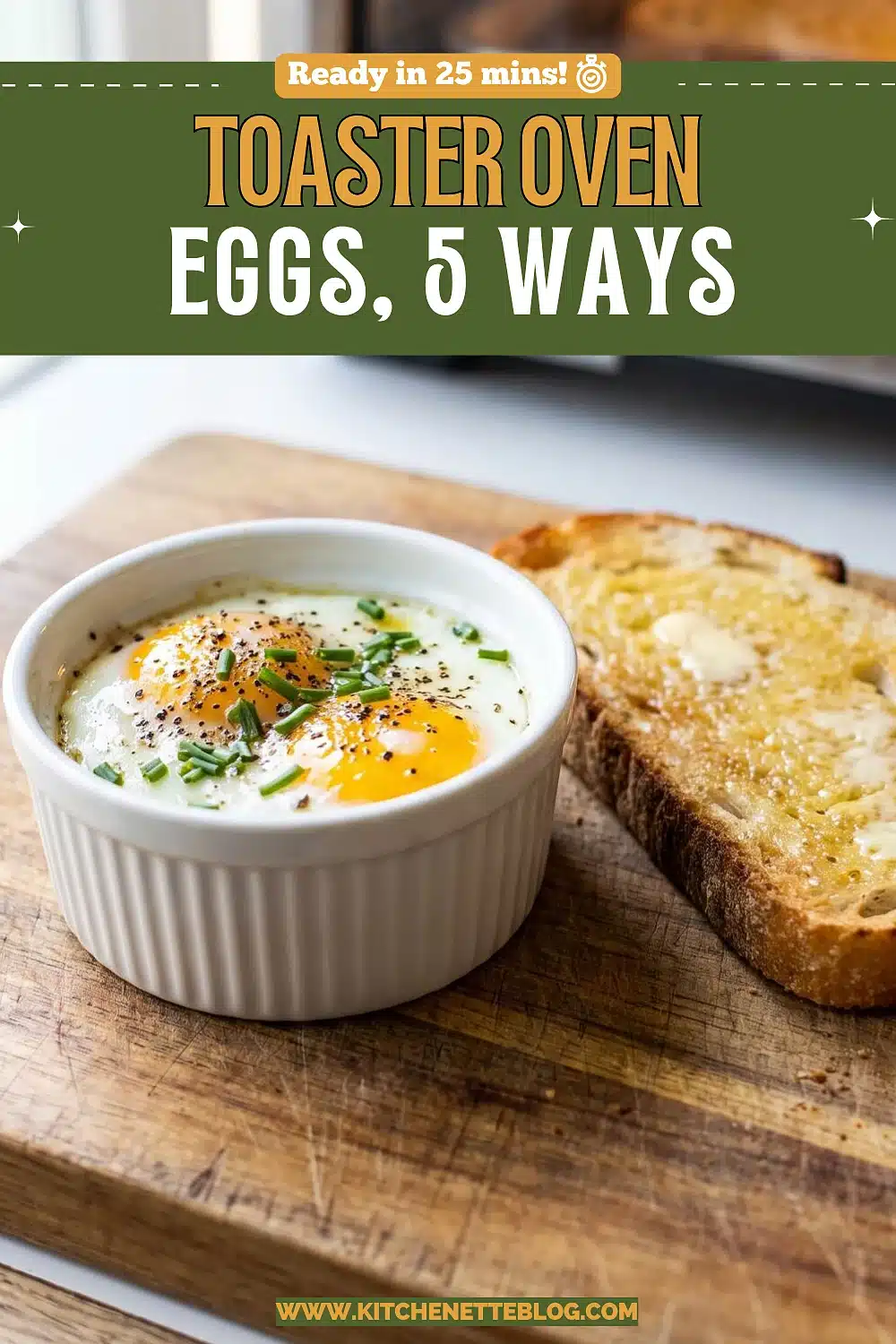
Start with what the appliance can and cannot do to an egg.
- Can You Cook Eggs in a Toaster Oven?
- Toaster Oven Eggs: Times and Temperatures
- Scrambled Toaster Oven Eggs
- Baked Eggs in a Ramekin
- Hard Boiled Eggs Without a Pot of Water
- Fried Eggs and Egg in a Hole
- What You Need Before You Start
- How To Make Toaster Oven Eggs
- How To Tell When Toaster Oven Eggs Are Done
- Storing Toaster Oven Eggs
- Variations and Substitutions
- What to Serve With Them
- Toaster Oven Eggs FAQ
Can You Cook Eggs in a Toaster Oven?
Yes, all of them, and toaster oven eggs beat a stovetop at several of them. Baked, scrambled, fried, poached in a muffin tin, and hard cooked in the shell with no water at all.
Toaster oven eggs are at their best in anything that wants steady surrounding heat and no attention: baked eggs in a ramekin, a small frittata, a tray of eggs for sandwiches. Dry heat sets the whites evenly from every side, and there is no hot spot in the middle of a pan to fight.
What it is bad at is anything that depends on watching. Toaster oven eggs go from underdone to overdone in about ninety seconds because the mass of food is tiny and the elements are close. There is no coasting period the way a heavy skillet gives you.
Two limitations are worth knowing before you commit to toaster oven eggs. Most machines run 15F to 25F hotter than the dial says, especially the smaller ones, which is why nearly every method here uses a lower temperature than the same dish would need in a wall oven. And the glass door leaks heat, so opening it to check costs more than it does upstairs. Look through it instead.
One thing to check in your manual: whether the manufacturer allows glass or ceramic dishes. Some compact models specify metal only, because the elements sit close enough to crack tempered glass.
Save this recipe
Enter your email and I’ll send this recipe straight to your inbox.
Toaster Oven Eggs: Times and Temperatures
These times are for toaster oven eggs in a preheated machine on the bake setting, rack in the middle position, unless the row says otherwise.
| Method | Temperature | Time | What to use |
|---|---|---|---|
| Scrambled, baked | 350F | 18 to 22 min, stirred twice | Small greased baking dish |
| Baked in a ramekin | 400F | 11 to 14 min | 6 ounce ramekin, buttered |
| Hard cooked in the shell | 325F | 25 to 30 min, then an ice bath | Straight on the rack |
| Fried, sunny side up | 425F | 6 to 8 min on a preheated pan | Small metal sheet pan |
| Egg in a hole | 400F | 10 to 12 min | Sheet pan, bread buttered both sides |
| Poached, in a tin | 350F | 10 to 12 min | Muffin tin, 1 tablespoon water per cup |
| Small frittata for two | 350F | 20 to 25 min | 6-inch skillet or 7 by 5 dish |
Add 2 minutes across the board for toaster oven eggs used straight from the refrigerator, and take 2 off for a convection or air fry setting, which moves air and cooks noticeably faster.
Scrambled Toaster Oven Eggs
This is the recipe in the card at the bottom of the page, and it is the method most people mean when they go looking for toaster oven eggs.
Beat four eggs with a quarter cup of milk, salt and pepper, pour them into a small buttered dish, and bake at 350F. The important part is that you stir twice, at ten minutes and again at fifteen, dragging the set edges into the liquid middle. Left alone the whole thing bakes into a single flat omelet, which is fine but is not scrambled eggs.
Milk rather than cream, and a quarter cup to four eggs. More liquid than that and the curds never come together; none at all and dry heat turns them tight and squeaky.
The dish matters more than you would expect with toaster oven eggs. A deep narrow dish gives soft, large curds and takes the full twenty-two minutes. A wide shallow one gives smaller curds in about sixteen. Both are good and they are noticeably different, so pick deliberately.
Toaster oven eggs done this way hold their heat well in the dish, which makes this the method to use if people are coming to the table at different times.
Baked Eggs in a Ramekin
The best of all the toaster oven eggs on this page. Butter a six ounce ramekin, add a tablespoon of cream and a pinch of salt, crack in one or two eggs, and bake at 400F.
Eleven minutes gives a set white and a yolk that still runs. Fourteen gives a yolk that is jammy at the center. Past sixteen it is firm all the way through, which is a legitimate thing to want but is a different dish.
The whites tell you where you are. They should be opaque and matte with no clear liquid trembling at the edge of the yolk. If the outer white has set but there is still a ring of translucent white against the yolk, it needs two more minutes.
Things worth putting under the egg before it goes in: a spoonful of tomato sauce, wilted spinach squeezed dry, a slice of ham folded into the base, or grated gruyere. All of them are already hot or already cooked, which matters, because eleven minutes is not enough to cook anything raw sitting underneath.
Hard Boiled Eggs Without a Pot of Water
Toaster oven eggs cooked in their shells in dry heat come out the same as boiled ones and take no attention at all. Set them straight on the middle rack at 325F for 25 to 30 minutes, then move them immediately into a bowl of ice water for at least 10 minutes.
The ice bath is not optional and it is the step people skip. It stops the cooking, which is what prevents the gray-green ring around the yolk, and it contracts the egg away from the shell so it actually peels.
Two things to expect. Small brown freckles appear where the shell touched the hot rack, which are cosmetic and vanish with the shell. And the first time you do this, cook one egg on its own as a test, because machines vary by enough that 25 minutes in one is 30 in another.
For a soft center, drop to 22 minutes. For a firm yolk that slices for a salad, 30. Older eggs peel more easily than very fresh ones no matter how they were cooked, which is worth knowing if you are separating any of them for something else. My guide on how to separate an egg covers the other direction.
Fried Eggs and Egg in a Hole
A fried egg needs a hot surface underneath it, so these are the toaster oven eggs with an extra step: preheat the pan with the machine, not after it. Slide a small metal sheet pan in while it comes up to 425F, pull it out, add a teaspoon of butter or oil, crack the egg straight onto the hot metal and put it back.
Six to eight minutes gives set whites and a soft yolk. The bottom will not be lacy and crisp the way a skillet makes it, because a sheet pan holds less heat than cast iron, but it is close.
Egg in a hole is the version that suits this appliance best. Cut a circle out of a slice of bread, butter both sides, lay it on the pan, crack an egg into the hole and bake at 400F for 10 to 12 minutes. The bread toasts and the egg sets in the same window, which is exactly the coordination a toaster oven is good at. Toast the cut-out circle alongside it.
What You Need Before You Start
- A small metal sheet pan: the quarter sheet that came with the machine is usually right. Metal conducts, glass insulates, and for frying you want conduction.
- A ramekin or two: six ounces is the useful size. Four ounces is too tight for two eggs and eight is too wide for one.
- Butter or oil: toaster oven eggs weld themselves to anything they are baked on. Grease more than feels necessary, right up the sides.
- An instant-read thermometer: the only way to know a baked egg dish is safe rather than probably fine.
- Eggs at room temperature: twenty minutes on the counter, or five in a bowl of warm water. Cold eggs add two minutes to every method here.
- Foil, sparingly: useful for lining, but never let it touch the elements or block the vents.
How To Make Toaster Oven Eggs
This is the scrambled method, which is the one to learn first. Exact amounts for these toaster oven eggs are in the recipe card at the bottom of the page.
- First, set the rack in the middle position and heat the machine to 350F on bake. Butter a small baking dish thoroughly, base and sides, because eggs stick to anything they touch.
- Next, beat the eggs, milk, salt and pepper together with a fork until the color is completely even, with no ribbons of white left. Streaky beaten eggs bake into streaky curds.
- Then pour the mixture into the dish and put it in. Leave it alone for the first 10 minutes, since nothing useful happens before the edges set.
- After that, pull the dish out and drag the set edges into the liquid center with a spatula, then return it. Do the same again at 15 minutes.
- Scatter the cheese over at the 18 minute mark if you are using it, and give it 2 to 4 minutes more, until the eggs are set but still look slightly glossy.
- Finally, take the dish out while there is still a faint sheen on the surface. Residual heat in the dish carries them the rest of the way, and eggs that look done in the oven are overdone on the plate.
How To Tell When Toaster Oven Eggs Are Done
There is a preference answer and a safety answer for toaster oven eggs, and they are not the same.
For safety, the American Egg Board’s egg handling and food safety guidance puts egg dishes at 160F internal, held briefly, and notes that runny yolks in any form do not reach it. That is a decision rather than a mistake, but it should be a decision, and it matters more if you are cooking for someone pregnant, elderly or immune compromised.
For preference, use your eyes. Scrambled toaster oven eggs are ready when the surface is set but still glossy and a spatula pushed to the bottom leaves a clean track that does not fill with liquid. Baked eggs are ready when the white is matte all the way to the yolk. A frittata is ready when the center barely wobbles as one piece rather than rippling.
The rubbery texture everyone complains about is almost always time rather than temperature. Two extra minutes at 350F does far more damage than the same dish at 375F for the correct time, because the proteins tighten and squeeze their water out and there is no getting it back.
Storing Toaster Oven Eggs
- Cooked eggs, refrigerated: toaster oven eggs keep 3 to 4 days in a sealed container. Cool them within 2 hours of cooking.
- Hard cooked in the shell: 1 week refrigerated with the shell on, and 3 days once peeled. Do not leave them in the ice water.
- Reheating: 300F for 5 to 6 minutes, covered with foil so the surface does not dry out. Low and covered is the whole trick.
- The microwave: works in 20 second bursts with a stir between them. Anything longer and they weep water.
- Freezing: scrambled eggs freeze acceptably for 2 months in portions. Baked whole eggs and hard cooked eggs do not, and the whites turn tough and watery.
- Meal prep: a double batch of the scrambled version, portioned cold into containers, is four breakfasts for about twenty-five minutes of work.
Variations and Substitutions
- Cheese: stir a quarter cup of sharp cheddar, gruyere or feta added in the last 3 minutes, not at the start, or it separates into oil.
- Vegetables: cook them first. Raw peppers, mushrooms or onion release water into the eggs and leave a puddle in the bottom of the dish.
- Herbs: chives, dill and parsley go in after cooking. Dried herbs go in at the beginning.
- Dairy-free: unsweetened oat or soy milk works in place of the dairy at the same quantity. Nut milks are thin enough to loosen the curds.
- Spicy: a tablespoon of salsa or harissa stirred through the beaten eggs, which is roughly the direction my Mexican breakfast hash takes.
- For sandwiches: bake the eggs flat and thin in a quarter sheet pan for 12 minutes at 350F, then cut them into squares.
- Egg whites only: six whites in place of four whole eggs, at 325F, checking from 14 minutes. They set faster and toughen faster.
What to Serve With Them
The obvious move once the toaster oven eggs are out is to use the same machine twice. Toast goes in while the eggs rest, and a toaster oven grilled cheese runs at almost the same temperature if you are feeding more than one person.
For something closer to a proper breakfast plate, a slice of sourdough with goat cheese under a baked egg is very close to my open-faced egg and goat cheese sandwich, and it can be assembled and baked in the same ramekin window.
Hot sauce, sliced avocado, a spoonful of yogurt with lemon in it, or a handful of dressed leaves. Eggs are rich and mild and they want either acid or heat next to them, and preferably both.
Here is what readers ask most often.
Toaster Oven Eggs FAQ
Frequently Asked Questions
How long does it take to cook an egg in a toaster oven?
It depends entirely on the method, which is why one number is never enough. A baked egg in a ramekin at 400F takes 11 to 14 minutes. Scrambled eggs baked in a dish at 350F take 18 to 22. An egg fried on a preheated pan at 425F takes 6 to 8, and an egg hard cooked in its shell at 325F takes 25 to 30 plus an ice bath. Add 2 minutes to any of them for eggs used straight from the refrigerator, and take 2 off on a convection setting.
Can you hard boil an egg in a toaster oven?
Yes, and no water is involved despite the name. Set the eggs directly on the middle rack, bake at 325F for 25 to 30 minutes, then move them straight into ice water for at least 10 minutes. The ice bath does two jobs: it stops the cooking before the yolk develops a gray-green ring, and it shrinks the egg away from the shell so peeling works. Expect small brown freckles where the shell rested on the rack. Cook one as a test the first time, because machines vary.
Can I cook scrambled eggs in a toaster oven?
Yes, and they are genuinely good, though they are baked scrambled eggs rather than stirred ones. Beat the eggs with a little milk, pour them into a buttered dish, bake at 350F, and stir the set edges into the liquid middle at 10 minutes and again at 15. Skipping the stirring gives you a flat omelet instead. Pull them out while the surface still looks slightly glossy, because the dish keeps cooking them on the counter.
More Questions About Toaster Ovens and Eggs
Good to Know
Why do my eggs come out rubbery?
Time, almost always, rather than temperature. Egg proteins tighten and squeeze out the water they were holding, and once that has happened nothing brings it back. Two minutes past done at 350F does more damage than the same dish cooked correctly at 375F. The second cause is not accounting for carryover: a small hot dish keeps cooking for two or three minutes after it comes out, so eggs that looked perfect in the machine are overdone by the time they reach a plate.
Can I use a glass dish?
Check the manual first. Several compact machines specify metal only, because the elements sit two or three inches from the food and that is close enough to shock tempered glass. Where glass is allowed it works well and holds heat longer than metal, which suits the scrambled and baked methods and works against the fried one. Never put a cold glass dish into a preheated machine either way.
Toaster Oven Eggs: Preheating and Equipment
Good to Know
Do I need to preheat?
For everything except the eggs cooked in their shells, yes. Toaster oven eggs put into a cold machine spend the first several minutes warming up slowly, which sets the outside long before the middle and gives a rubbery rim around a wet center. Preheating takes about three minutes on most machines. Eggs in the shell are forgiving enough that a cold start only costs a couple of extra minutes.
Can you cook an egg on a pop-up toaster?
No, and it is worth saying plainly because the question comes up constantly. A pop-up toaster has vertical slots and no tray, so anything liquid runs onto the elements, which is a fire risk and ruins the appliance. A toaster oven has a horizontal cavity and a rack and is a different machine entirely. If yours is the pop-up kind, a nonstick pan is still your best option.
Pick the method, use the temperature for a small machine rather than a large one, and stop a minute before it looks finished. That is most of what there is to know about toaster oven eggs. For the other thing this appliance does better than a pan, try my toaster oven grilled cheese.
Toaster Oven Scrambled Eggs
Save this recipe
Enter your email and I’ll send this recipe straight to your inbox.
Ingredients
For the Eggs
- 4 large eggs at room temperature, or add 2 minutes to the bake
- 1/4 cup whole milk not cream, which makes the curds heavy
- 1/4 teaspoon kosher salt
- 1/8 teaspoon black pepper freshly ground
For the Dish and the Finish
- 1 tablespoon unsalted butter for greasing the dish thoroughly, base and sides
- 1/4 cup sharp cheddar grated, optional, added in the last few minutes
- 2 tablespoons chives chopped, scattered over after cooking
Instructions
Heat the Machine and Beat the Eggs
- First, set the rack in the middle position and heat the toaster oven to 350F on the bake setting. Butter a small baking dish thoroughly, base and sides.
- Next, beat the eggs, milk, salt and pepper with a fork until the color is completely even and no ribbons of white remain. Streaky beaten eggs bake into streaky curds.
- Then pour the mixture into the dish, slide it in, and leave it alone for the first 10 minutes while the edges set.
Stir Twice and Pull Them Early
- After that, take the dish out and drag the set edges into the liquid center with a spatula, then return it and repeat at the 15 minute mark.
- Scatter the cheddar over at about 18 minutes if you are using it and give the dish 2 to 4 minutes more, until the eggs are set but still faintly glossy.
- Finally, take them out while the surface still has a sheen on it, scatter the chives over, and let the dish finish them on the counter for 2 minutes before serving.