
This jicama salad is matchsticks of raw jicama and firm mango, carrot shaved into ribbons with a peeler, and a dressing of nothing but lime juice, honey, grated ginger, salt and a little ground chile. No oil at all, which is what keeps it tasting like fruit rather than like a dressed salad.
Jicama salad rests entirely on the root itself. It stays genuinely crisp after it is cut, does not brown, does not go soft in the bowl, and tastes faintly of apple and water. That combination is rare enough in a raw vegetable to be worth building a whole dish around.
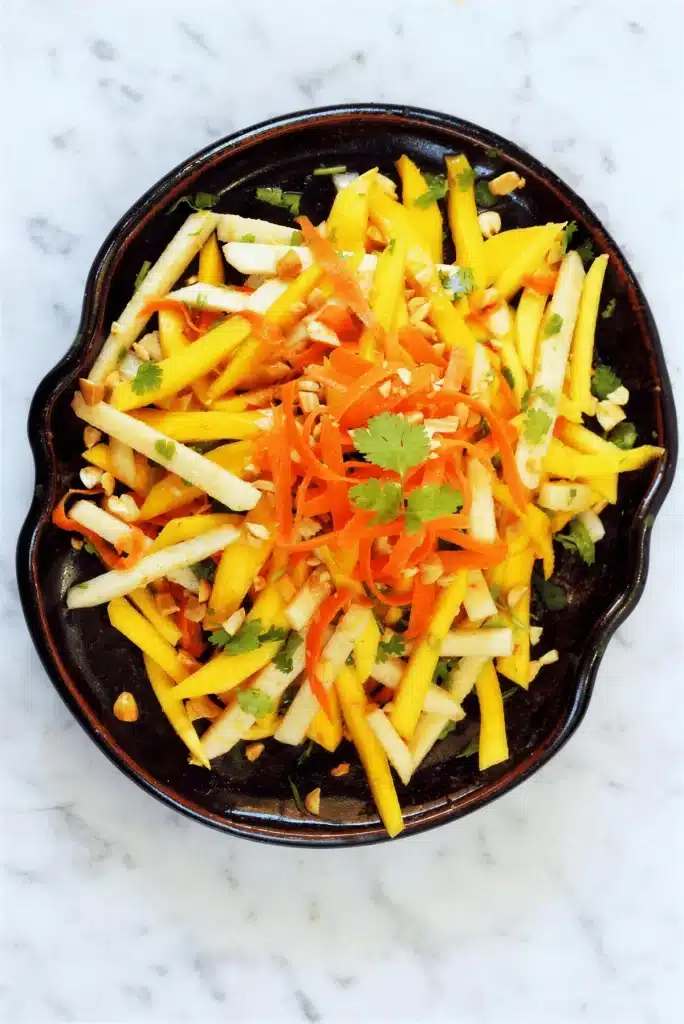
- Raw, crisp and ready in twenty minutes with no cooking of any kind
- An oil-free dressing of lime, honey, ginger and chile, so it tastes clean rather than rich
- Jicama holds its crunch for hours, unlike cucumber or apple
- Carrot shaved into ribbons rather than grated, which changes the texture completely
- Roasted peanuts and cilantro for salt and bite
- It goes with almost anything grilled, and it costs very little to make

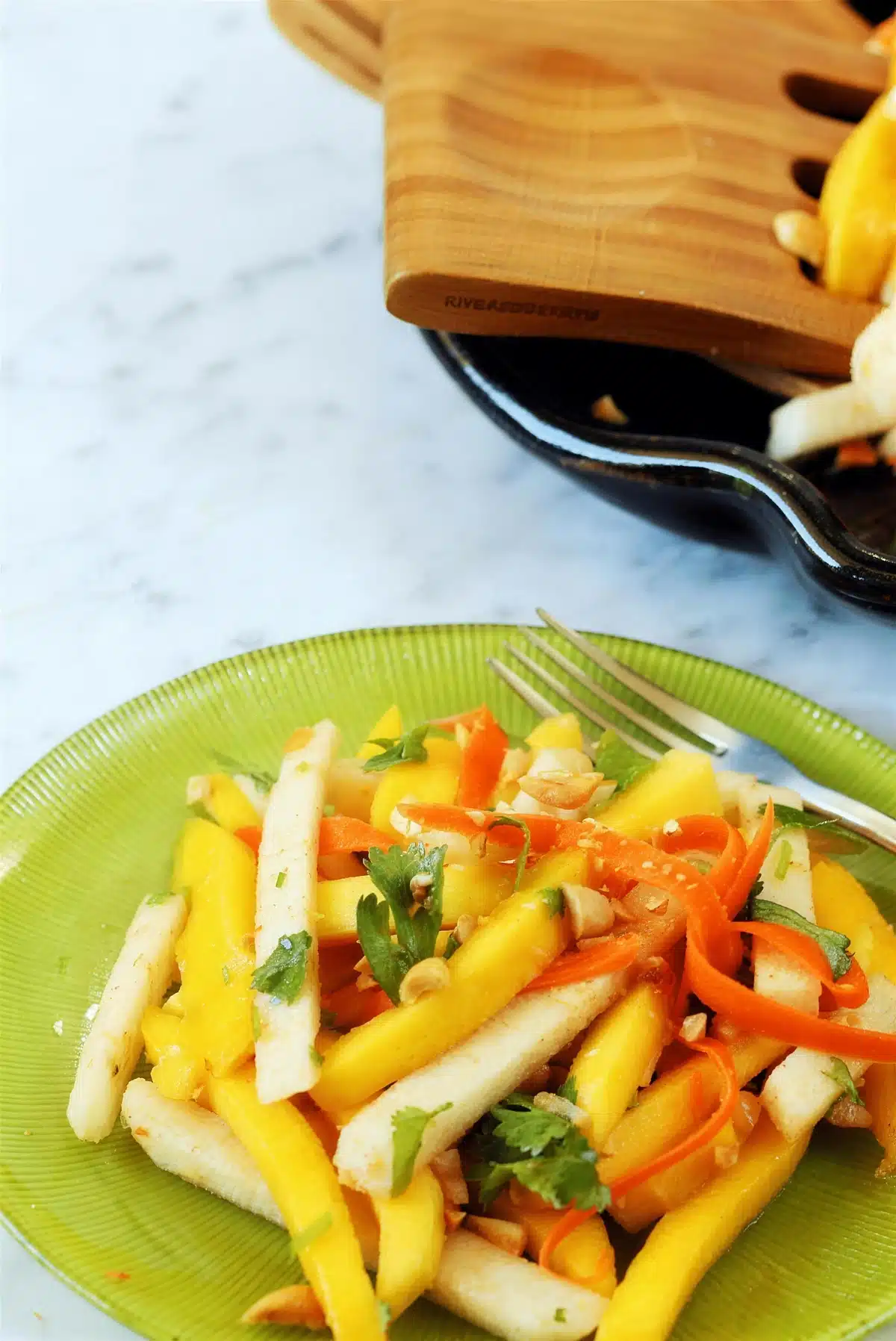
A jicama salad has only three components, so each of them has to be cut properly.
What Jicama Actually Tastes Like
Jicama is a Mexican root vegetable, a legume tuber, sold as a brown papery-skinned ball anywhere between three quarters of a pound and four pounds. Under the skin it is white, dense and wet.
It tastes like an underripe pear crossed with a water chestnut. Faintly sweet, mostly neutral, very juicy. It contributes texture more than flavor, which is exactly what you want against mango.
It does not brown. Cut apple and cut pear oxidize within minutes. Jicama sits on a board for an hour and stays white, which makes it uniquely useful in a salad that has to travel.
Its sweetness comes from an unusual source. Much of the carbohydrate in jicama is inulin, a fiber that the body does not digest as sugar, which is why it tastes mildly sweet without being sugary.
Buy it heavy for its size, with skin that does not give under a thumbnail. Soft patches mean it is old, and old jicama is fibrous and slightly sour. A quarter of a large one is often more than a recipe needs, so weigh it rather than counting.
Save this recipe
Enter your email and I’ll send this recipe straight to your inbox.
What Makes This Jicama Salad Different
Most versions of jicama salad go in one of two directions: chunks of fruit in a bowl, or a shredded slaw with a creamy dressing. This one is neither.
Everything is cut the same length. Jicama and mango in matchsticks of roughly the same size, carrot in long ribbons. A forkful picks up all three, which is the entire point of the dish and the reason chunks do not work.
There is no oil in it. Three tablespoons of lime juice, two teaspoons of honey, grated ginger, salt and ground chile. Oil coats the tongue and dulls the fruit, and a raw jicama salad needs sharpness more than it needs richness.
The mango is firm rather than soft. Ripe enough to be golden and sweet, firm enough to hold a matchstick. Soft mango collapses into puree the moment it is tossed and turns the whole bowl into a smoothie.
The peanuts go in last. Roasted and salted, chopped coarsely, added at the table. Left in the dressing they go soft in twenty minutes.
Ingredient Notes
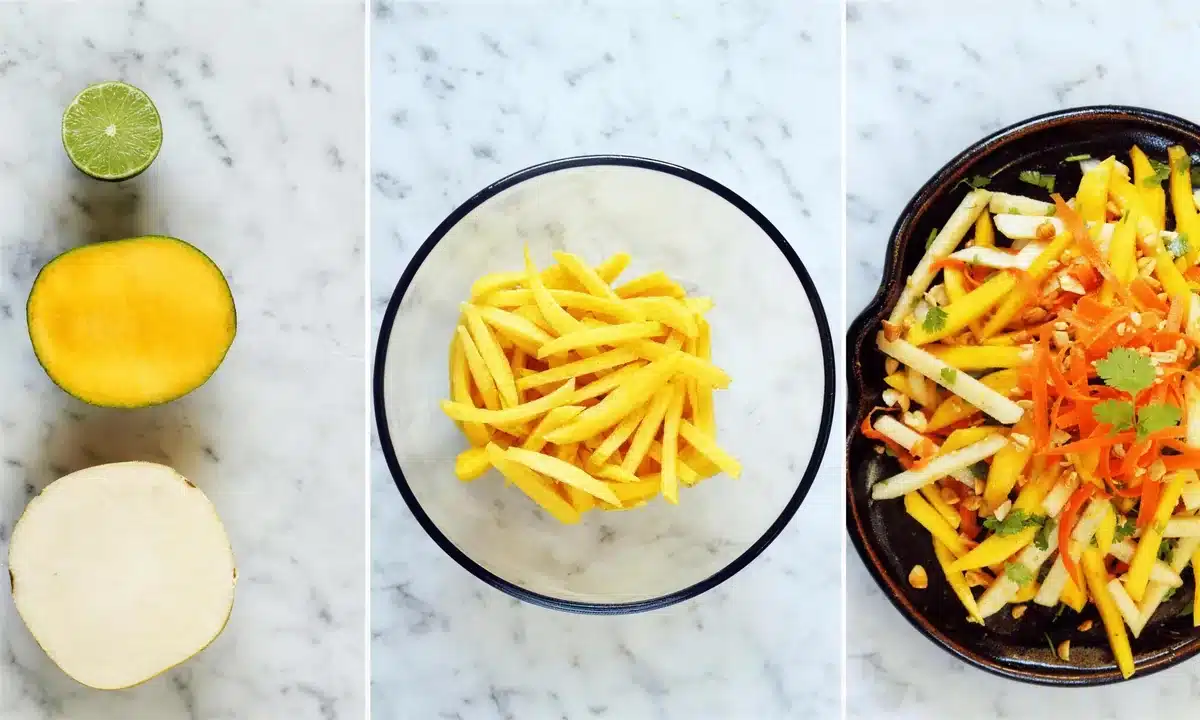
A jicama salad of this kind runs to ten ingredients, all of them raw. Exact amounts are in the recipe card below.
- Jicama: twelve ounces peeled, which is about half a medium root. Weighing it matters here more than usual, because jicama varies from the size of an orange to the size of a melon and “half a jicama” can mean triple the amount.
- Mangoes: two large, firm and golden. Ataulfo and Kent hold their shape best. Press near the stem: it should give slightly and no more.
- Carrots: two medium, shaved into ribbons with a vegetable peeler rather than grated. Ribbons tangle through the matchsticks and hold dressing; grated carrot sinks to the bottom.
- Lime juice: three tablespoons to start, from about two limes, with more at the end. Bottled juice tastes flat in a dressing with nothing to hide behind.
- Honey: two teaspoons, which is there to round the lime rather than to sweeten the fruit.
- Ground chile: a quarter teaspoon of ancho or a Tajin-style lime chile salt. Cayenne works at half the amount.
- Peanuts: a third of a cup, roasted and salted, chopped coarse. Raw peanuts have none of the toasted flavor this needs.
How To Cut Jicama Into Matchsticks
The cutting is most of the work in a jicama salad and it takes about ten minutes once you have done it twice.
Peel it with a knife, not a peeler. Under the papery brown skin there is a fibrous layer a couple of millimeters thick that a peeler leaves behind and that stays stringy however long it sits in dressing. Cut the top and bottom flat, stand it up and take the skin off in strips.
Cut it into slabs about a quarter-inch thick, then stack two or three slabs and cut them across into matchsticks. Aim for the thickness of a wooden skewer and about two inches long.
Match the mango to it. Cut the cheeks off either side of the stone, score them into sticks and run the knife along the skin.
Do the carrots last, with a Y-peeler, pressing hard and going the full length of the carrot. Turn it a quarter turn each time so the ribbons stay wide.
A mandoline with a julienne blade does the jicama in a minute if you have one, though the hand-cut sticks are more irregular and look better.
How To Make Jicama Salad
Dress this one shortly before it goes to the table. Jicama and mango both release water, and a jicama salad that has been sitting dressed for an hour sits in a puddle.
- First, peel and matchstick the jicama, cut the mango cheeks into sticks of the same size, and shave the carrots into ribbons.
- Next, whisk the 3 tablespoons of lime juice with the honey, grated ginger, salt and ground chile until the honey has dissolved.
- Then pour it over the jicama, mango and carrot and toss with your hands rather than tongs, which break the matchsticks.
- After that, taste it. It should be sharp enough to make you blink. Add lime a teaspoon at a time and a little more salt until it does.
- Finally, fold through most of the cilantro, pile it into a shallow bowl and scatter the chopped peanuts and the rest of the cilantro over the top just before serving.
Getting the Lime and Honey Balance Right
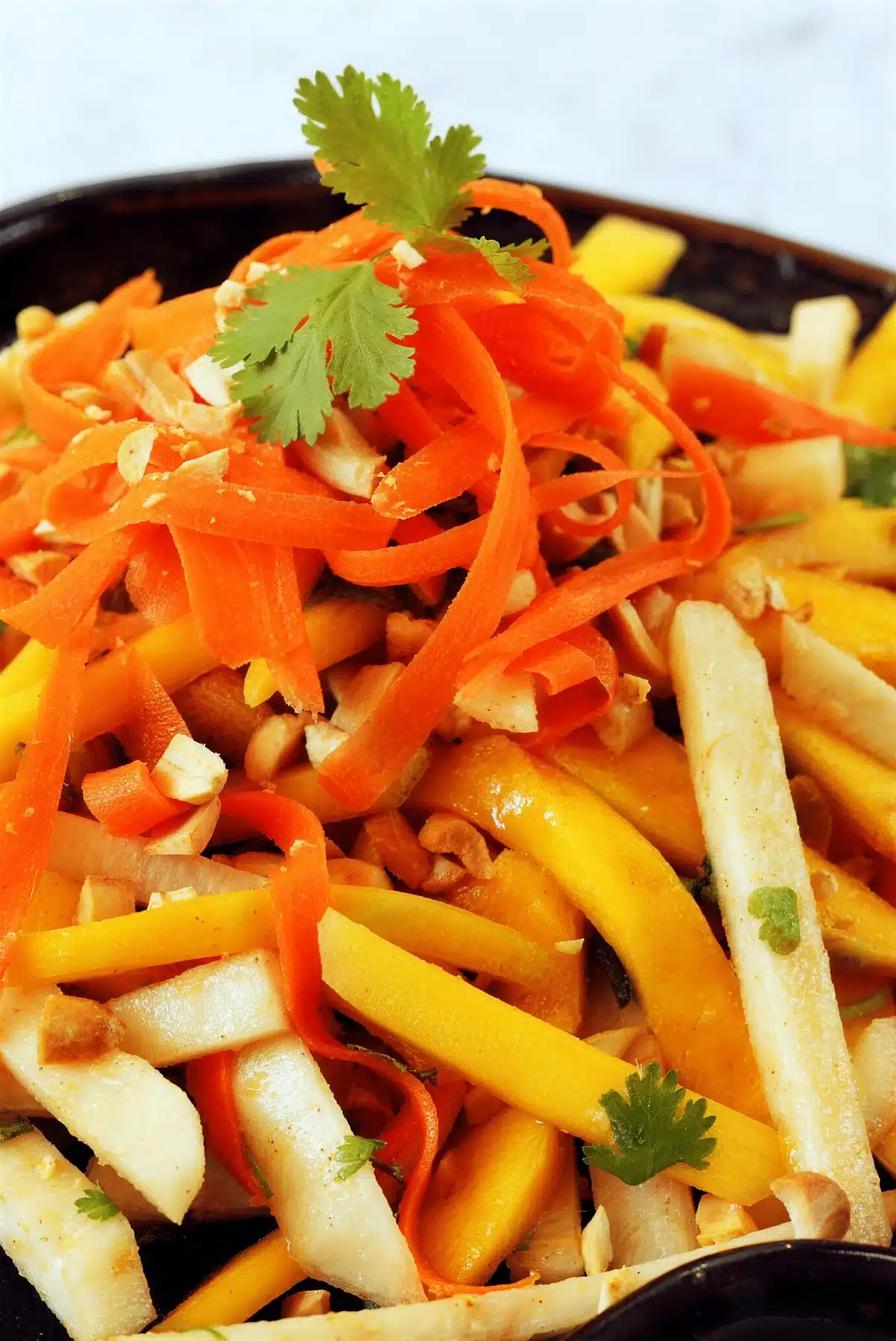
There is no oil to soften anything in this jicama salad, so the dressing is doing all of the work and it needs tasting twice.
Start at three tablespoons of lime. That is deliberately not quite enough. Mangoes vary enormously in sweetness and a fourth tablespoon is often needed.
Two teaspoons of honey, no more. Its job is to take the edge off the acid, not to sweeten fruit that is already sweet. If the salad tastes sugary, you have gone too far and only more lime will fix it.
Salt is the one people leave out. Half a teaspoon of fine sea salt across six servings sounds like a lot for a fruit salad and it is what makes the mango taste of mango.
Taste after tossing, not before. The juices that come out of the jicama and mango dilute the dressing noticeably within a minute or two.
Adjust at the table if it has been standing. A squeeze of lime over the top wakes the whole bowl up again.
Make It Ahead
A jicama salad is a good thing to prep in advance and a bad thing to assemble in advance, and the difference matters.
Cut the jicama up to two days ahead. It genuinely does not brown or soften. Keep it in a sealed box in the refrigerator, dry rather than in water, which makes it waterlogged.
Shave the carrots a day ahead and keep them in a box with a damp paper towel over them so they stay flexible.
Mix the dressing a day ahead. The ginger infuses and it is better for the wait.
Cut the mango on the day. Mango softens once cut in a way that jicama does not, and by the second day the sticks are limp.
Combine no more than thirty minutes before serving, and add the peanuts at the very last moment. If you have to dress it earlier, drain off the liquid that collects and add a fresh squeeze of lime.
Storing Jicama Salad
- Refrigerated, dressed: jicama salad keeps 2 days and stays crisp, though it sits in its own juice. Drain and re-season before serving.
- Refrigerated, undressed components: jicama 2 days, carrot ribbons 1 day, mango on the day.
- The peanuts separately, always. Twenty minutes in the dressing is enough to soften them.
- Whole jicama, uncut: 2 weeks in a cool dry place, not the refrigerator, which makes the flesh mealy.
- Do not freeze it. The cell walls collapse and it thaws into wet string.
Variations and Substitutions
In a jicama salad the root and the lime are the structure. The rest is negotiable.
- Green mango: use it hard and unripe and this becomes closer to a Thai som tam, sour rather than sweet. Add a teaspoon more honey.
- Fish sauce: two teaspoons in place of the salt, which turns it savory and is the version to serve with grilled pork.
- Cucumber: half an English cucumber in matchsticks, added at the last minute since it does not hold like jicama.
- Red onion: a quarter of one, sliced paper-thin and soaked in the lime juice for ten minutes first.
- Mint instead of cilantro, or both, which suits the green mango version particularly.
- Pepitas or cashews in place of the peanuts, toasted the same way.
- Watermelon in place of half the mango in high summer, cut into the same sticks.
What to Serve with Jicama Salad
Jicama salad is sharp, crunchy and cold, so it belongs next to something hot, fatty and charred.
- Grilled fish tacos, where it works as both the salad and the slaw.
- Carnitas or grilled pork shoulder, which is the classic pairing in Mexico.
- Anything blackened, since the lime cuts straight through the spice crust.
- As one of three or four things on a table rather than as a side to one plate.
- Alongside shrimp fajitas, which is the pairing I make most often.
For more in the same direction, there is my coconut shrimp, a creamy broccoli slaw for when you want the richer kind of crunch, and homemade lime salt, which is very good scattered over this.
Here is what readers ask most often.
Jicama Salad FAQ
Frequently Asked Questions
Can I eat jicama raw?
Yes, and raw is the best way to eat it. The flesh is safe and crisp straight from the root and it is how it is sold and eaten across Mexico, usually with lime and chile. The skin, the leaves, the stem and the seeds of the plant are not edible and should be cut away and discarded, so peel it thickly and use only the white interior. Cooked jicama is fine but loses the crunch that makes this salad work.
What can I use instead of jicama?
Nothing matches it exactly, because no other raw vegetable stays this crisp for this long. Water chestnuts are the closest in texture and come tinned, though they taste of far less. Kohlrabi, peeled and cut the same way, is the best fresh substitute. Green apple or Asian pear will work for flavor but both brown quickly and go soft in the dressing, so cut them at the last minute and add extra lime.
How far ahead can I make it?
Cut the jicama up to two days ahead and mix the dressing a day ahead, but combine them no more than thirty minutes before serving. A dressed jicama salad stays crisp for hours, unusually, but it steadily releases liquid and by the second hour it is sitting in a pool that dilutes the seasoning. Drain it and add a fresh squeeze of lime if that happens.
More Questions About Jicama and Mango
Good to Know
How do I know if a mango is firm enough?
Press gently near the stem end. It should give very slightly, the way a peach does two days before you would eat it. A mango that dents under a thumb is too soft for this and will shred rather than cut. Color is unreliable since some varieties stay green when ripe. Ataulfo, the small yellow ones, and Kent both hold a matchstick better than the common red Tommy Atkins.
Why peel jicama with a knife?
Because there is a fibrous layer under the brown skin that a vegetable peeler will not take off. It is two or three millimeters thick and it stays tough and stringy no matter how long it sits in the dressing. Cut a flat top and bottom, stand the root on the board and cut the skin away in strips, taking a little more than looks necessary.
Is this salad spicy?
Only faintly. A quarter teaspoon of ancho chile across six servings gives warmth and color rather than heat. Cayenne is much hotter, so use half as much. Leave the chile out entirely and it is still good, just less interesting against grilled meat.
Can I make it without honey?
Yes. Maple syrup works one for one, and agave is sweeter so use slightly less. Leaving the sweetener out makes the dressing harsher, so cut the lime back to two tablespoons and let the mango carry the sweetness.
A good jicama salad is really a lesson in cutting rather than cooking, and twenty minutes with a sharp knife is the whole recipe. If you are grilling anyway, it goes on the table next to my shrimp fajitas and disappears first.
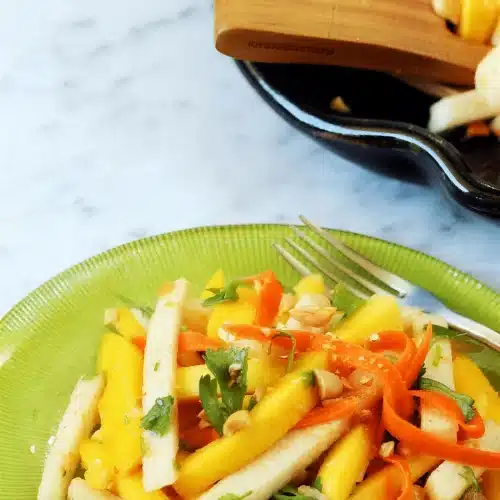
Jicama Salad with Mango, Lime and Peanuts
Save this recipe
Enter your email and I’ll send this recipe straight to your inbox.
Ingredients
The Salad
- 2 large mangoes firm and golden, cut into matchsticks
- 12 ounces jicama peeled weight, about half a medium root, in matchsticks
- 2 medium carrots shaved into long ribbons with a peeler
- 1/3 cup roasted salted peanuts chopped coarse, added at the table
- 1/2 cup chopped cilantro leaves and fine stems
The Lime Dressing
- 3 tablespoons fresh lime juice about 2 limes, plus more to finish
- 1 teaspoon finely grated fresh ginger
- 2 teaspoons honey
- 1/2 teaspoon fine sea salt
- 1/4 teaspoon ground ancho chile or half as much cayenne
Equipment
- Large Bowl
- Vegetable peeler
- Knife
Instructions
Cut Everything the Same Size
- Trim the top and bottom off the jicama, stand it on the board and cut the brown skin away in strips with a knife, taking a little more than looks necessary so the fibrous layer beneath goes too. Cut it into quarter-inch slabs, stack them and cut across into matchsticks about the thickness of a wooden skewer.
- Slice the cheeks off each mango, score the flesh into sticks of the same size and run the knife along the skin to release them. Shave the carrots into long ribbons with a Y-peeler, turning the carrot a quarter turn each pass.
Mix the Dressing
- Whisk the lime juice, ginger, honey, salt and ground chile together in a small bowl until the honey has dissolved completely. It should taste sharper than you think it needs to.
Toss and Taste
- Put the jicama, mango and carrot in a wide bowl, pour the dressing over and toss with your hands rather than tongs, which snap the matchsticks. Lift from the bottom and turn the whole thing over three or four times.
- Taste it now, not before, because the fruit releases juice as soon as it is dressed. Add lime a teaspoon at a time and a pinch more salt until it is bright enough to make you blink.
Finish at the Table
- Fold through most of the cilantro and pile the salad into a shallow serving bowl.
- Scatter the chopped peanuts and the remaining cilantro over the top just before it goes out. Peanuts added earlier soften in the dressing within twenty minutes.