
A good carrot parsnip soup tastes like it has cream in it before any cream goes near it, and the reason is the oven. Roast the roots until the edges go brown and sticky and the soup arrives sweet, nutty and thick. Boil them in stock instead and you get orange water.
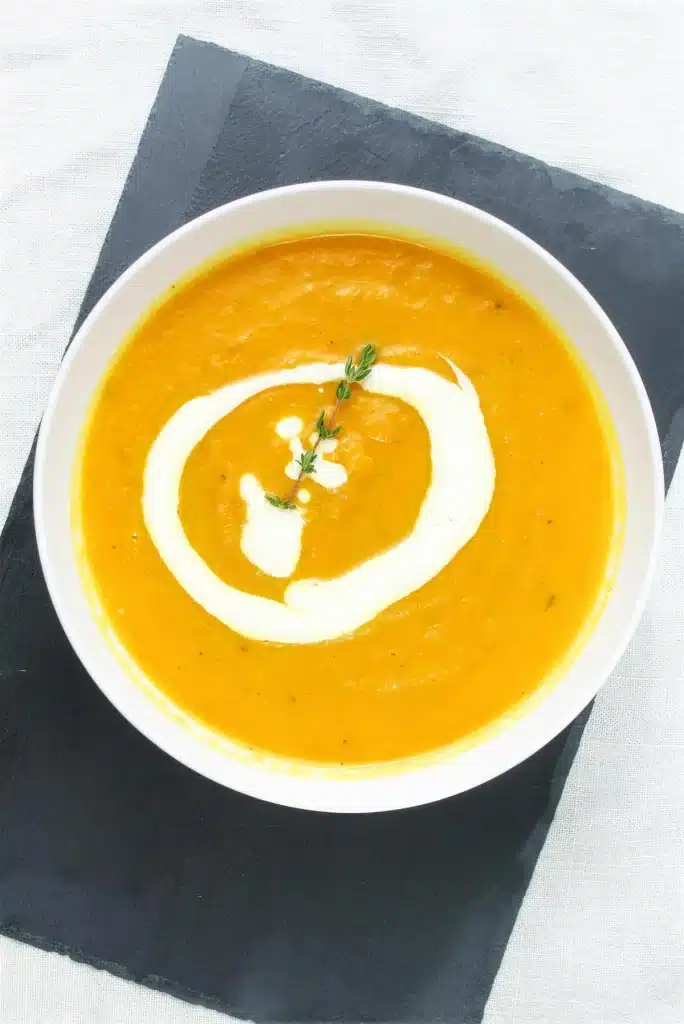
- Roasted rather than boiled, which is the difference between sweet and watery
- Naturally thick with no cream, no potato and no flour in the pot
- The lemon ginger cream is whisked in one bowl in about two minutes
- Vegan if you swap the garnish, gluten-free as written
- It freezes properly, which most dairy-finished soups do not
- Roast the vegetables up to three days ahead and the soup is a fifteen minute job
The other half of this is the spoonful of lemon ginger cream that goes on top. Roasted root vegetables are sweet in a way that flattens after four spoonfuls, and a cold, sharp, gingery yogurt swirled through the middle resets it every time. That contrast is the whole point of a carrot parsnip soup.

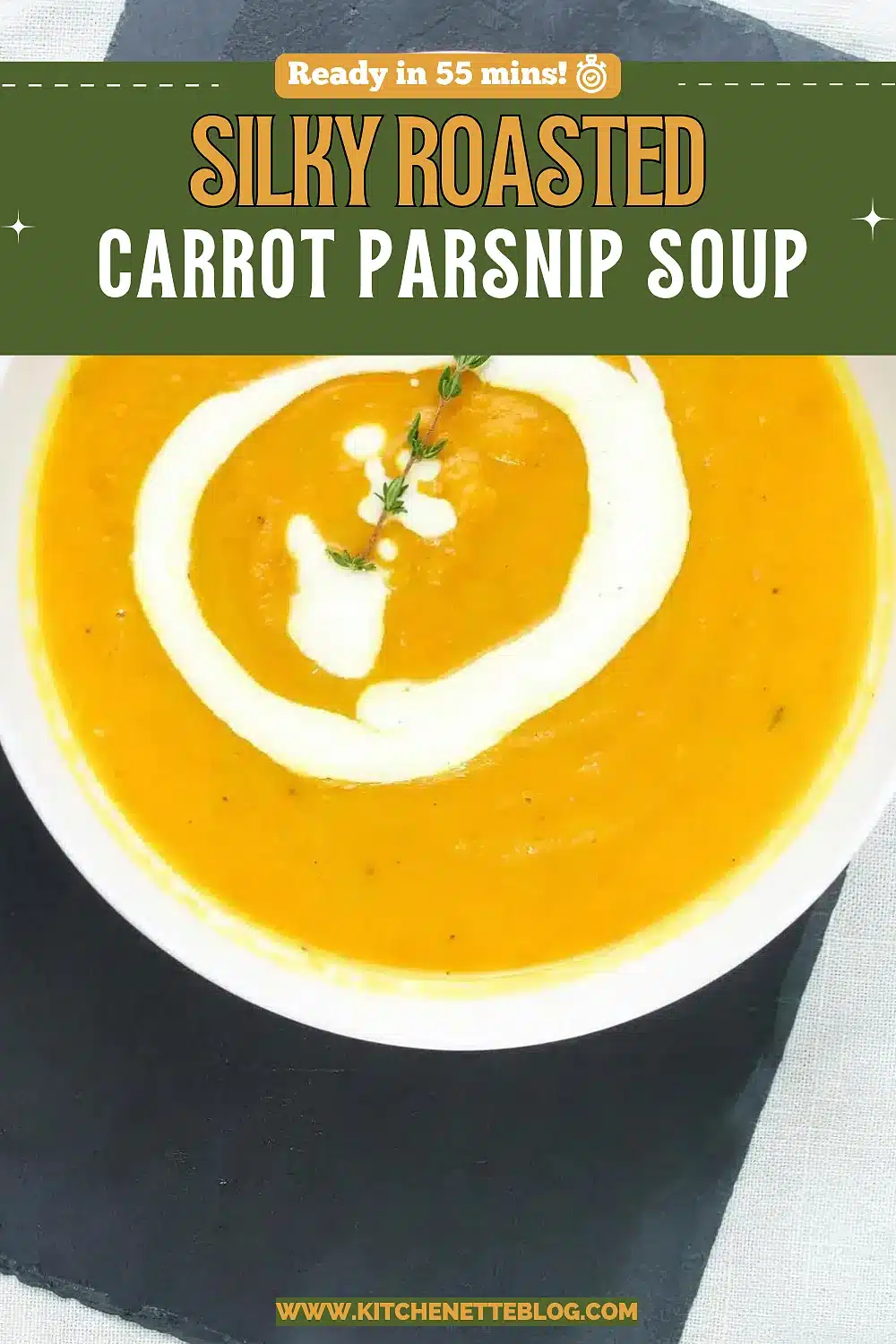
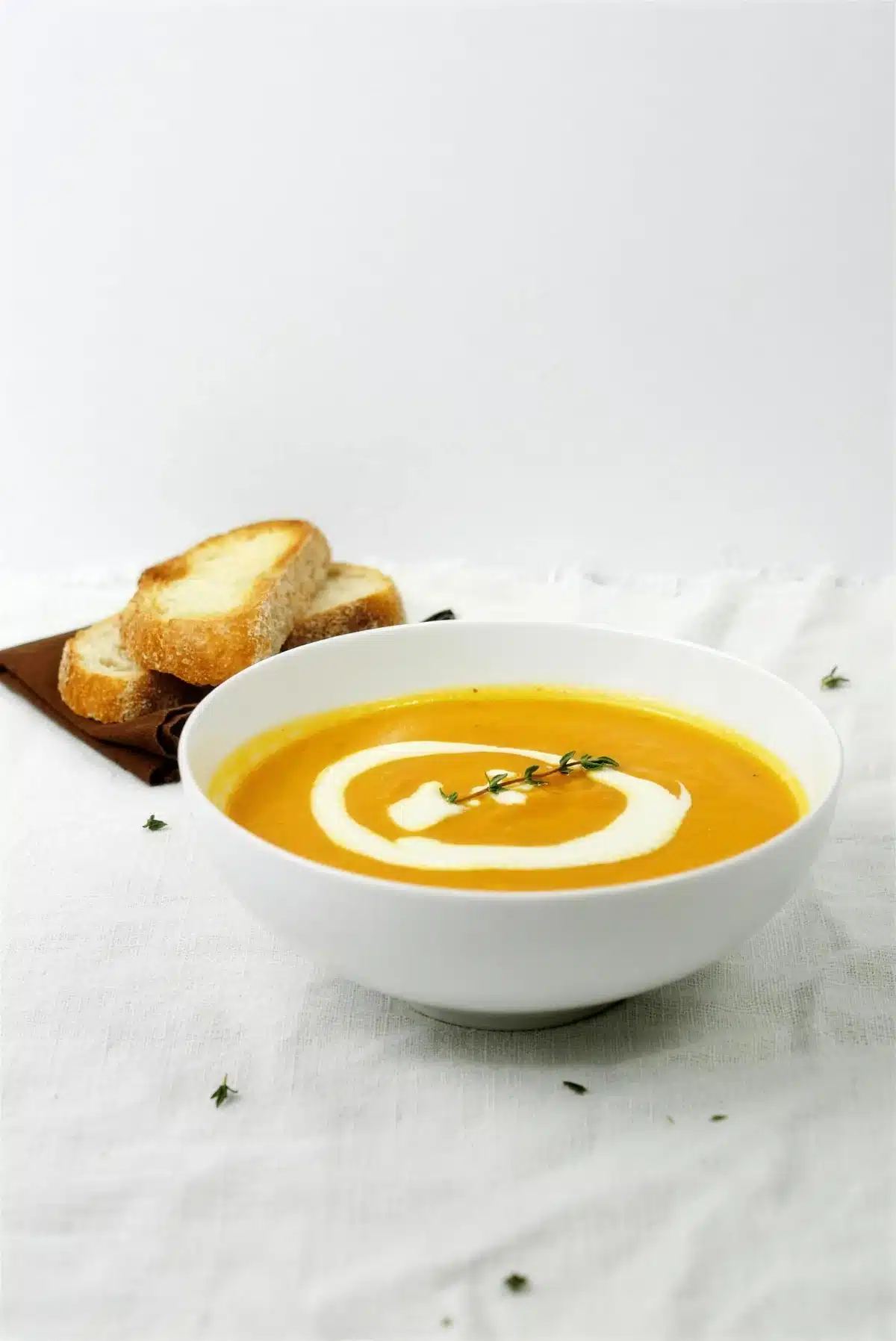
Carrot parsnip soup comes down to two roots, one oven tray and a cold spoonful on top.
- What Parsnips Do That Carrots Cannot
- Ingredient Notes
- Why Roasting Beats Simmering for Carrot Parsnip Soup
- How To Make Carrot Parsnip Soup
- The Lemon Ginger Cream, and Why It Does Not Split
- How To Tell When It Is Done
- Make It Ahead
- Storing Carrot Parsnip Soup
- Variations and Substitutions
- What to Serve with Carrot Parsnip Soup
- Carrot Parsnip Soup FAQ
What Parsnips Do That Carrots Cannot
Carrots on their own make a thin, one-note soup. They are sweet and they are watery, and once pureed they need cream or potato to give them any body at all.
Parsnips solve both problems at once, which is why carrot parsnip soup exists as a dish at all. They carry far more starch than a carrot, so a blender turns them velvety without anything being added, and their sweetness has a spiced, almost aniseed edge behind it that stops the bowl tasting like baby food.
There is a seasonal reason they work so well in winter. Parsnips convert their starch to sugar after a few weeks of near-freezing weather in the ground, which is why a January parsnip tastes sweet and a September one tastes like a woody carrot. Illinois Extension’s notes on preparing parsnips are worth reading on this, and on the one job most people skip.
That job is the core. A parsnip much thicker than about 2 inches at the shoulder has a fibrous core running down it that never softens, no matter how long it roasts or how hard the blender works. Quarter the fat end lengthwise and cut the pale woody wedge out with the tip of a knife. Small and medium parsnips do not need it.
Roughly five parts parsnip to three parts carrot by weight is the ratio I keep returning to for carrot parsnip soup. More carrot and it goes thin. More parsnip and the aniseed note takes over.
Save this recipe
Enter your email and I’ll send this recipe straight to your inbox.
Ingredient Notes
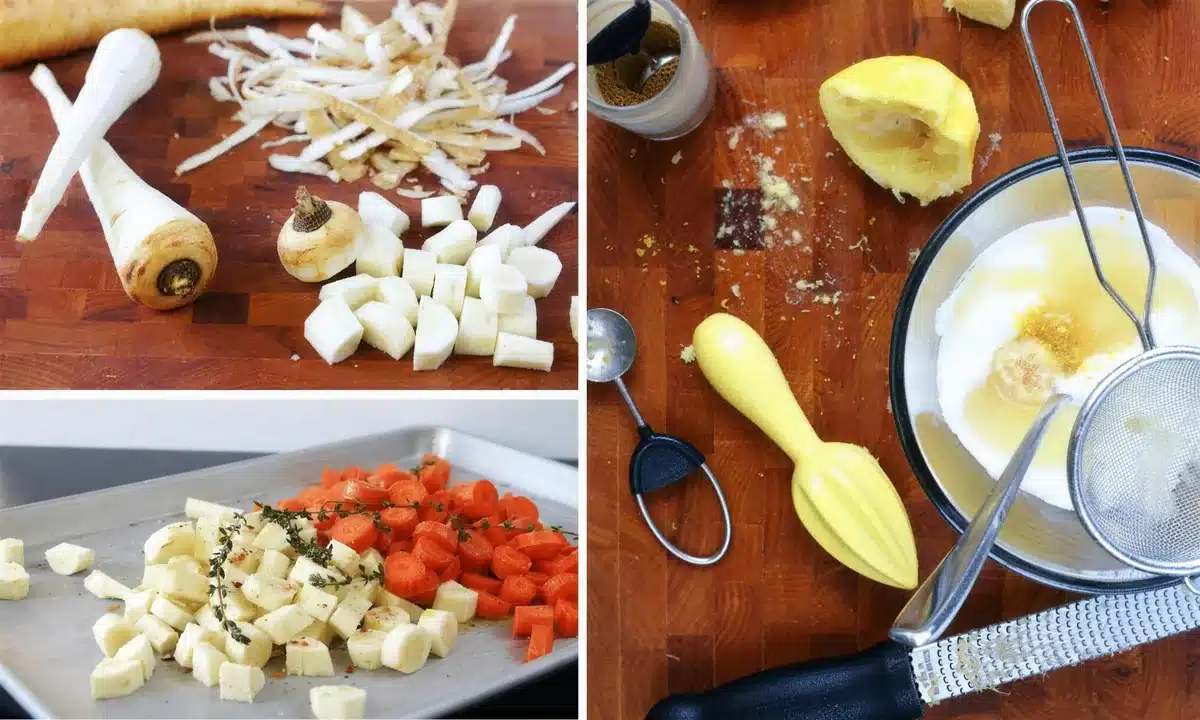
Carrot parsnip soup takes nine things in the pot and seven in the garnish, and none of them is unusual. Exact amounts are in the recipe card below.
- Parsnips: about 1 1/4 pounds, which is four medium ones. Choose firm, dry, pale roots. Yellowing or a brown ring around the core means an old parsnip and a bitter soup.
- Carrots: about 3/4 pound. Whole carrots rather than the bagged batons, which are cut from oversized roots and carry a soapy note when concentrated.
- Olive oil: three tablespoons, two on the tray and one in the pot. Skimping on the tray is the most common reason vegetables dry out instead of caramelizing.
- Thyme: eight sprigs, thrown on whole and pulled off after roasting. The leaves fall off in the oven and the stems come out easily.
- Shallot and garlic: one large shallot and two cloves, cooked gently in the pot afterward. Roasting them alongside the roots burns them before the parsnips are ready.
- Stock: four cups of vegetable broth, with up to another cup held back to thin. Water works if the roasting was done properly, which tells you how much of the flavor is coming from the tray.
- Greek yogurt: a cup of the whole milk kind for the cream. Low fat splits far more readily and tastes chalky against a sweet soup.
- Lemon and ginger: the zest of a whole lemon but only two tablespoons of the juice. More than that and the yogurt loosens into a pourable sauce that sinks instead of sitting in a swirl.
Why Roasting Beats Simmering for Carrot Parsnip Soup
Simmering does one thing to a root vegetable: it softens it. Roasting does three.
It removes water. A raw carrot is about ninety percent water and a parsnip close to eighty. Half an hour in a hot oven drives a good deal of that off, and everything left behind is more concentrated. This is why a roasted carrot parsnip soup can be thick without cream.
It browns the sugars. Above about 300F the sugars on the cut faces caramelize into the sticky brown edges you can see on the tray. Those edges are most of what makes the soup taste of something.
It keeps the pot clean. Roasted carrot parsnip soup never scorches on the bottom. Nothing sticks, nothing catches, and there is no thirty minute simmer during which the thyme goes bitter.
The cost of a roasted carrot parsnip soup is time and one extra pan. Thirty minutes at 425F, cut into 1-inch chunks so the pieces cook evenly, and spread across the tray in a single layer with room around them. Crowded vegetables steam in their own moisture and come out pale, which is the failure that sends people back to boiling.
How To Make Carrot Parsnip Soup
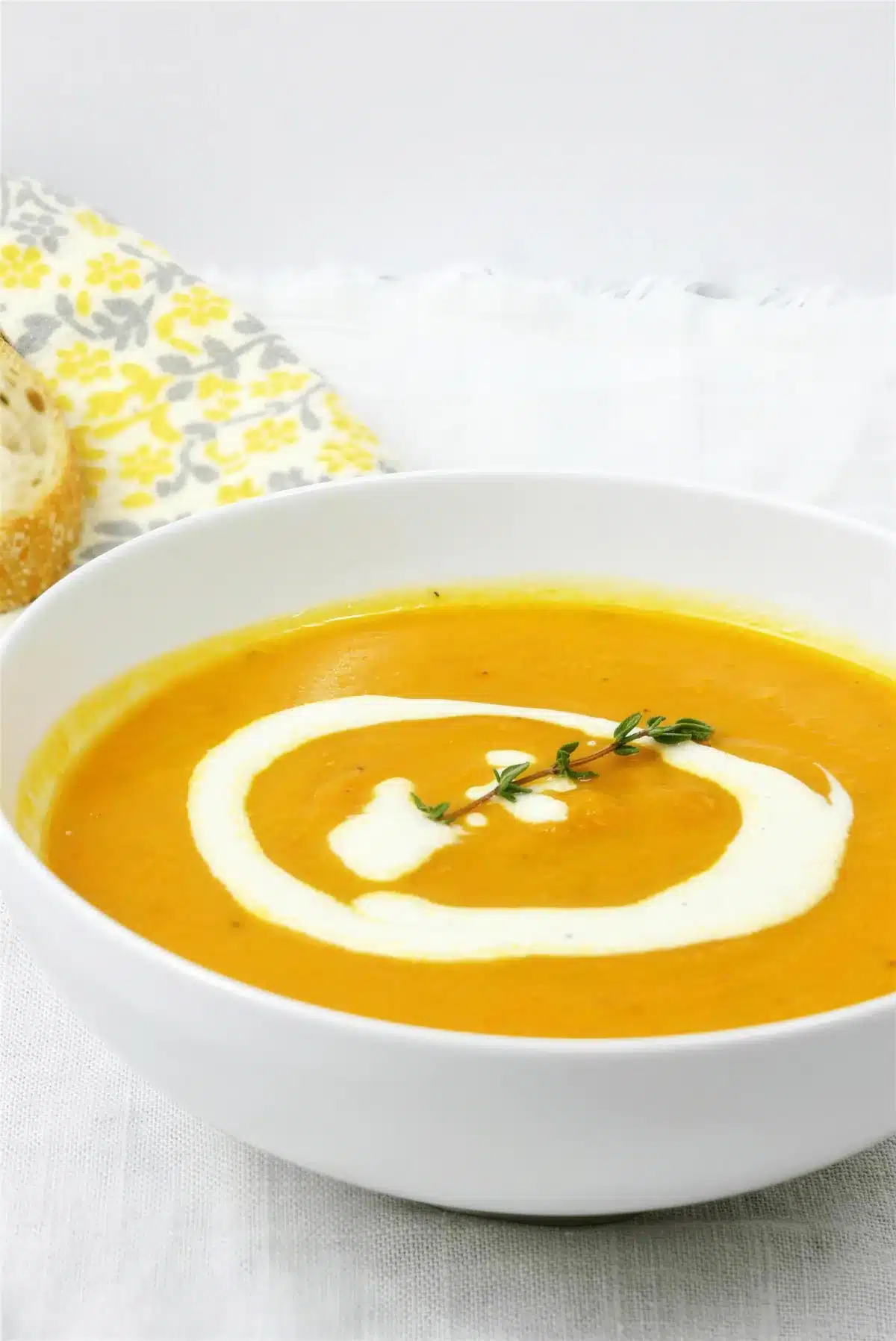
Exact amounts are in the recipe card at the bottom of the page.
- First, heat the oven to 425F. Peel the roots, core any thick parsnips, and cut everything into 1-inch chunks so the two vegetables finish together.
- Next, toss the chunks on a sheet pan with two tablespoons of the oil, the thyme sprigs, the pepper flakes, a teaspoon of the salt and the black pepper. Spread them into one layer with space between the pieces.
- Then roast for 30 minutes, turning once at the halfway mark, until the edges are properly brown and a knife goes through a parsnip with no resistance. Pull the thyme stems off and discard them.
- After that, warm the last tablespoon of oil in a large pot over medium heat and cook the shallot for 4 minutes until translucent, then the garlic for 1 minute more. Do not let the garlic color.
- Add the roasted vegetables and four cups of stock, bring it to a simmer and hold it there for 5 minutes. This step is not optional. It brings everything to temperature and marries the roasted flavor into the broth before anything is blended.
- Finally, blend until completely smooth with an immersion blender or in batches in a jug blender, loosening with more stock until it coats a spoon and falls off slowly. Taste, add the remaining salt, and spoon the lemon ginger cream over each bowl.
The Lemon Ginger Cream, and Why It Does Not Split
The garnish that finishes this carrot parsnip soup is whole milk Greek yogurt, lemon zest and juice, honey, grated ginger, salt and a quarter teaspoon of cumin, whisked in a bowl until smooth. Two minutes, no cooking.
The two rules that keep it intact are simple. Use whole milk yogurt, because the fat protects the proteins from curdling. And put it on top of the soup rather than into the pot, since yogurt stirred into anything above about 175F will break into grains no amount of whisking recovers.
If you want it through the soup rather than on it, temper it: whisk half a cup of the hot soup into the yogurt a spoonful at a time until the bowl is warm to the touch, then stir that back in off the heat.
The cumin is doing more than it looks like it should. A quarter teaspoon is not enough to taste as cumin, but it is enough to give the yogurt a savory floor so the honey does not read as dessert.
For a vegan version, use a thick unsweetened coconut yogurt and maple syrup instead of the honey. It splits less readily than dairy does, so it will survive being stirred in.
How To Tell When It Is Done
There are two moments to judge in a carrot parsnip soup and people usually only check the second.
The first is on the tray. The roots are ready when the cut faces are genuinely brown in patches, not merely dry and beige, and a knife slides through the thickest parsnip with no resistance at all. Anything less and the fiber survives the blender.
The second is consistency, and the test is the back of a spoon. Lift a spoonful and tip it. Correct carrot parsnip soup coats the metal and falls off slowly in a sheet. If it runs off like water you have added too much stock, and simmering it uncovered for 5 minutes brings it back. If it sits on the spoon in a mound it needs another half cup of stock.
Season a carrot parsnip soup at the end, never at the blender. Roasted vegetables concentrate as they cook and a soup salted to taste before blending is almost always over-seasoned once it is smooth.
Make It Ahead
Carrot parsnip soup is one of the better soups to split across two days, because the roasting is the part that takes time and it holds perfectly.
Roast the vegetables up to 3 days ahead, cool them, and keep them covered in the refrigerator. The soup then takes fifteen minutes from cold, and the roasted flavor is arguably better on day two.
The finished carrot parsnip soup keeps 4 days refrigerated and reheats without any loss. Make the lemon ginger cream up to 3 days ahead too, and expect it to thicken in the cold. A teaspoon of water loosens it.
For a party, roast a double tray, blend the soup the day before, and serve it from a slow cooker on low with the cream in a bowl alongside. Nothing about it suffers from sitting.
Storing Carrot Parsnip Soup
- Refrigerator: carrot parsnip soup keeps 4 days in a sealed container, with the lemon ginger cream stored separately.
- Freezer: up to 3 months. This soup freezes better than most because there is no dairy or potato in it, and neither one survives a freeze intact.
- Portioning: freeze it flat in bags rather than in tubs. A flat bag thaws in about twenty minutes under cool running water.
- Reheating: gently, over medium-low heat, stirring. It thickens in the cold and usually wants a splash of stock or water to come back to the right consistency.
- The cream: 3 days refrigerated and it does not freeze. Two minutes of whisking makes a fresh batch, so there is no reason to try.
Variations and Substitutions
- Curried: turn the carrot parsnip soup into a curried one with two teaspoons of curry powder tossed with the vegetables before roasting, and a can of coconut milk in place of one cup of the stock.
- Apple: one tart apple, cored and roasted alongside. It sharpens the sweetness and adds pectin, which thickens things further.
- Sweet potato: swap half the carrot for sweet potato and expect a rounder, less peppery soup.
- Toasted seeds: pumpkin seeds toasted in a dry pan with salt, scattered over. The bowl badly wants something crunchy.
- Vegan: vegetable stock, coconut yogurt and maple syrup in the cream. Nothing else changes.
- Roasted garlic: a whole head wrapped in foil on the same tray, squeezed into the pot instead of the raw cloves.
- Thinner and lighter: six cups of stock instead of four turns it into a first course rather than a lunch.
What to Serve with Carrot Parsnip Soup
Bread is not optional beside a carrot parsnip soup, because it is smooth from edge to edge and the bowl needs texture from somewhere. Toasted sourdough rubbed with a cut garlic clove is the standard, and a grilled cheese cut into fingers is better.
For a larger table, a bright salad is the right counterweight. My winter panzanella with roasted grapes uses the same oven at the same temperature, so both can go in together. A tray of quinoa with roasted vegetables makes it a full meal.
If you are building a run of cold weather soups, my acorn squash soup works on the same roast-then-blend principle, and the stovetop potato soup is the one to make when there is no time to heat an oven at all.
Here is what readers ask most often.
Carrot Parsnip Soup FAQ
Frequently Asked Questions
Should I peel parsnips before putting them in soup?
Yes for soup, and here is the nuance. A lot of the flavor sits directly under the skin, so for roasting parsnips as a side dish a hard scrub is often enough. In a pureed soup the skin is the problem, because it does not break down in a blender and leaves fine flecks and a slightly bitter edge through an otherwise smooth bowl. Peel them thinly. And on anything thicker than about 2 inches at the shoulder, cut out the woody core as well, which never softens at all.
What makes carrot soup taste better?
Three things, in order of impact. Roast the vegetables instead of simmering them, which concentrates them and browns their sugars. Add something acidic at the end, which is what the lemon in the ginger cream is doing and why the same soup tastes flat without it. And use a little fat, since carrot and parsnip flavor compounds are fat-soluble and a soup made with no oil at all tastes muted no matter how good the vegetables were.
Can I make carrot parsnip soup without a blender?
Yes, and it will be rustic rather than velvety. Roast the vegetables until they are properly soft, then mash them hard against the side of the pot with a potato masher and whisk vigorously as you add the stock. A food mill gives a better result than a masher and a fine sieve gives the best result of all, though pushing this quantity through one is about ten minutes of real work.
More Questions About Parsnips and Texture
Good to Know
Why is my soup bitter?
Almost always the parsnips. An old parsnip, a very large one, or one with a brown ring around the core carries a bitterness that roasting concentrates rather than removes. Buy firm, pale, medium roots and core the fat ones. The other cause is burnt garlic, which is why the garlic goes into the pot for sixty seconds at the end rather than onto the roasting tray.
Can I freeze it with the cream on top?
No. Freeze the soup on its own and make the lemon ginger cream fresh, which takes two minutes. Yogurt separates when frozen and thawed, and stirring it back together gives you a grainy liquid rather than the thick swirl the bowl needs. The soup itself freezes unusually well precisely because there is no dairy in it.
Carrot Parsnip Soup: Sweetness and Timing
Good to Know
Is it supposed to be this sweet?
Sweet, yes, cloying, no. If it is tipping into dessert the fix is acid and salt rather than less carrot. Add the lemon ginger cream, then a squeeze of lemon straight into the pot and another half teaspoon of salt, and taste again. A pinch more red pepper also helps, since heat reads as a counterweight to sweetness.
Do carrots and parsnips cook at the same rate?
Close enough, if you cut them the same size. Parsnips are slightly softer to begin with and slightly starchier, so at 1-inch chunks they finish within a couple of minutes of each other. If you leave the parsnips in larger pieces they will still be firm in the middle when the carrots are done, and that firmness survives the blender as grit.
Roast them properly, blend them longer than feels necessary, and put something cold and sharp on top. That is all a carrot parsnip soup asks for. For another bowl built the same way, try my easy acorn squash soup.

Roasted Carrot Parsnip Soup with Lemon Ginger Cream
Save this recipe
Enter your email and I’ll send this recipe straight to your inbox.
Ingredients
For the Roasted Roots
- 1 1/4 pounds parsnips about 4 medium, peeled, cored if thick, cut into 1-inch chunks
- 3/4 pound carrots about 5 medium, peeled and cut into 1-inch chunks
- 3 tablespoons olive oil divided, 2 on the tray and 1 in the pot
- 8 sprigs fresh thyme left whole, stems pulled out after roasting
- 1 1/2 teaspoons kosher salt divided, 1 on the tray and the rest at the end
- 1/2 teaspoon black pepper freshly ground
- 1/4 teaspoon red pepper flakes
- 1 large shallot minced
- 2 cloves garlic minced
- 4 cups vegetable broth plus up to 1 cup more to loosen the finished soup
For the Lemon Ginger Cream
- 1 cup whole milk Greek yogurt low fat splits and tastes chalky here
- 1 teaspoon lemon zest finely grated, from 1 lemon
- 2 tablespoons lemon juice fresh, and no more than this or the cream goes runny
- 1 teaspoon fresh ginger finely grated
- 3/4 teaspoon kosher salt
- 1 tablespoon honey or maple syrup for a vegan version
- 1/4 teaspoon ground cumin not enough to taste as cumin, enough to stop it reading as dessert
- 1 pinch black pepper freshly ground
Equipment
- Baking sheet
- Immersion Blender
- Medium Pot
Instructions
Roast the Vegetables
- First, heat the oven to 425F. Peel the parsnips and carrots, cut the woody core out of any parsnip thicker than about 2 inches at the shoulder, and cut everything into 1-inch chunks.
- Next, toss the chunks on a sheet pan with 2 tablespoons of the oil, the thyme sprigs, the red pepper flakes, 1 teaspoon of the salt and the black pepper, then spread them into a single layer with space between the pieces.
- Then roast for 30 minutes, turning once halfway, until the cut faces are brown in patches and a knife goes through a parsnip with no resistance. Pull out the thyme stems and discard them.
Build and Blend the Soup
- After that, warm the last tablespoon of oil in a large pot over medium heat, cook the shallot for about 4 minutes until translucent, then add the garlic for 1 minute more without letting it color.
- Add the roasted vegetables and 4 cups of broth, bring it to a simmer, and hold it there for 5 minutes so everything comes to temperature and the roasted flavor moves into the broth.
- Blend for a full 2 minutes with an immersion blender, or in batches in a jug blender, adding more broth until the soup coats the back of a spoon and falls off slowly. Season with the remaining salt.
Make the Cream and Serve
- Whisk the yogurt, lemon zest and juice, ginger, salt, honey, cumin and pepper together in a small bowl until completely smooth. It should be thick enough to sit in a swirl rather than sink.
- Finally, ladle the soup into bowls and spoon the lemon ginger cream over the top rather than stirring it into the pot, since yogurt breaks above about 175F. Finish with thyme leaves and a little more black pepper.