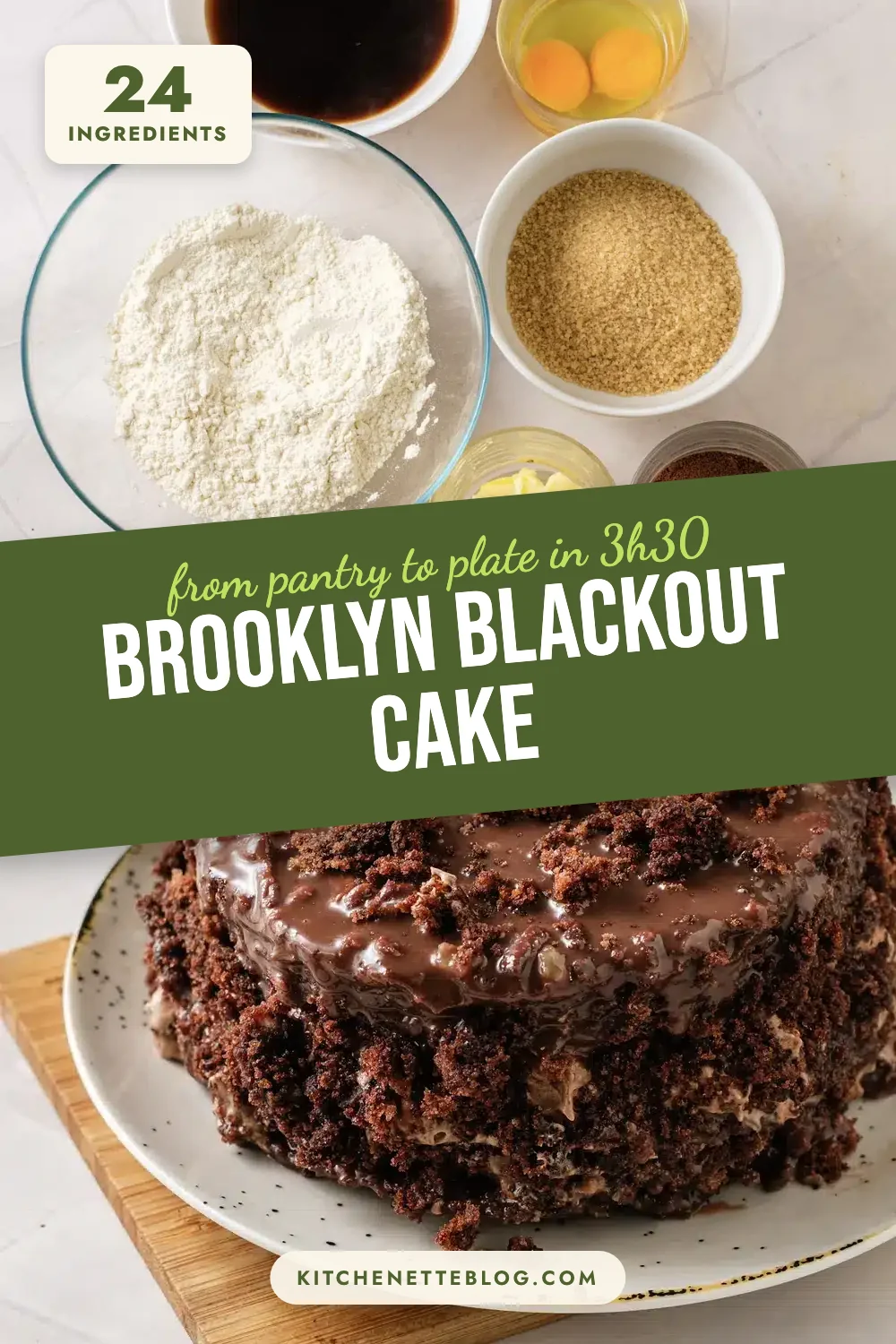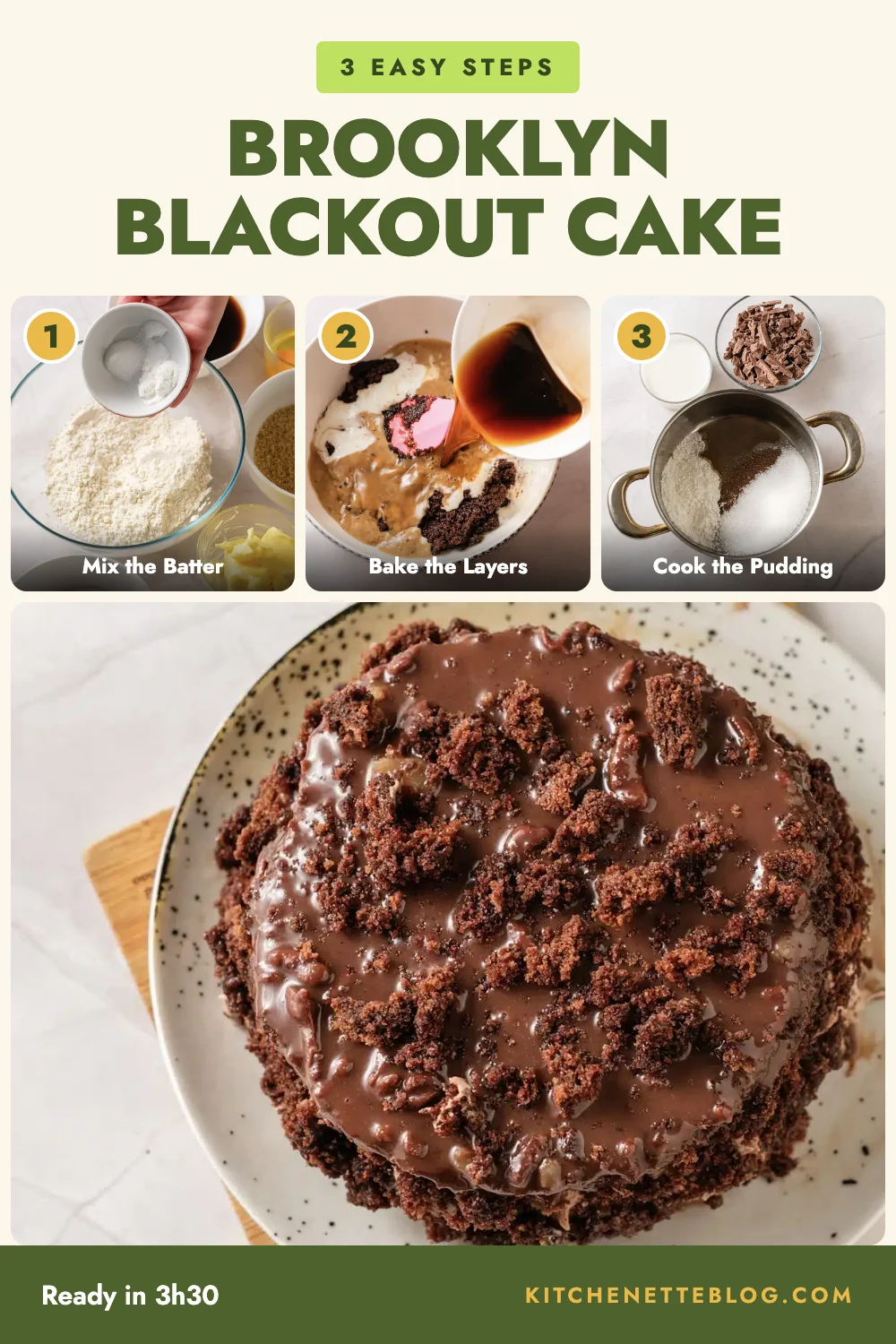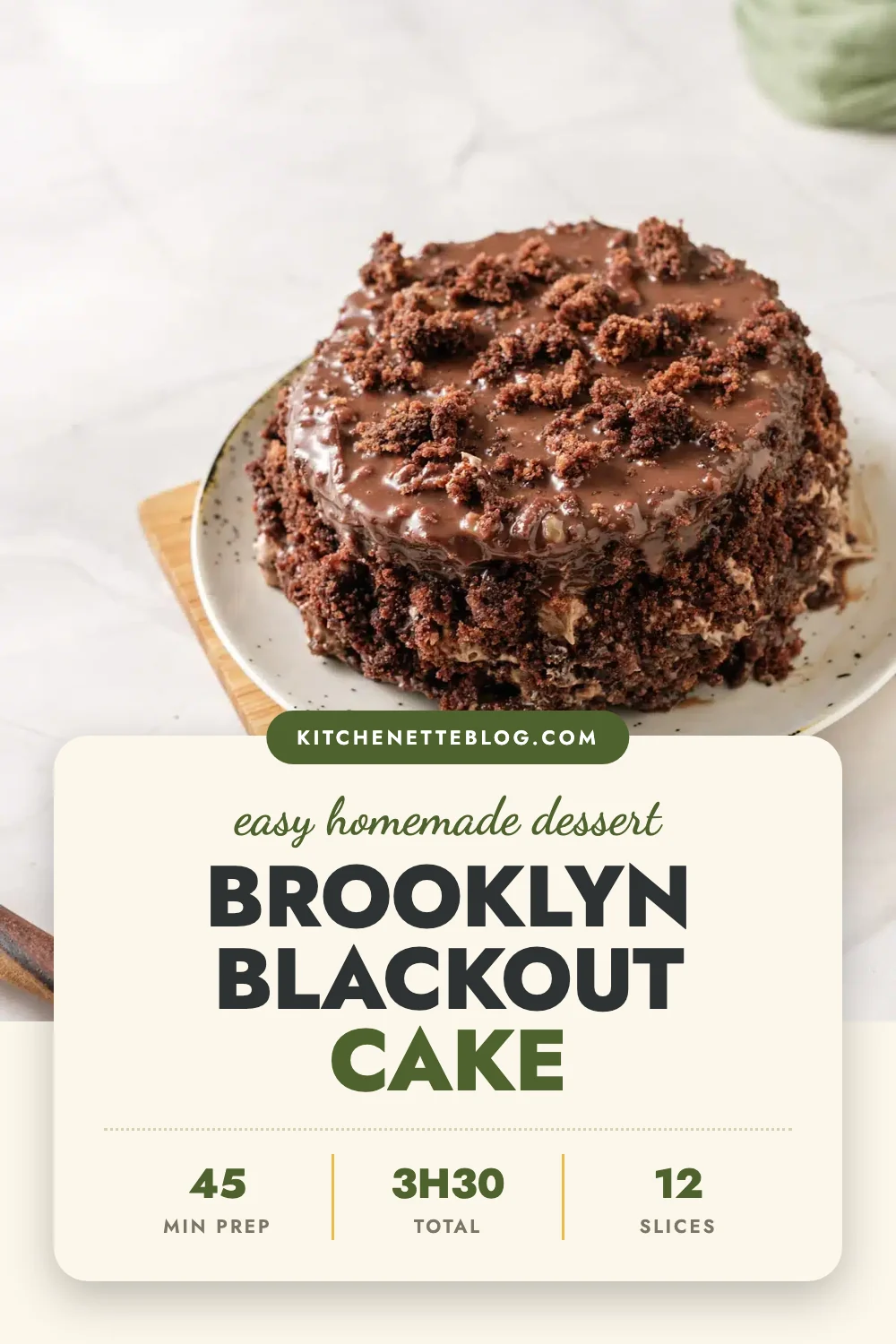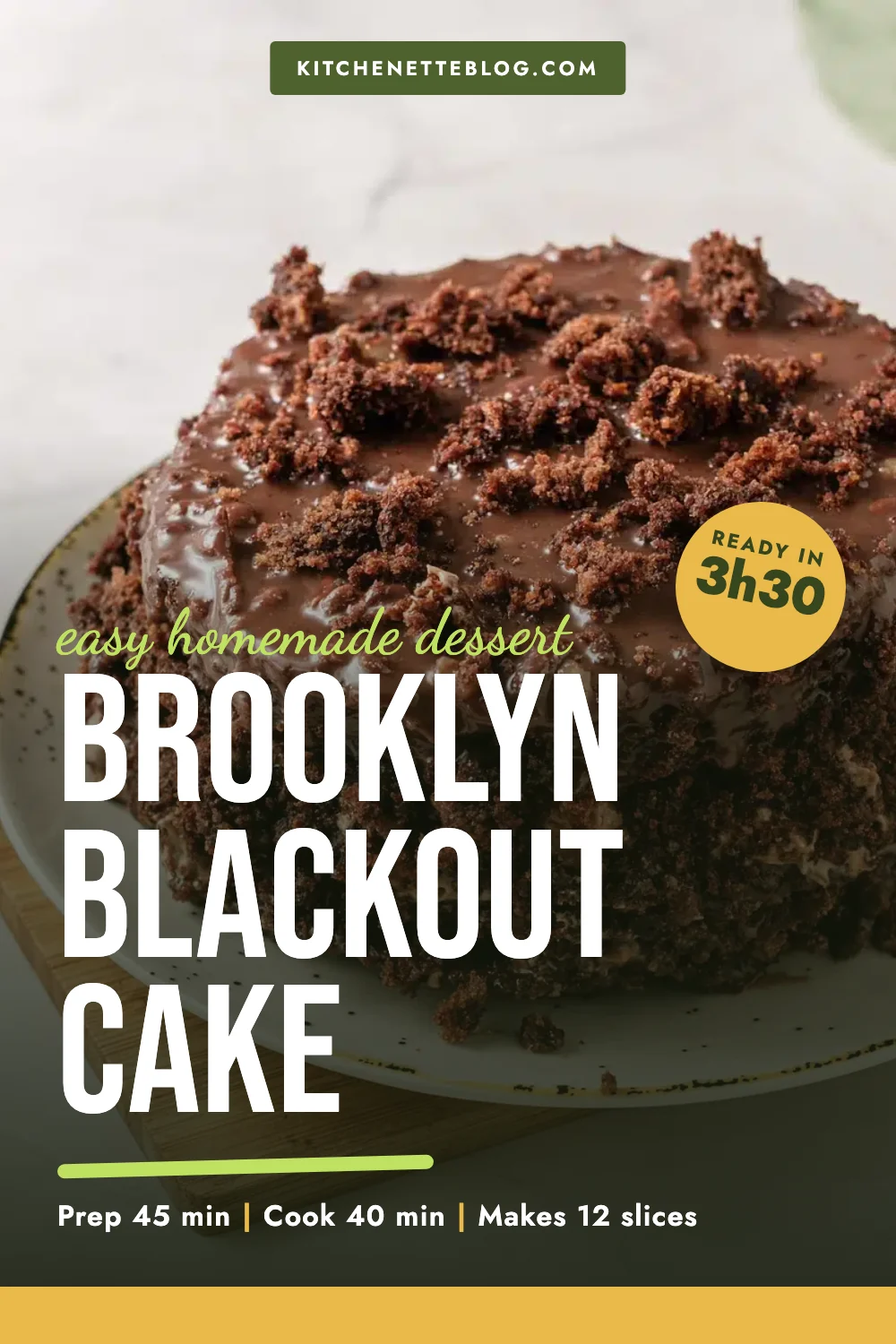
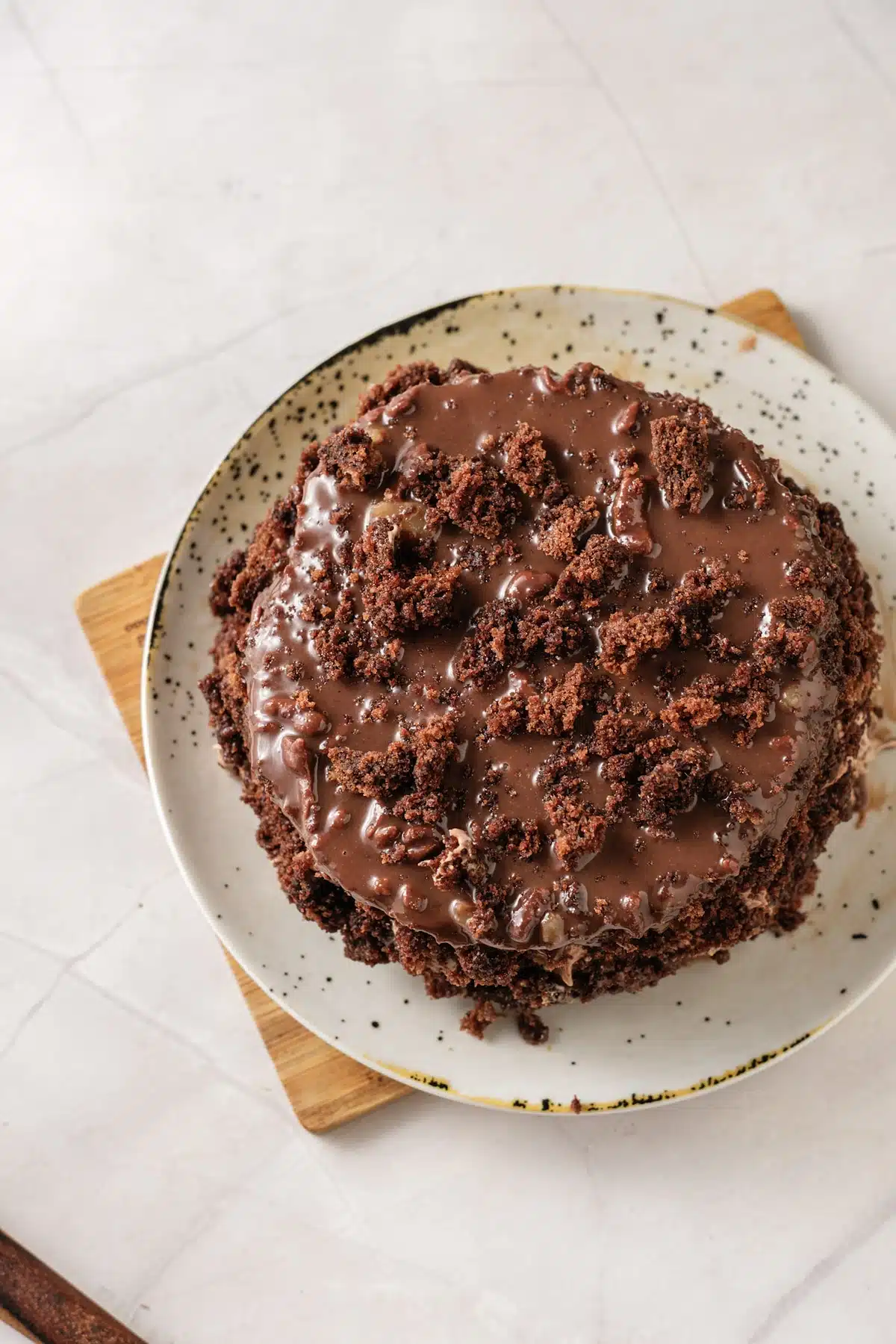
Brooklyn blackout cake is a dark chocolate layer cake filled with cooked chocolate pudding, covered in a glossy chocolate frosting, and then coated top to bottom in its own cake crumbs. The batter uses Dutch-process cocoa, hot coffee and buttermilk, the pudding is thickened with cornstarch and melted chocolate, and the whole thing takes about three and a half hours including the chilling, most of it hands-off. It cuts into 12 slices.
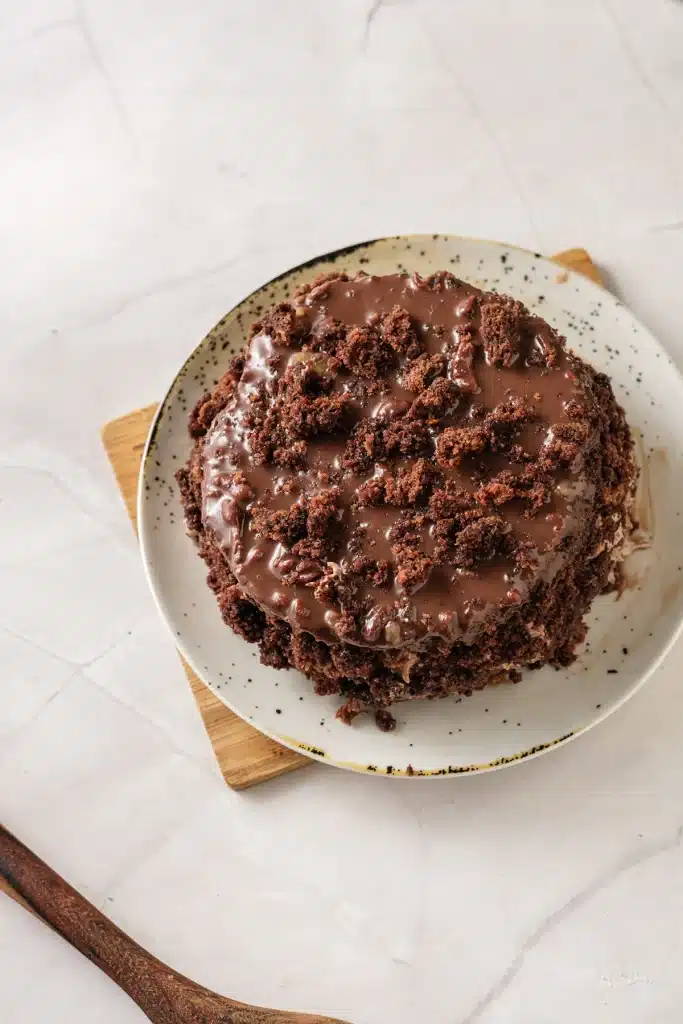
- Three kinds of chocolate in one slice: cocoa cake, pudding filling and a fudge frosting
- Hot coffee and Dutch-process cocoa make the layers taste darker than they look
- The pudding filling is cooked in one saucepan with no eggs to temper
- A crumb coat that forgives messy frosting, because nobody will ever see it
- Brooklyn blackout cake tastes better on day two, so it is built for making ahead
- Every component keeps, which breaks a long recipe into three short sessions
In short: two 8-inch layers baked at 325°F for 35 to 40 minutes, a cornstarch pudding filling and a chocolate frosting under a crumb coat. Brooklyn blackout cake takes 3 hours 30 minutes with chilling, serves 12, about 570 calories a slice.
The original came from Ebinger’s, a chain of Brooklyn bakeries that closed in 1972, and the name is a nod to the wartime blackout drills of the 1940s. Nobody has the real recipe, so every Brooklyn blackout cake is a reconstruction, and this one aims for the things people remember: a cake that is more black than brown, a filling that is pudding rather than ganache, and a crumb coat that hides every bit of frosting.

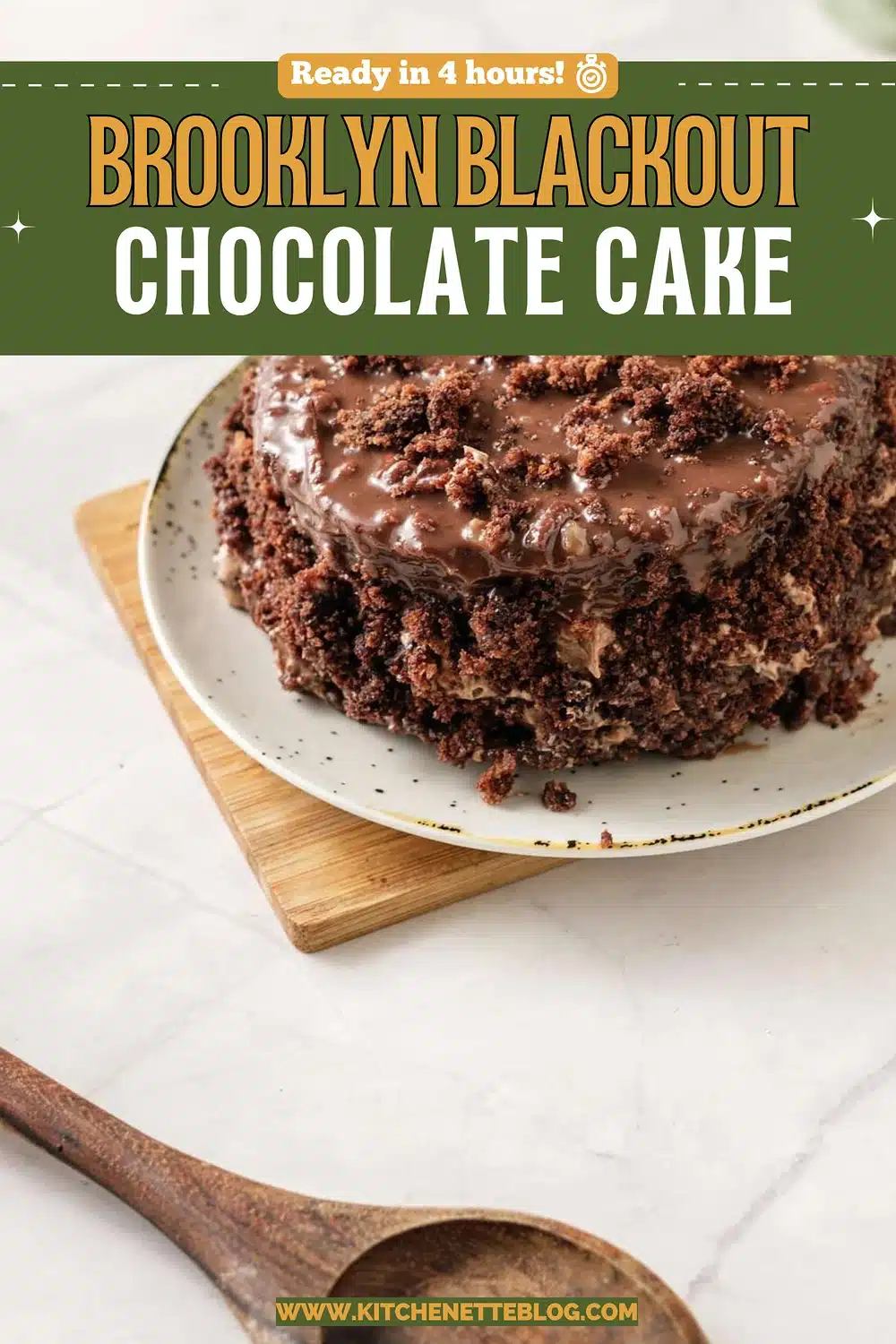
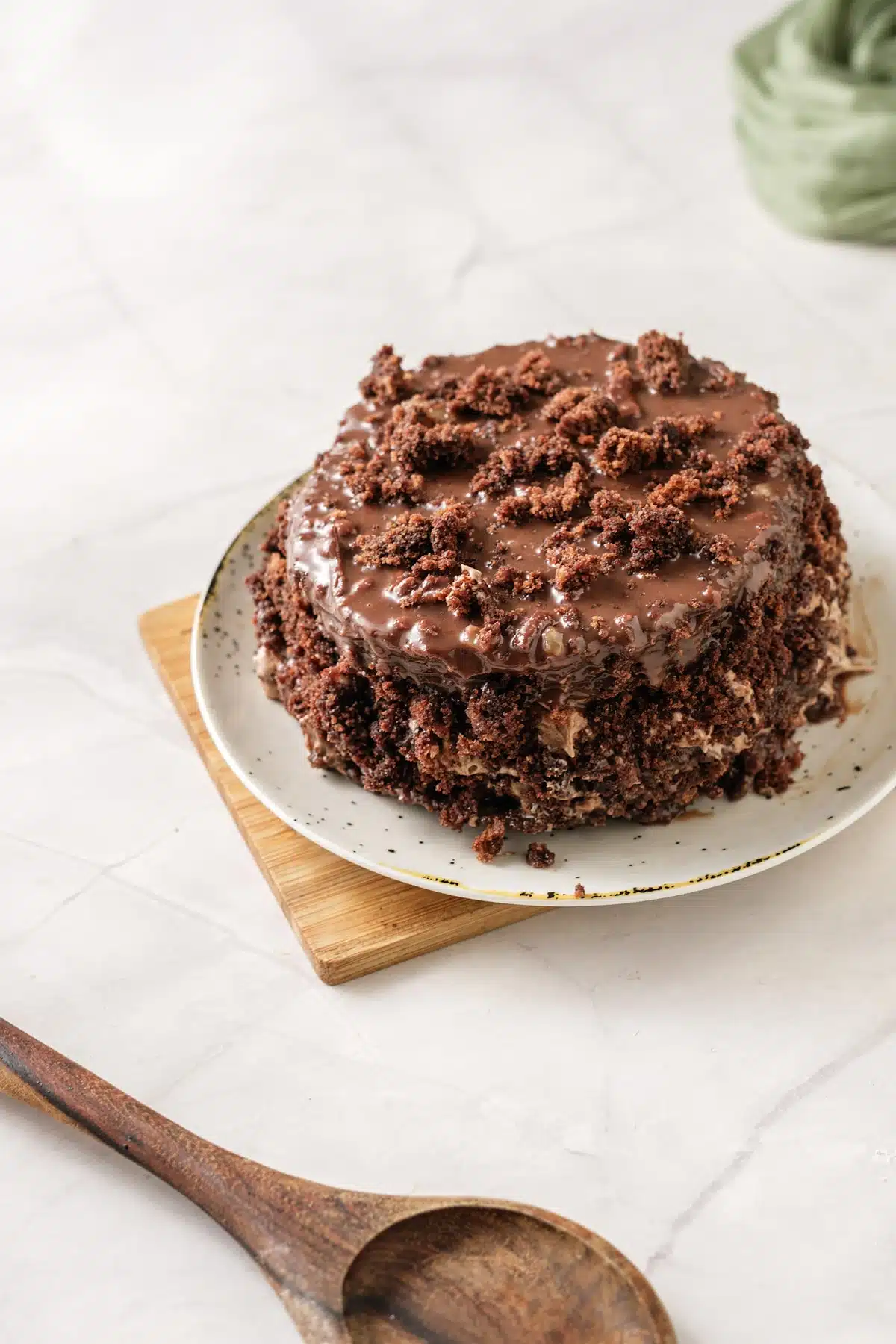
- What Is Brooklyn Blackout Cake?
- Ingredient Notes
- Dutch-Process Cocoa and Coffee in the Batter
- How To Make Brooklyn Blackout Cake
- How To Tell When Brooklyn Blackout Cake Is Done
- Make It Ahead
- Storing Brooklyn Blackout Cake
- Variations and Substitutions
- What to Serve with Brooklyn Blackout Cake
- Brooklyn Blackout Cake FAQ
What Is Brooklyn Blackout Cake?
Brooklyn blackout cake is a chocolate layer cake defined by its filling and its finish. The layers are a cocoa cake made dark with Dutch-process cocoa and coffee. Between them sits a thick chocolate pudding, the kind set with cornstarch on the stove, rather than a buttercream or a whipped ganache. The outside is frosted, then one whole cake layer is crumbled and pressed over the frosting so the cake looks like it is wearing a coat of black soil.
That crumb coat is the part people argue about. Some bakers leave the frosting bare and skip the sacrificed layer, but then it is simply a chocolate pudding cake. The crumbs are what make it a Brooklyn blackout cake: they add a soft texture to every forkful, they keep the frosting from smearing in the box, and they are the reason it looks the way it does in every old photograph of an Ebinger’s window.
Compared to a standard chocolate buttermilk cake, the layers here are darker, slightly denser and less sweet, because the pudding and frosting carry plenty of sugar on their own. A Ho Ho cake has the same idea of a soft filling inside a dark chocolate cake, but blackout cake is deeper and more grown-up in flavor.
Save this recipe
Enter your email and I’ll send this recipe straight to your inbox.
Ingredient Notes
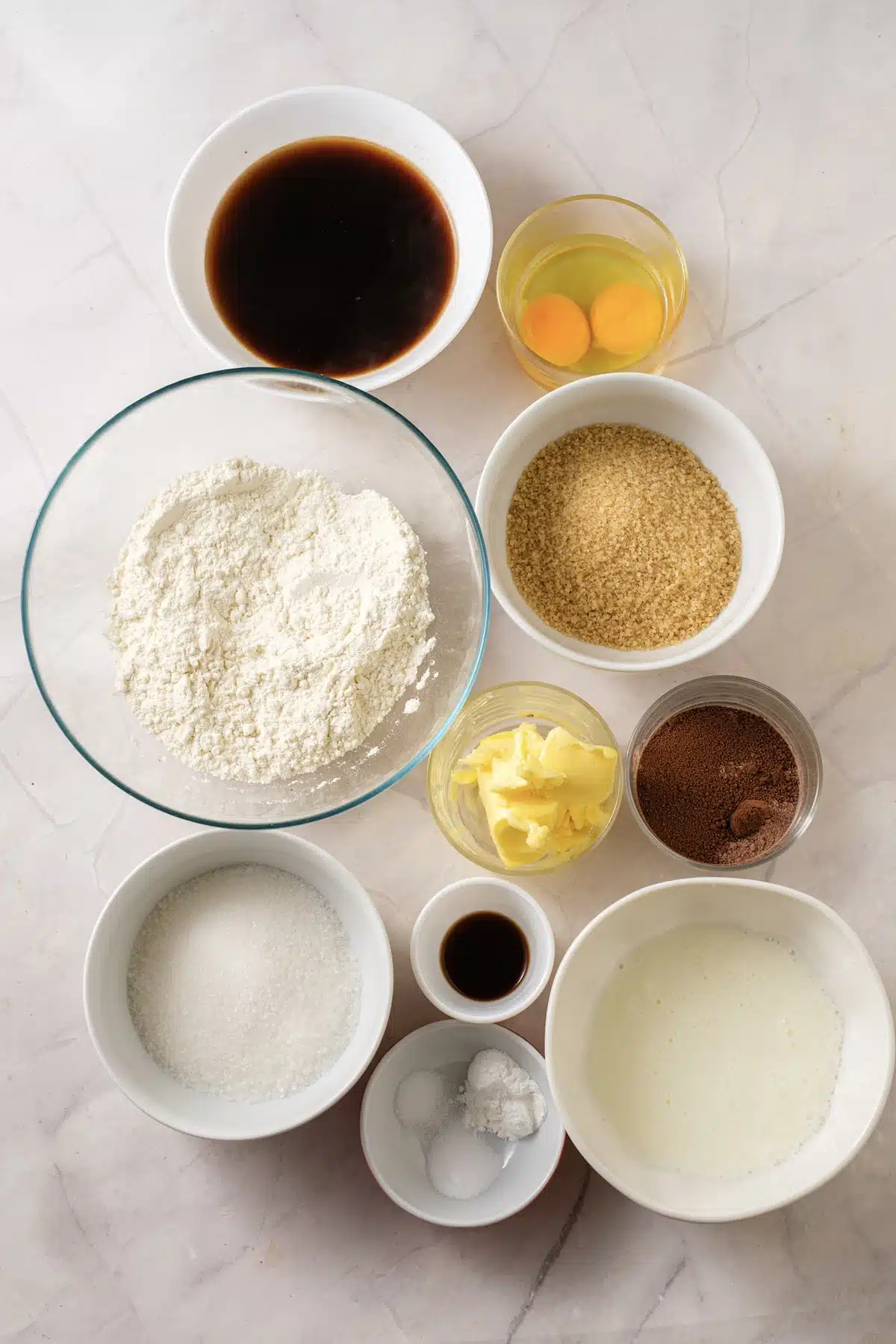
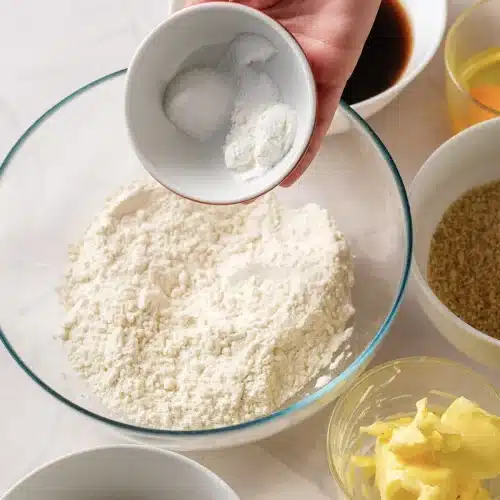
The first flat lay is everything for the layers; the second, further down, is for the pudding and the frosting. Exact amounts are in the recipe card.
- All-purpose flour. Two cups. Measure it by spooning into the cup and leveling, because a packed cup makes a dry, heavy layer.
- Dutch-process cocoa powder. Three quarters of a cup for the cake, plus 2 tablespoons for the pudding. Dutch cocoa is alkalized, which is what gives the cake its near-black color and mellow, rounded chocolate flavor.
- Baking powder and baking soda. Two teaspoons of powder and one of soda. The cake needs both; see the section below for why.
- Unsalted butter. Three quarters of a cup for the batter, melted, and another three quarters of a cup for the frosting.
- Light brown sugar and granulated sugar. A cup and a half of packed brown and a cup of white. The brown sugar brings moisture and a faint caramel note that reads as depth rather than sweetness.
- Buttermilk. One cup, at room temperature. Its acid tenderizes the crumb and gives the baking soda something to react with.
- Strong brewed coffee. Three quarters of a cup, hot. It blooms the cocoa and deepens the chocolate without tasting like coffee.
- Eggs. Three large, at room temperature so they do not seize the melted butter.
- Vanilla extract. Two teaspoons in the cake, one each in the pudding and the frosting.
- Kosher salt. A teaspoon in the cake and a quarter teaspoon in the pudding.
Pudding and Frosting Ingredients
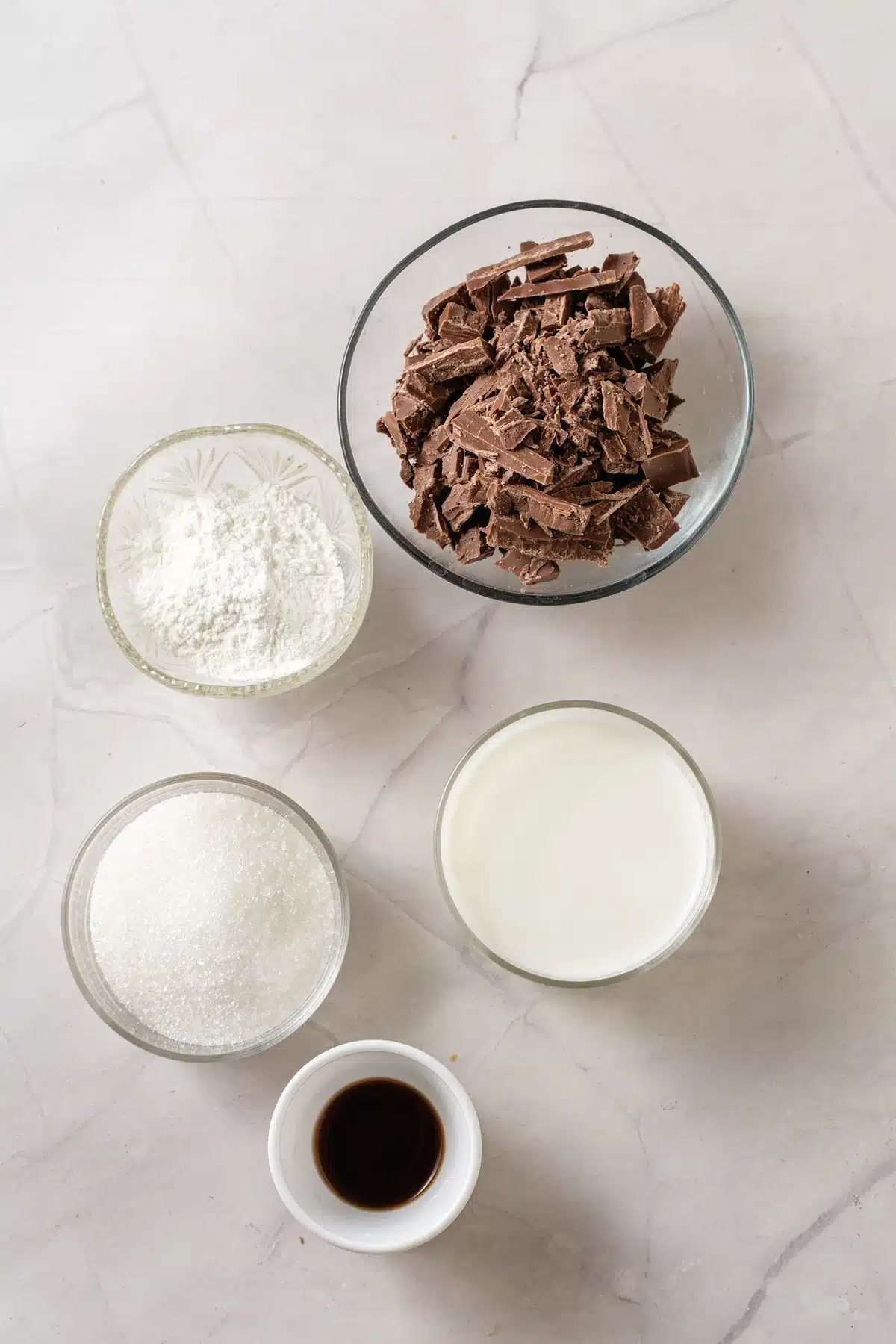
- Semisweet chocolate. Four ounces for the pudding and 8 ounces for the frosting, chopped. A bar melts more smoothly than chips, which carry stabilizers, but chips work in the frosting if that is what you have.
- Cornstarch. Two tablespoons. This is what sets the pudding firmly enough to hold between the layers.
- Whole milk. A cup and a quarter for the pudding. Lower-fat milk sets looser.
- Light corn syrup. Two tablespoons in the frosting. It keeps the frosting glossy and stops the melted chocolate from turning grainy as it cools.
- Hot water. A quarter cup, whisked into the frosting to loosen it to a spreadable, pourable consistency.
Dutch-Process Cocoa and Coffee in the Batter
Two choices give Brooklyn blackout cake its color and flavor. The first is the cocoa. Dutch-process cocoa has been treated with an alkali, which neutralizes its acidity, darkens it to a deep reddish-black and softens its flavor. Because it is no longer acidic, it cannot activate baking soda on its own, so this recipe uses baking powder for most of the lift and a smaller amount of baking soda, which reacts with the buttermilk instead. The Illinois Extension explains the difference plainly: soda needs an acid, and powder brings its own.
The second is the coffee. Three quarters of a cup of hot, strong coffee goes into the batter right after the cocoa, and the heat blooms the cocoa the way hot water blooms ground spices. The result is a deeper, rounder chocolate flavor with no coffee taste in the finished cake. Hot water with a teaspoon of instant espresso works the same way, and plain hot water is the fallback if you need to avoid caffeine; the cake will be slightly less intense.
How To Make Brooklyn Blackout Cake
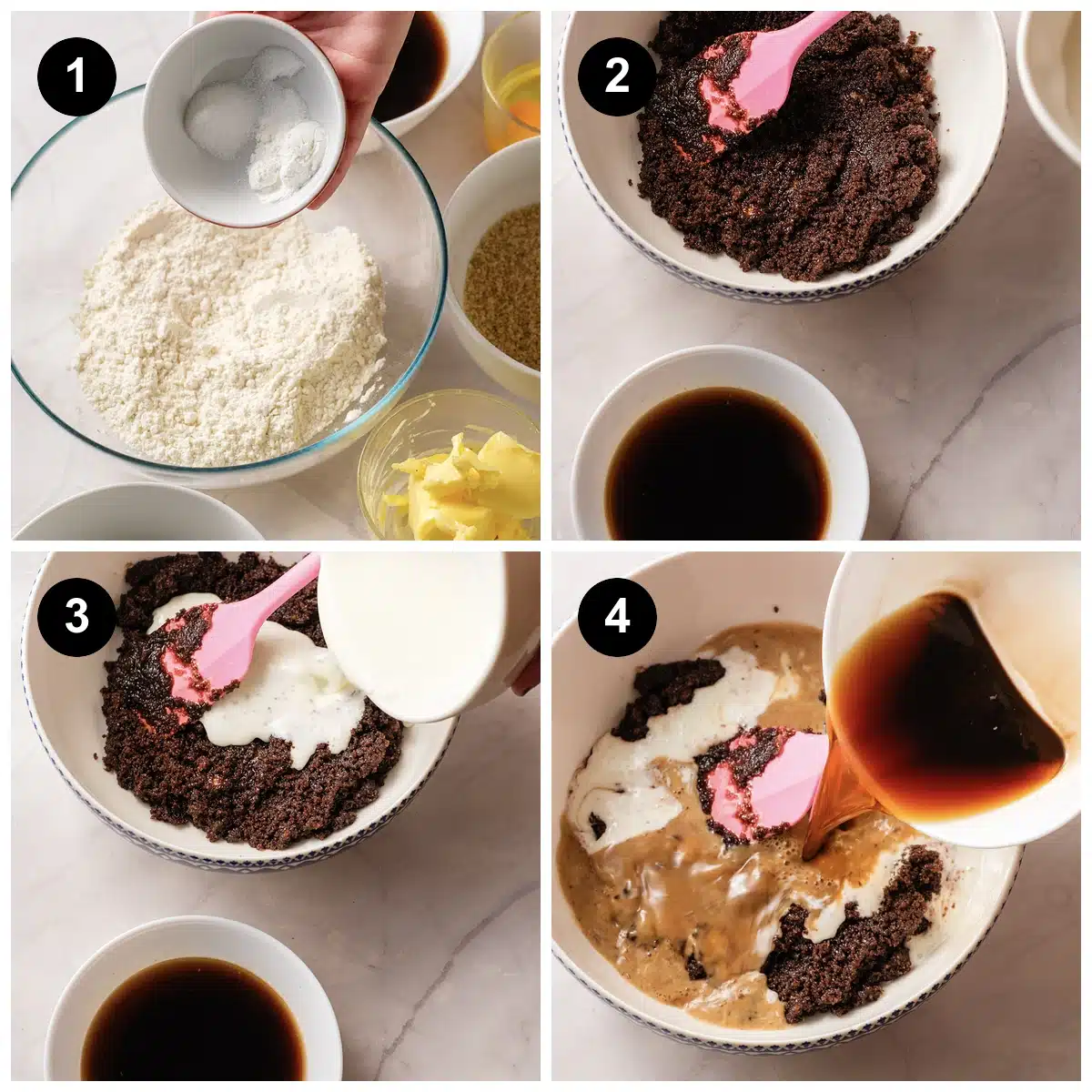
Set the oven to 325°F and grease two 8-inch round pans, then line the bottoms with parchment. The lower temperature gives the center of a cake this dark time to bake through without the edges drying.
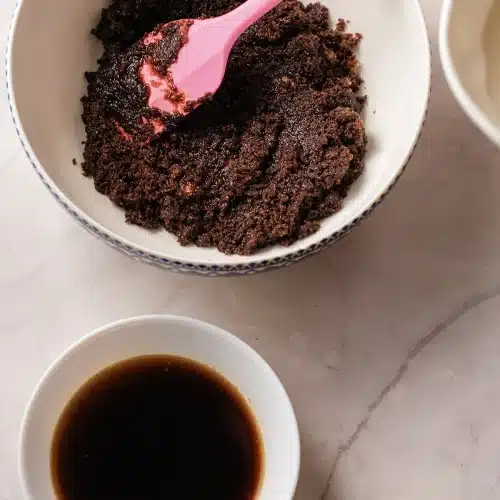
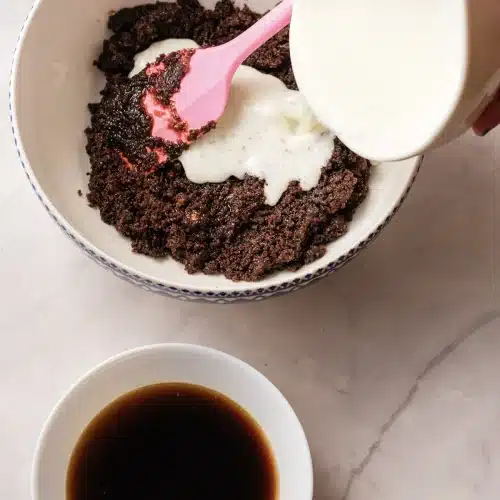
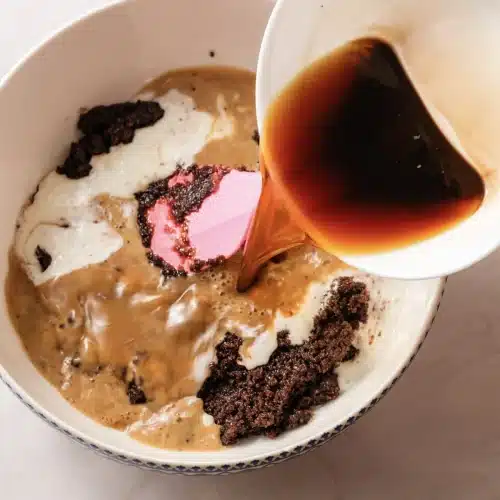
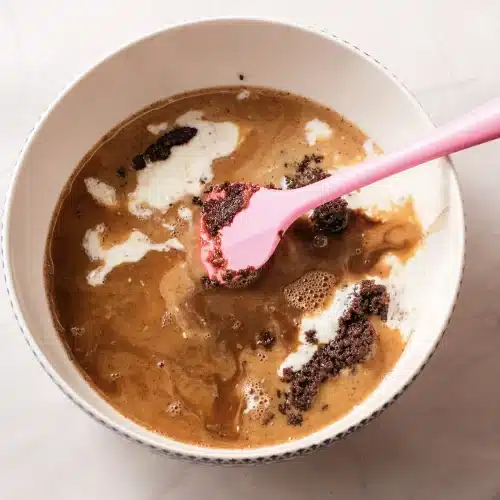
First, whisk the flour, baking powder, baking soda and salt together in a bowl so the leaveners are evenly spread. Next, melt the butter and stir in the cocoa until you have a smooth, thick paste, then stir in both sugars; the mixture looks like wet sand at this point and that is correct. Then stir in the buttermilk, the hot coffee and the vanilla. It may look grainy or slightly split, which is the butter reacting to the cold buttermilk, and it smooths out with the eggs.
After that, whisk in the eggs one at a time, beating until each one disappears before adding the next. Finally, add the dry ingredients and fold gently with a spatula just until no streaks of flour remain. Over-mixing at this stage develops the gluten and gives a tough, rubbery layer, so stop as soon as the batter is uniform.
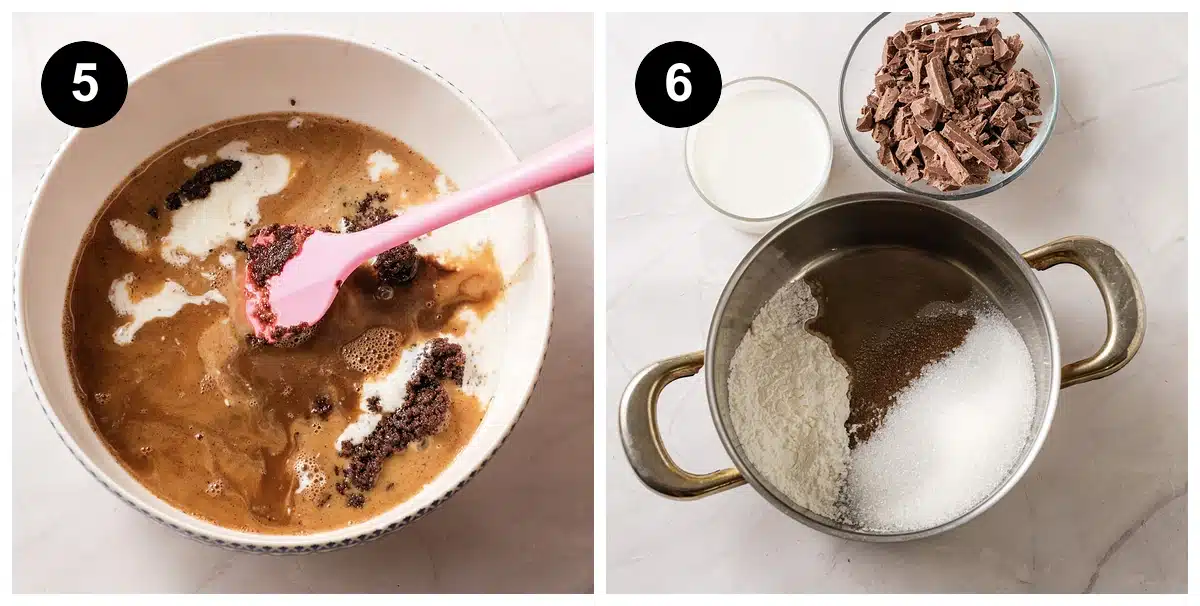
Divide the batter between the pans and bake for 35 to 40 minutes, until a toothpick in the center comes out with a few moist crumbs and no wet batter. Cool the layers in their pans for 10 minutes, then turn them onto a rack to cool completely. A warm layer will melt the pudding, so there is no rushing this.
The Pudding and the Frosting
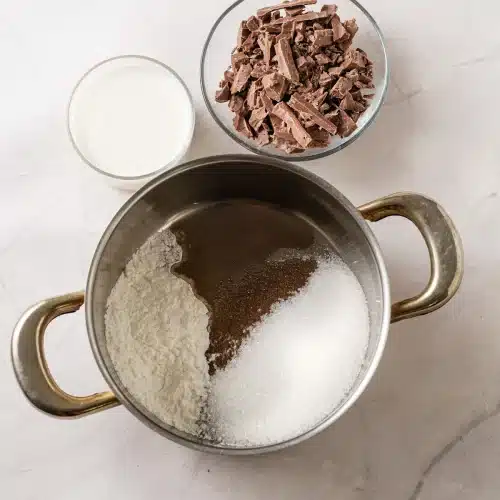
For the pudding, whisk the sugar, cornstarch, cocoa and salt in a saucepan, then whisk in the milk a little at a time so the cornstarch dissolves without lumps. Cook over medium heat, whisking constantly, until it thickens and bubbles, then keep it bubbling for a full minute so the cornstarch cooks through. Off the heat, stir in the chopped chocolate and vanilla until smooth. Scrape it into a bowl, press plastic wrap onto the surface and chill it until completely cold and firm.
For the frosting, melt the chocolate and butter together in a bowl set over simmering water, stirring until smooth. Take it off the heat and whisk in the hot water, corn syrup and vanilla until glossy. Chill it, stirring every 15 minutes, until it thickens to a spreadable consistency that still flows a little off a spoon.
Assembling the Layers
Use a long serrated knife to slice each cooled cake in half horizontally so you have four thin layers. Choose the least even one and crumble it into fine crumbs with your fingers; this is the coating. Set one layer on a serving plate and spread half the cold pudding over it, leaving a half-inch border because the next layer will push it outward. Add the second layer, the remaining pudding, then the third layer, and press gently so the stack is level.
Frost the top and sides with the chocolate frosting. It does not need to be neat, because the next step hides everything. Press handfuls of crumbs onto the sides and over the top until no frosting shows, working over a tray to catch what falls. Chill the Brooklyn blackout cake for at least an hour before slicing so the pudding firms up and the layers stop sliding.
Split the layers cold rather than at room temperature. This cake is moist and tender, and a soft 8-inch layer tends to tear or crumble under a serrated knife, which leaves thin layers too uneven to stack on a soft pudding filling. Wrap the cooled layers and chill them for about 30 minutes first.
Score a shallow line all the way around the side at the halfway point, then saw gently along it while turning the cake, instead of pushing straight through from one side.
Nayla — kitchen note
How To Tell When Brooklyn Blackout Cake Is Done
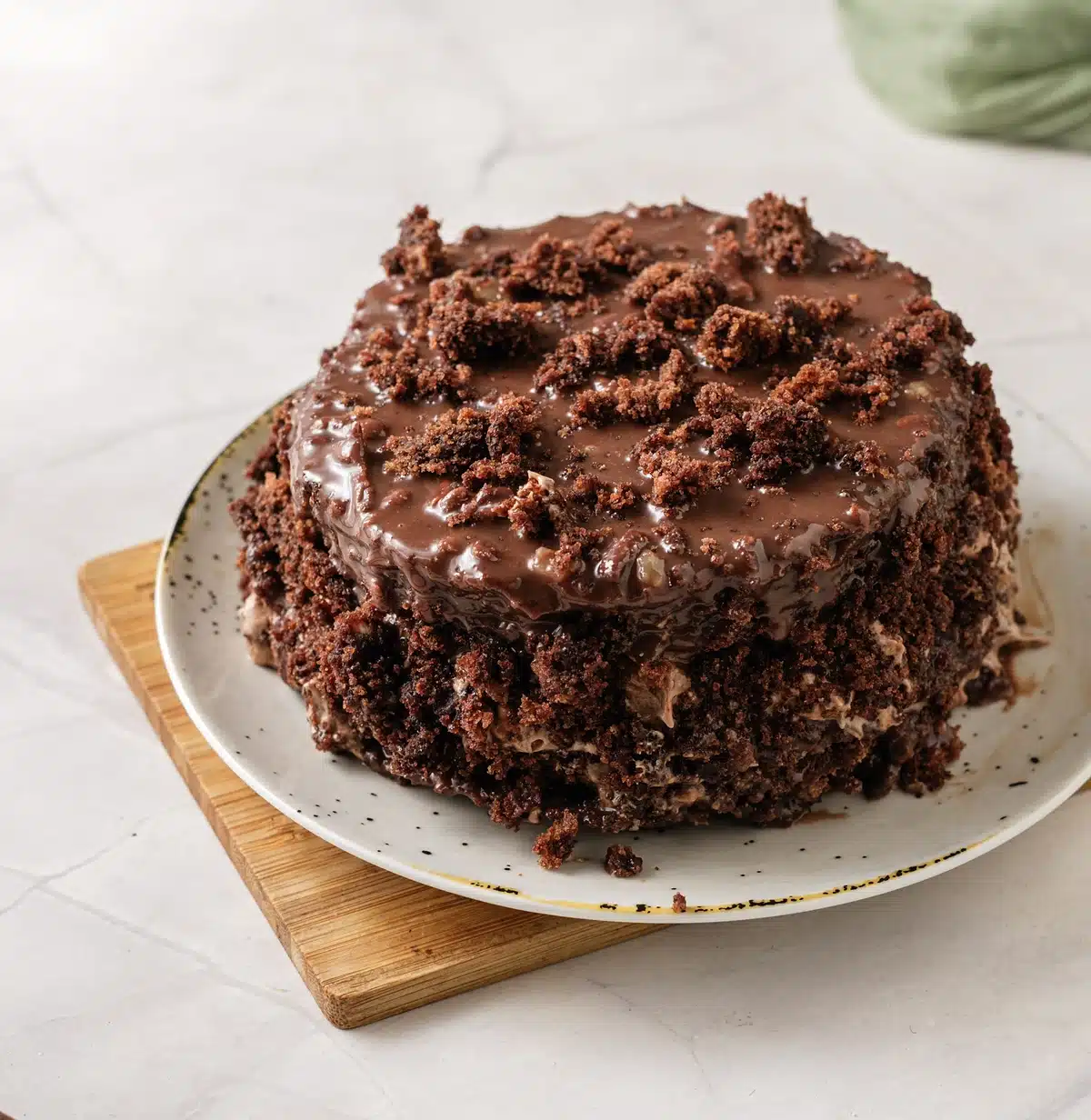
Brooklyn blackout cake is done in three stages: the layers when a toothpick comes out with moist crumbs after 35 to 40 minutes at 325°F, the pudding once it has bubbled for a full minute, and the assembled cake after at least 1 hour in the fridge. The cake layers are done when a toothpick pushed into the center comes out with a few moist crumbs clinging to it, the top springs back from a light press, and the edges have just started to pull away from the pan. Start checking at 35 minutes; color is no guide with a batter this dark.
The pudding is done when it has bubbled for a minute and a spoon dragged through it leaves a trail that holds for a second before closing. It thickens much more as it chills. The frosting is ready when it mounds softly on a spoon and spreads without running off the sides; if it slides down and pools at the base, it needs more time in the fridge.
The assembled Brooklyn blackout cake is ready to cut when the frosting under the crumbs has set and a knife pressed into the side meets some resistance. An hour in the fridge is the minimum; overnight is better.
Make It Ahead
This is the ideal project to spread over two days. On day one, bake the layers, cool them completely, wrap them in plastic and leave them at room temperature overnight, or freeze them for up to a month. Cook the pudding the same day and chill it; it keeps for 3 days covered in the fridge. The frosting can be made a day ahead too and warmed for a few seconds before spreading.
On day two, slice the layers, assemble, frost and crumb-coat, then chill. Assembling the whole Brooklyn blackout cake the day before you serve it gives the pudding time to settle into the layers and the crumbs time to soften against the frosting.
Storing Brooklyn Blackout Cake
Keep Brooklyn blackout cake in the refrigerator, loosely covered with a cake dome or an upturned bowl, for up to 5 days. The pudding filling is dairy-based and needs to stay cold. It slices most cleanly straight from the fridge and tastes best after sitting out for 20 to 30 minutes so the frosting loses its chill.
To freeze, cut the cake into slices, freeze them uncovered on a tray until firm, then wrap each slice in plastic and foil. They keep for up to 2 months. Thaw slices overnight in the fridge, still wrapped, so condensation forms on the wrapping rather than on the crumbs. Do not reheat it; warm pudding turns loose and the layers slide.
Variations and Substitutions
Espresso instead of coffee. A teaspoon of instant espresso dissolved in three quarters of a cup of hot water gives a slightly stronger mocha edge than brewed coffee.
Sour cream for buttermilk. A cup of full-fat sour cream thinned with 2 tablespoons of milk brings the same acidity and a slightly richer crumb.
Chocolate chips. Dark or semisweet chips can replace chopped chocolate by weight; a chopped bar melts more smoothly in the pudding.
Gluten-free. A cup-for-cup gluten-free flour blend works well here because the cake is so moist. Check the baking powder label too.
A hint of chili. A quarter teaspoon of ground cayenne in the batter gives a faint warmth in the style of Mexican hot chocolate.
Nine-inch pans. The batter fits two 9-inch pans and bakes in 30 to 35 minutes, but the layers come out thinner, so skip the horizontal slicing and make a two-layer Brooklyn blackout cake with all the pudding in the middle and the leveling trimmings as the coating.
What to Serve with Brooklyn Blackout Cake
Strong, unsweetened coffee or an espresso is the classic pairing, because the bitterness cuts the richness. Cold milk does the same job for anyone skipping caffeine. Lightly sweetened whipped cream alongside a slice softens the intensity, and a small scoop of vanilla ice cream turns it into a plated dessert.
If this is the finish to a dinner, keep the main course light. A piece of pan-seared cod with rainbow chard leaves plenty of room for a slice this rich. For a dessert table, a pan of Texas sheet cake covers the crowd while the blackout cake is the showpiece, and a plate of chocolate chip pudding cookies gives the chocolate theme something small to go with it.
Brooklyn Blackout Cake FAQ
Frequently Asked Questions
Why is it called Brooklyn blackout cake?
It was named for the blackout drills held in Brooklyn during World War II, when the Navy Yard required residents to darken their windows. Ebinger’s Bakery sold a cake so dark it matched the mood, and the name stuck long after the bakery closed in 1972.
How long does Brooklyn blackout cake last in the fridge?
Up to 5 days, loosely covered, because the pudding filling is dairy-based and must stay cold. For longer storage, freeze wrapped slices for up to 2 months and thaw them overnight in the fridge.
Do you have to cut the layers of Brooklyn blackout cake in half?
Yes, if you want the four-layer look and a layer to crumble for the coating. Two 8-inch layers split horizontally give three thin layers for the stack and one for crumbs. A simpler two-layer cake with all the pudding in the middle still tastes right.
Can I use natural cocoa instead of Dutch-process in Brooklyn blackout cake?
Yes, but the cake will be lighter in color and sharper in flavor, and it rises a little differently because natural cocoa is acidic. Keep the leaveners as written; the extra acid gives the baking soda more to work with, so the layers may dome slightly more.
What can I use instead of buttermilk in Brooklyn blackout cake?
Soured milk: stir 1 tablespoon of white vinegar or lemon juice into 1 cup of whole milk and let it stand for 5 to 10 minutes until it curdles slightly. It behaves the same way in the batter. A cup of full-fat sour cream thinned with 2 tablespoons of milk also works.
More Questions About Blackout Cake
Good to Know
Is the crumb coating on Brooklyn blackout cake necessary?
Not strictly, but it is what makes the cake a blackout cake rather than a chocolate pudding cake, and it has a practical job too: it protects the frosting, adds texture and hides any rough spots in the frosting. Skip it and you still have an excellent cake, just not this one.
Why did the pudding for my Brooklyn blackout cake turn out thin?
It was pulled off the heat too early. Cornstarch needs to reach a full boil and bubble for about a minute to thicken fully. Return it to the pan, bring it back to a bubble while whisking, and give it another minute, then chill it completely before using.
How many calories are in a slice of Brooklyn blackout cake?
About 570 calories per slice when the cake is cut into 12, with roughly 74 g carbohydrates, 7 g protein and 28 g fat. These are estimates and change with the chocolate and milk you use.
Bake the layers on a Saturday, cook the pudding while they cool, and put it all together on Sunday. A Brooklyn blackout cake built that way is a weekend well spent, and the Ho Ho cake is the quicker cousin for the weeks in between.
Brooklyn Blackout Cake
Save this recipe
Enter your email and I’ll send this recipe straight to your inbox.
Ingredients
Cake Layers
- 2 cups all-purpose flour spooned and leveled
- 2 tsp baking powder
- 3/4 cup Dutch-process cocoa powder
- 1 tsp baking soda
- 1 tsp kosher salt
- 3/4 cup unsalted butter melted
- 1 1/2 cups light brown sugar packed
- 1 cup granulated sugar
- 3 large eggs at room temperature
- 1 cup buttermilk at room temperature
- 2 tsp vanilla extract
- 3/4 cup strong brewed coffee hot
Chocolate Pudding Filling
- 1/3 cup granulated sugar
- 2 tbsp cornstarch
- 2 tbsp Dutch-process cocoa powder
- 1/4 tsp kosher salt
- 1 1/4 cups whole milk
- 4 oz semisweet chocolate chopped
- 1 tsp vanilla extract
Chocolate Frosting
- 8 oz semisweet chocolate finely chopped, or chips
- 3/4 cup unsalted butter cut into pieces
- 1/4 cup hot water
- 2 tbsp light corn syrup
- 1 tsp vanilla extract
Equipment
- Two 8-inch round cake pans
- Mixing bowls
- Saucepan
- Whisk
- Wire rack
- Offset spatula
- Serrated Knife
- Parchment paper
Instructions
Mix the Batter
- Heat the oven. Set the oven to 325°F (160°C). Grease two 8-inch round pans and line the bottoms with parchment.
- Whisk the dry ingredients. Whisk the flour, baking powder, baking soda and salt together in a bowl.

- Make the cocoa base. Stir the cocoa into the melted butter until smooth, then stir in both sugars. The mixture will look like wet sand.
- Add the buttermilk. Pour in the buttermilk and stir it through; the mixture may look grainy at this point.
- Add the coffee and vanilla. Pour in the hot coffee and the vanilla.
- Stir smooth, then add the eggs. Stir until the base is smooth, then whisk in the eggs one at a time, beating until each disappears.
- Fold in the flour. Add the dry ingredients and fold gently with a spatula just until no streaks of flour remain. Do not over-mix.
Bake the Layers
- Bake. Divide the batter between the pans and bake for 35 to 40 minutes, until a toothpick in the center comes out with moist crumbs. Cool in the pans for 10 minutes, then turn out onto a rack and cool completely.
Cook the Pudding
- Combine the dry ingredients. Whisk the sugar, cornstarch, cocoa and salt together in a saucepan, then whisk in the milk a little at a time until smooth.
- Cook and chill. Cook over medium heat, whisking constantly, until thick and bubbling, then keep it bubbling for 1 minute. Off the heat, stir in the chocolate and vanilla until smooth. Scrape into a bowl, press plastic wrap onto the surface and chill until cold and firm.
Make the Frosting
- Melt and whisk. Melt the chocolate and butter in a bowl set over simmering water, stirring until smooth. Off the heat, whisk in the hot water, corn syrup and vanilla until glossy. Chill, stirring every 15 minutes, until spreadable but not solid.
Assemble
- Split and stack. Slice each cooled cake in half horizontally for four thin layers. Crumble one layer into fine crumbs. Set a layer on a plate, spread half the pudding over it, top with the second layer and the remaining pudding, then the third layer.
- Frost, coat and chill. Frost the top and sides, press the crumbs over the frosting until it is completely covered, and chill for at least 1 hour before slicing.